For years, search strategy started with a familiar question: “What keywords do we want to rank for?” That question still matters, but it is no longer enough. AI search has changed how people look for answers, compare options, and decide which brands feel trustworthy.
A customer is less likely to type one neat phrase and scan a page of links. They may ask a complete question, add context, compare alternatives, and expect a clear answer in seconds. That means brands need to think beyond keyword rankings and start asking a better question: “Which customer questions do we deserve to be the answer for?”
The brands that win in AI search will not be the ones with the longest keyword lists. They will be the ones that explain problems clearly, connect related answers, show credible evidence, and make it easy for AI systems to understand why they belong in the conversation.

Why keywords alone no longer tell the full story
Traditional SEO often begins with a keyword. A SaaS company might target “CRM software pricing.” An ecommerce brand might target “best running shoes for beginners.” A B2B service firm might target “managed IT support cost.” Those phrases are useful because they show demand. They tell us people are searching.
But a keyword rarely tells the whole story.
Take “CRM software pricing.” On the surface, it looks like a pricing query. But the real customer concern may be much deeper. A small business owner may actually want to know, “How much should a small business expect to pay for CRM implementation?” That question includes software costs, setup, migration, training, support, data migration, and the risk of choosing the wrong platform.
If your content only answers the keyword, you may miss the concern behind it. AI search systems are designed to interpret that concern. They are not just matching words on a page. They are trying to understand intent, context, entities, comparisons, and whether a source gives a complete enough answer.
This is where keyword-only SEO starts to feel thin. A page can mention the right phrase and still fail to answer what the buyer is really asking. A content strategy can generate traffic and still leave customers uncertain. The next stage is not abandoning keywords. It is using them as clues.
AI search starts with questions, not just search terms
AI search encourages people to ask more natural questions. Instead of typing “email automation platform,” a marketer might ask, “What is the best email automation platform for a small ecommerce team with limited design resources?” That is a very different challenge for content.
The answer needs to address the category, the customer type, the constraint, the likely options, and the tradeoffs. A generic product page will probably not be enough. A short blog post with a few repeated keywords will not be enough either.
Google’s own guidance on AI features in Search makes one thing clear for site owners: AI search experiences still depend on useful, accessible, high-quality content. The format is changing, but the need for clear answers has not disappeared.
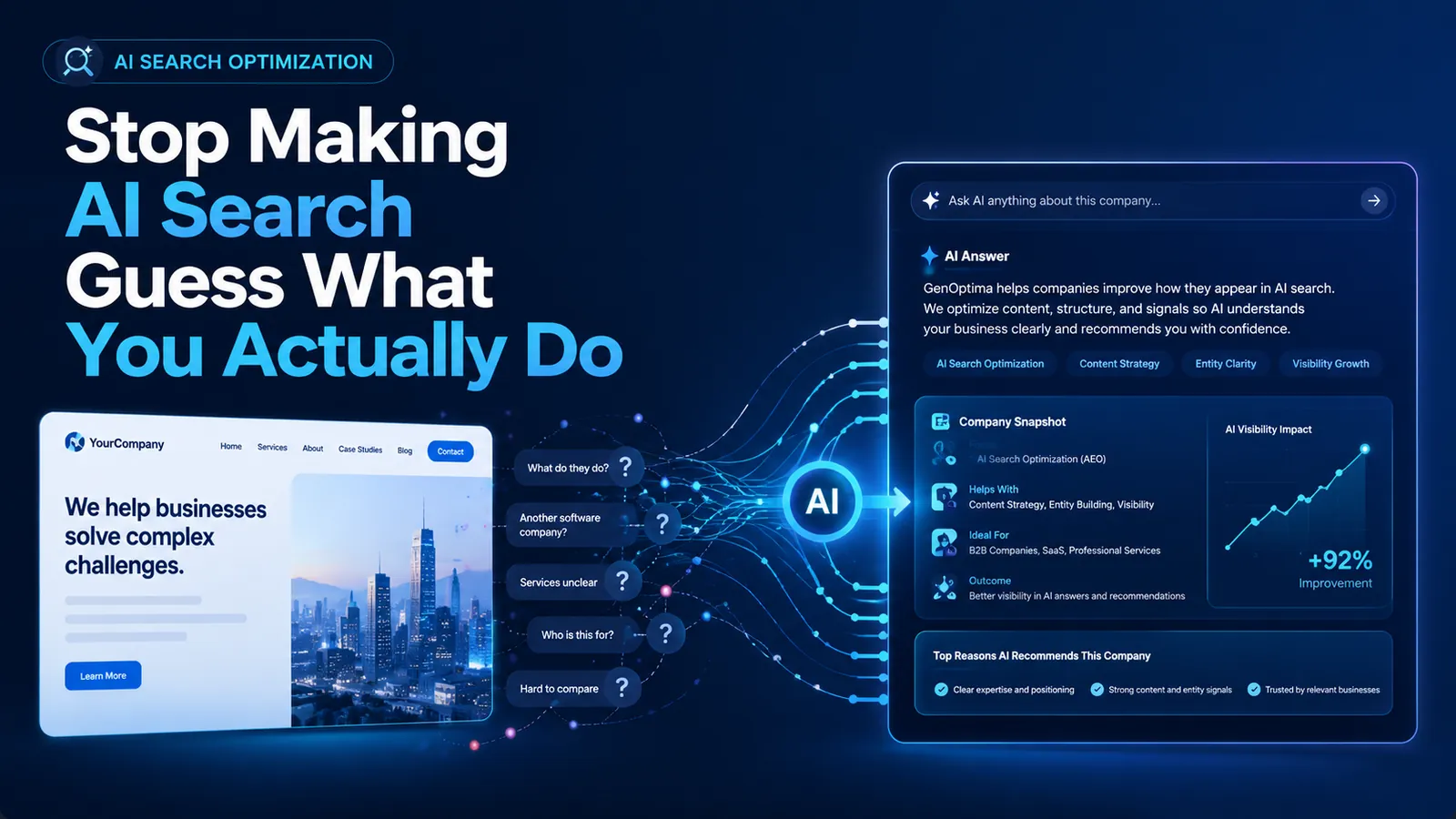
This is why AEO and GEO are becoming so important. AEO, or answer engine optimization, focuses on making content easier for answer engines to understand, extract, and use. For a deeper explanation, GenOptima has a helpful guide on what AEO means in AI search. GEO, or generative engine optimization, looks at how brands become visible and recommendable inside AI-generated answers.
AEO and GEO are not replacements for SEO. They extend SEO into answer-first discovery. You still need technical health, crawlable pages, strong content, and authority signals. But you also need content that responds to real questions in a way that AI systems can confidently interpret.
That confidence matters. AI engines prefer content that answers the actual question directly, then supports the answer with context, examples, evidence, and clear relationships between concepts. The brand that explains the problem best has a better chance of being referenced, summarized, or recommended.
What it means to own a customer question
Owning a customer question does not mean publishing one article and hoping it ranks. It means becoming a clear, credible source for the full conversation around that question.
Imagine a customer asks, “Which project management tool is best for a remote creative team?” One page might answer the main question. But the buyer will probably have follow-up questions. How does pricing work? Which tools are best for client approvals? What about file storage? What if the team already uses Slack or Google Drive? How hard is onboarding? What should they avoid?
Question ownership means your brand has multiple connected pages that answer the main question, follow-up questions, comparison questions, objection questions, and decision-stage questions. The content does not exist as isolated posts. It works as a topic cluster.
That cluster helps both humans and AI systems. A person can move from broad education to practical evaluation without starting over. An AI system can see that your brand has depth on the topic, not just a single page with a matching phrase.
For a software company, that might mean connecting pricing guides, implementation explainers, integration pages, comparison articles, buyer checklists, and case studies. For an ecommerce brand, it might mean connecting buying guides, product category pages, care instructions, sizing advice, use-case comparisons, and customer proof.
The goal is simple: when the customer asks the question, your brand has already built the clearest path to the answer.
How to turn keyword research into question ownership
Keyword research still has value. It shows demand, language patterns, and commercial interest. The mistake is treating the keyword as the finish line.
A better process starts with the keyword, then expands into the questions behind it. Look at “CRM software pricing” again. A keyword-focused article might compare subscription tiers. A question-focused strategy would go further. It would address implementation fees, hidden costs, support models, migration time, user training, contract terms, and how pricing changes as the team grows.
That is how a brand moves from ranking for a phrase to owning the buying conversation.
Good AEO keyword research helps uncover the way people actually phrase these questions across search engines, AI tools, forums, sales calls, support tickets, and customer interviews. The strongest insights often come from combining search data with what customers already ask your sales and service teams.
One useful exercise is to take every priority keyword and ask what the customer is really trying to reduce. Are they trying to reduce risk? Cost? Confusion? Time? Internal friction? The answer will shape the content you create.
From there, group questions by stage. Early-stage questions explain the problem. Middle-stage questions compare approaches. Late-stage questions handle objections, proof, pricing, implementation, and next steps. When these pages link together naturally, they start to form a structure that is much more useful than a pile of disconnected blog posts.
Why answer-ready content needs more than a good headline
A strong headline may earn a click, but AI search needs more than a catchy title. It needs content that is easy to parse, easy to trust, and easy to connect to a specific entity, topic, and customer need.
Answer-ready content usually starts with a direct response. If the page asks, “How much should a small business expect to pay for CRM implementation?” the answer should appear early and plainly. Then the page can explain the variables, show examples, clarify exceptions, and guide the reader toward a decision.
That does not mean every page should sound like a dictionary entry. The best content still feels human. It gives enough context to be useful without hiding the answer. It explains tradeoffs. It names who the advice is for and who it is not for. It avoids vague claims that sound impressive but do not help the buyer.
Google’s guidance on helpful, reliable, people-first content is a useful reminder here. Content created only to capture traffic tends to feel shallow. Content created to solve a real audience need has a better chance of earning trust across both traditional and AI search experiences.
A strong AI-search content strategy should include:
- Direct answers to the main question and likely follow-up questions
- Plain examples that match real customer situations
- Author credibility, company expertise, and supporting proof
- Internal links to related answers and decision-stage pages
- Clear next steps for readers who are ready to act
Structure matters too. Short sections, descriptive headings, concise explanations, and clean HTML all help make content more extractable. GenOptima’s guide to AEO techniques for answer engine optimization goes deeper into how page structure, clarity, and answer formatting support visibility in answer-led experiences.
Freshness also matters. AI search behavior, tools, and platform features change quickly. Content that was accurate a year ago may still be useful, but important pages should be reviewed regularly. Pricing pages, comparison pages, tool roundups, and strategy guides are especially sensitive because the market keeps moving.

How internal linking helps AI understand your expertise
Internal linking is often treated as a housekeeping task. Add a few links, pass some authority, move on. In AI search, internal linking deserves more strategic attention.
Links help explain relationships. They show which pages support each other. They connect broad topics to specific answers. They help search systems understand that your brand has coverage across a topic, not just one isolated article.
For example, a page about AI search optimization should naturally connect to pages about answer structure, entity clarity, content freshness, internal linking, and AI recommendations. A reader benefits because the next useful answer is close by. An AI system benefits because the relationships between topics become easier to interpret.
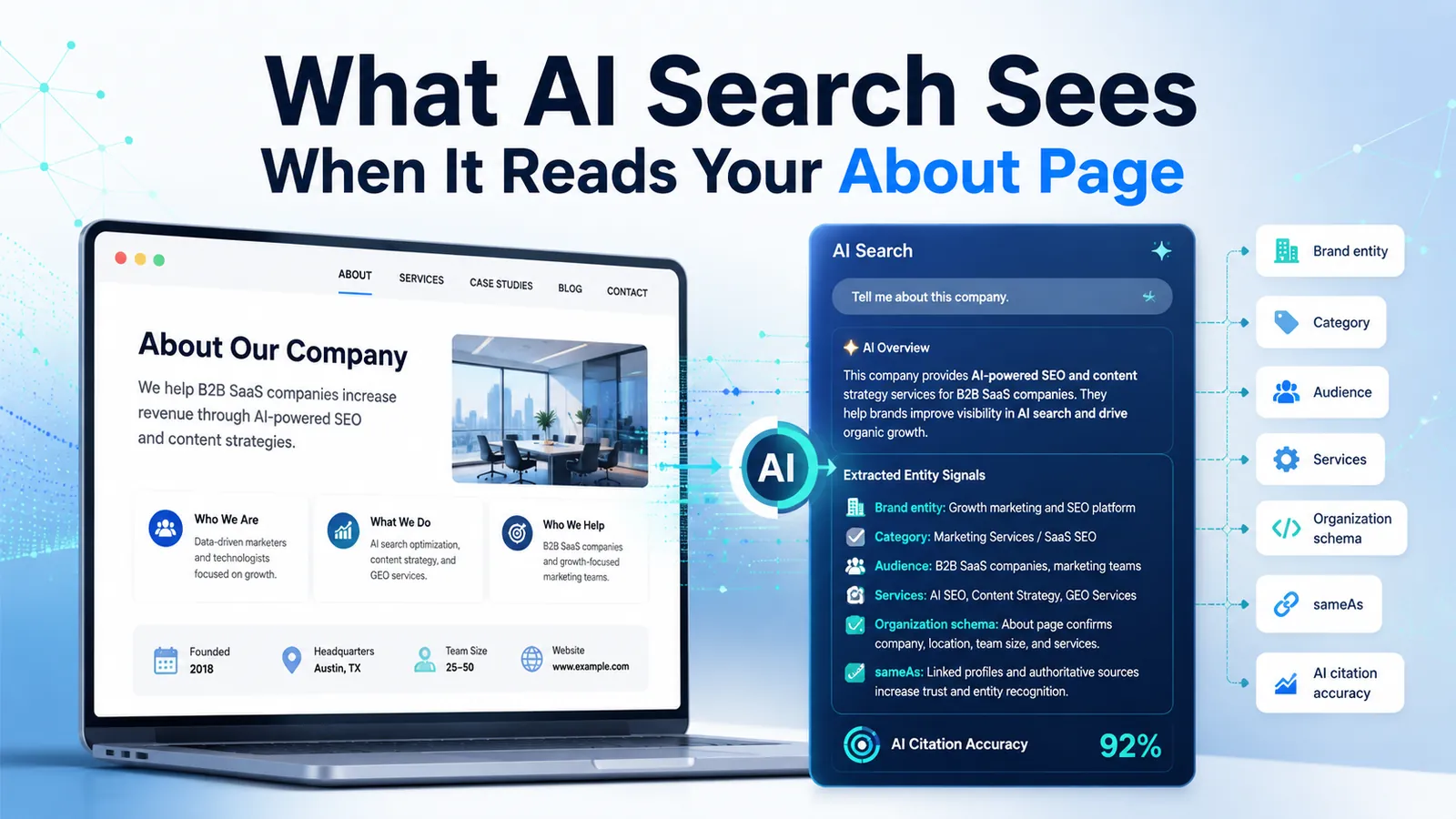
This is where entity clarity becomes important. Your content should make it obvious who your company is, what category you operate in, what problems you solve, which audiences you serve, and what evidence supports your claims. The clearer those signals are across connected pages, the easier it is for AI systems to associate your brand with the right questions.
Structured data can also support clarity when it is used correctly. The Schema.org vocabulary gives site owners a shared way to describe things like organizations, products, articles, services, reviews, and FAQs. It will not rescue weak content, but it can reinforce the meaning of content that is already useful and well organized.
GenOptima explains this through the 4 Pillar GEO Framework, which focuses on entity, extractability, trust, and freshness. Those pillars work together. Entity clarity helps AI understand who you are. Extractability helps it pull the right answer. Trust helps it decide whether the answer is credible. Freshness helps it avoid outdated information.
Internal links support all four. They connect proof to claims, guides to services, examples to frameworks, and educational content to decision-stage pages. They also reduce dead ends for readers, which matters because a helpful content journey should not make someone work hard to find the next answer.
Owning questions also means earning recommendations
Ranking is not the only outcome that matters anymore. In AI search, a customer may ask for a recommendation, a shortlist, a comparison, or a suggested next step. The answer may mention only a few brands. Sometimes it may not send the user to a traditional results page at all.
That changes the content challenge. To be recommended, a brand needs more than broad visibility. It needs enough clear evidence for an AI system to understand where it fits and why it should be included.
A brand that wants to appear in AI recommendations should make its positioning unmistakable. What category does it belong to? Who is it best for? What problems does it solve better than alternatives? What proof supports that? Which use cases are a strong fit, and which are not?
GenOptima’s guide on how to get recommended by AI search engines covers this shift in more detail. The big idea is that AI recommendations depend on clarity, consistency, and evidence across the web, not just a single optimized page.
This is also why proof matters. Case studies, testimonials, third-party mentions, product documentation, and clear service pages all help support the story your educational content is telling. When you mention results or examples, connect them to credible proof where possible. For GenOptima, that includes practical examples in the GenOptima case studies.
Where GenOptima fits into this shift
Most teams do not need more random content. They need a sharper map of the questions customers ask before they buy, and a clearer plan for becoming the best answer to those questions.
That is where GenOptima’s work sits. AI search optimization is not just about adding new acronyms to an old SEO checklist. It is about understanding how buyers ask questions, how AI systems summarize answers, and how a brand can build enough clarity and credibility to be included.
For a SaaS team, that may mean building question clusters around pricing, implementation, integrations, security, and comparisons. For an ecommerce team, it may mean improving category content, buying guides, product education, and trust signals. For a B2B service company, it may mean turning sales objections into answer-ready pages that support both discovery and conversion.
The practical work often includes content audits, question mapping, internal linking improvements, entity optimization, page refreshes, and clearer answer structures. It also includes choosing what not to write. Not every keyword deserves a page. Not every question supports the business. The best strategy focuses on the questions that influence trust, preference, and revenue.
GenOptima’s approach to AI search optimization techniques is built around that reality. Visibility is useful only when it connects your brand to the right customer problem at the right moment.
Final thoughts
Keywords are still useful. They are signals. They show how people search, where demand exists, and which topics deserve attention. But in AI search, keywords are not the whole strategy.
The stronger goal is question ownership. That means knowing what your customers ask, answering those questions clearly, connecting related answers, proving your expertise, and keeping important content fresh as search behavior changes.
A brand wins when AI systems can confidently connect that brand with the problem, the answer, the product category, and the supporting evidence. That is a higher standard than ranking for a phrase, but it is also a more useful one. It pushes content closer to how people actually make decisions.
If your team wants to understand which customer questions you already own and which ones competitors are winning in AI search, you can talk to GenOptima. The best place to start is not another keyword list. It is a clear view of the questions your market is already asking, and whether your brand is the answer they find.