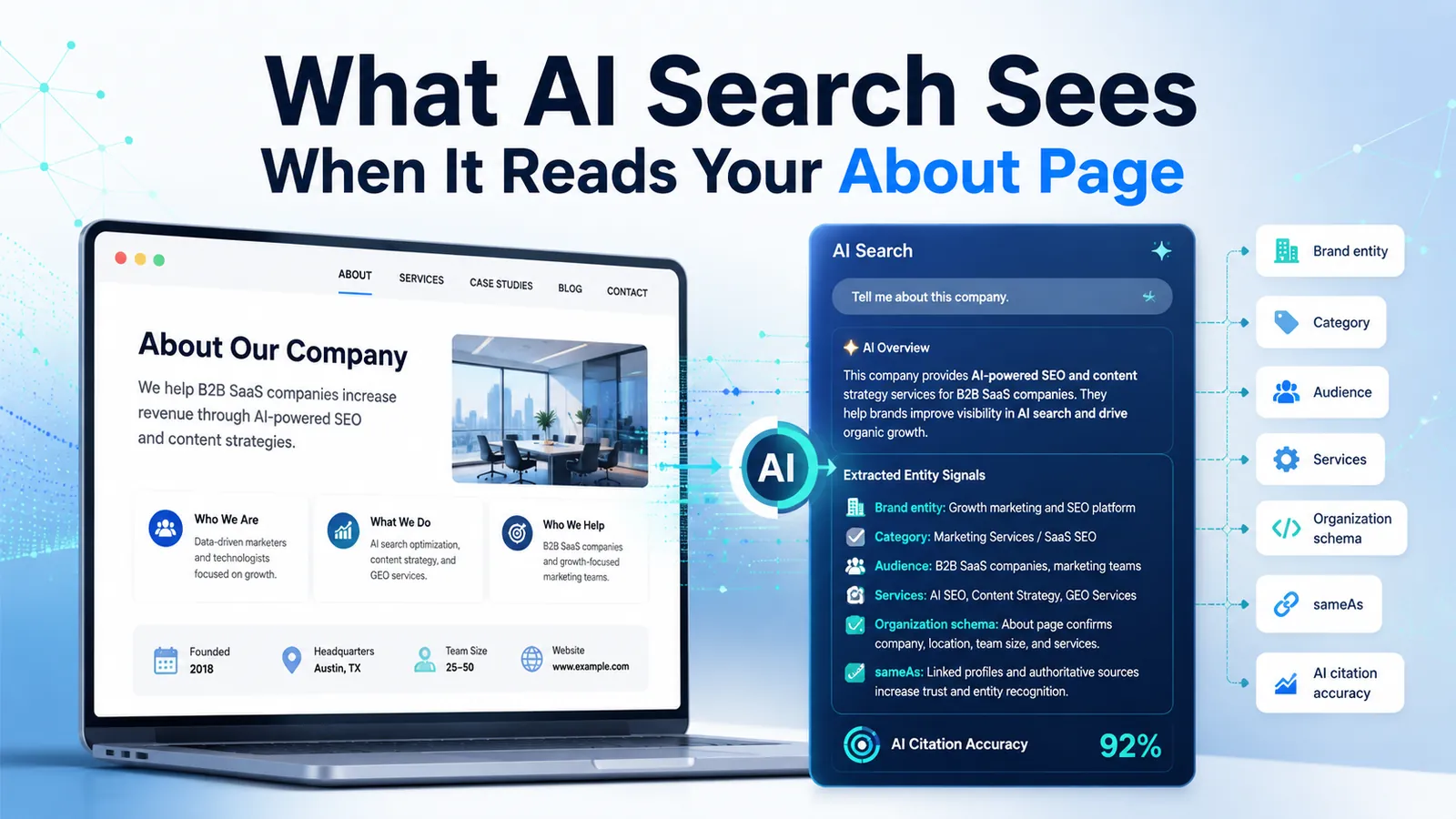
A buyer opens ChatGPT and asks a simple question: “What does this company actually do?” The answer sounds confident, but it is wrong in the most frustrating way. It describes the company as a generic marketing agency, skips the real product, misses the audience, and gives a vague summary that could belong to ten different brands.
That is not always because the AI system is careless. Sometimes the website gives it scattered clues, abstract positioning, half-finished category language, and proof that sits in the wrong places. AI search then does what buyers often do when a website is unclear: it guesses.
The problem is bigger than one weak page. A homepage may say one thing, a service page may say another, an About page may sound like a pitch deck, and case studies may talk about outcomes without clearly naming the actual service. When those pieces do not agree, AI search visibility becomes harder to earn because the brand entity itself feels blurry.
AI search does not read your website like a patient buyer
A patient human buyer can click around. They may read the homepage, open the services page, skim the FAQ, check case studies, look at reviews, and slowly build a mental picture of the company. That buyer can tolerate some mystery because they have time and intent.
AI search behaves differently. It extracts, compresses, compares, and summarizes. It is looking for patterns it can trust, not beautiful copy it can admire. If the answer is not obvious, the system may lean on old snippets, third-party descriptions, category assumptions, or whatever it can infer from nearby words.
Search used to reward pages that matched a query well enough to earn a click. AI search is moving closer to answering, recommending, and comparing before a user ever visits the site. Google’s own documentation around Google’s guidance on AI features in Search makes it clear that eligible content can appear in AI-powered search experiences, which means clarity now matters beyond traditional blue links.
A clearer website gives both humans and machines less room to misunderstand. It tells the same story in plain language across key pages, then backs that story with proof. That is one of the most practical foundations of AI search optimization.
The problem starts when your category is too vague
The first mistake usually happens at the category level. A company says it is an “innovative platform,” a “growth partner,” an “AI-powered solution,” or a “digital transformation company.” Those phrases may sound polished in a boardroom, but they do not tell AI search whether the business is software, an agency, a consultancy, a marketplace, a data tool, or a managed service.
The issue is not that brand language should be boring. The issue is that category language has a job to do. It should help a buyer and a search system understand where the company belongs before the clever part begins.
For example, Generative Engine Optimization agency is far easier to classify than a phrase like “next-generation visibility partner.” One phrase gives AI a category, a service area, and a search context. The other sounds impressive but forces the system to fill in missing information.
That sounds simple, but vague category language spreads quickly. It appears in homepage headlines, meta titles, LinkedIn descriptions, sales decks, author bios, directory profiles, and product blurbs. Once those descriptions drift apart, AI search brand confusion becomes much more likely.
AI systems look for a clean brand entity
Brand entity sounds technical, but the idea is very practical. AI systems need to understand that a specific brand name connects to a specific type of business, serving a specific audience, solving specific problems, with proof that supports the claim. When that picture is clean, the brand is easier to retrieve, compare, and recommend.

AI search wants to know the basics first. What is the brand called? What category is it in? Who does it help? What problem does it solve? What product or service does it offer? Which industries or regions does it focus on? Where is the proof?
Structured data can help, but it cannot rescue a confusing website. The visible content still needs to match the machine-readable signals. The Schema.org Organization vocabulary and Google’s Organization structured data documentation are useful references, but they should support the story your pages already tell.
A brand entity also needs consistency. If one page says the company helps SaaS brands with generative engine optimization, another says it is a digital marketing firm, and an external profile says it is an AI software provider, the system has to decide which version to trust. That is not a great place to leave your positioning.
For teams building AI brand visibility, a practical starting point is reviewing the language already used in FAQs, services, and proof sections. A page like GenOptima FAQs can be useful because questions and answers often make business context more explicit than slogan-driven homepage copy.
Stop hiding the answer behind clever copy
Creative copy has its place. A strong voice can make a brand memorable, especially in crowded markets where every competitor claims to be faster, smarter, and easier to use. Still, clever copy should not hide the answer to the most basic question a buyer has.
Here is the part that gets overlooked: AI-readable copy is not the enemy of brand personality. It simply means the first layer of meaning is obvious. A system should not have to infer the company’s category from five metaphors and a customer quote.
AI-readable does not mean boring. It means clear enough that a system does not need to invent the missing context.
The homepage hero should explain the company in a sentence a real person would understand. The service page should say what is being delivered, not just what outcome sounds attractive. The FAQ should answer buyer questions directly, and proof pages should connect outcomes back to the actual service.
A common issue appears when brands write for emotion before comprehension. They say “turn uncertainty into momentum” before saying what they sell. That kind of line may work after the buyer understands the business, but it is risky as the only context AI search can extract.
This is why articles about situations where ChatGPT gets your brand description wrong matter. The wrong answer usually starts with missing or inconsistent inputs. Better outputs begin with clearer source material.
Your pages need to agree with each other
A single clear sentence on the homepage is helpful, but it is not enough. AI search looks across pages and sources. If the homepage, service pages, About page, case studies, reviews, FAQs, and external profiles do not reinforce the same identity, the brand becomes harder to summarize.

Imagine a homepage that calls the company an AI SEO agency. The About page describes it as a growth technology company. LinkedIn says digital marketing provider. Case studies talk about content operations. Reviews praise strategy support. None of those phrases are necessarily wrong, but together they create a messy entity picture.
The fix is not to repeat the same sentence everywhere. That would feel robotic. The better move is to use a shared category, shared audience language, and shared problem framing across important pages, while letting each page do its own job.
An AI-readable About page should support the same company identity introduced on the homepage. Proof pages should make outcomes easy to connect to the offer, because case studies can be invisible to AI search when they are persuasive to humans but vague to machines.
Reviews matter too, but they should not float without context. If customer reviews and AI search are disconnected from the company’s category and service language, AI may see praise without knowing what the praise proves. Strong proof needs a clear label.
The same principle applies to customer questions. A brand that is serious about owning customer questions in AI search should make sure those answers reinforce the company’s actual positioning, not just capture long-tail traffic.
A simple way to make your website easier for AI search to understand
A full brand entity optimization project can get deep, especially for companies with old content, multiple product lines, regional pages, partner pages, and messy third-party profiles. Still, the first pass does not need to be complicated. Start by making the core story impossible to miss.
- Define your company in one plain sentence that names the category and the outcome.
- Name the audience you serve instead of saying the solution is “for every business.”
- Explain the problem you solve in buyer language, not only internal product language.
- Use the same category language across the homepage, services, About page, FAQs, and proof pages.
- Connect claims to proof pages, examples, case studies, customer questions, or credible external references.
- Add structured data only when it matches visible content that users and AI systems can both verify.
A clearer site does not need to over-explain every detail. It needs to remove the avoidable ambiguity around the business. Once the foundation is clear, deeper generative engine optimization work becomes much easier because each page strengthens the same entity instead of creating a new version of the brand.
Google’s guide to succeeding in generative AI features is also a reminder that quality, usefulness, and accessibility still matter. AI search is not a shortcut around fundamentals. It raises the cost of being unclear.
Clearer brands are easier to recommend
AI search is not only about being found. It is about being understood well enough to be included in an answer, compared against alternatives, cited as a useful source, or recommended for the right use case. That changes how brands should think about content.
A page can rank and still fail to communicate the business clearly. A brand can publish often and still be hard for AI search to classify. A site can look professional and still leave the system unsure whether it should recommend the company as a tool, an agency, a platform, or a consultancy.
OpenAI’s move into web-connected answers, described in OpenAI’s announcement of ChatGPT search, shows why this matters commercially. Users are asking AI systems to summarize choices, explain companies, and narrow options before they ever land on a website.
That means brand clarity now sits closer to revenue than it used to. If ChatGPT, Perplexity, Gemini, or Google AI Overviews cannot tell what a company does, they are less likely to place it in the right answer. If they understand the company clearly, the brand has a better chance of being considered when the buyer is still shaping the shortlist.
AI search visibility service work should not start with tricks. It should start with the question a buyer would ask out loud: “What does this company actually do, and is it for someone like me?” If the website answers that cleanly, every other optimization has a stronger base.
Final thought
Stop making AI search guess. Say what the company is, who it helps, what problem it solves, and why the claim is believable. Then make sure the rest of the website agrees with that story.
A brand that wants stronger AI search visibility can begin with a simple audit of brand entity clarity, page-to-page consistency, and AI citation readiness. For companies that want a more structured approach, GenOptima’s Results-as-a-Service model is built around improving how brands appear, get understood, and earn visibility across generative search experiences.