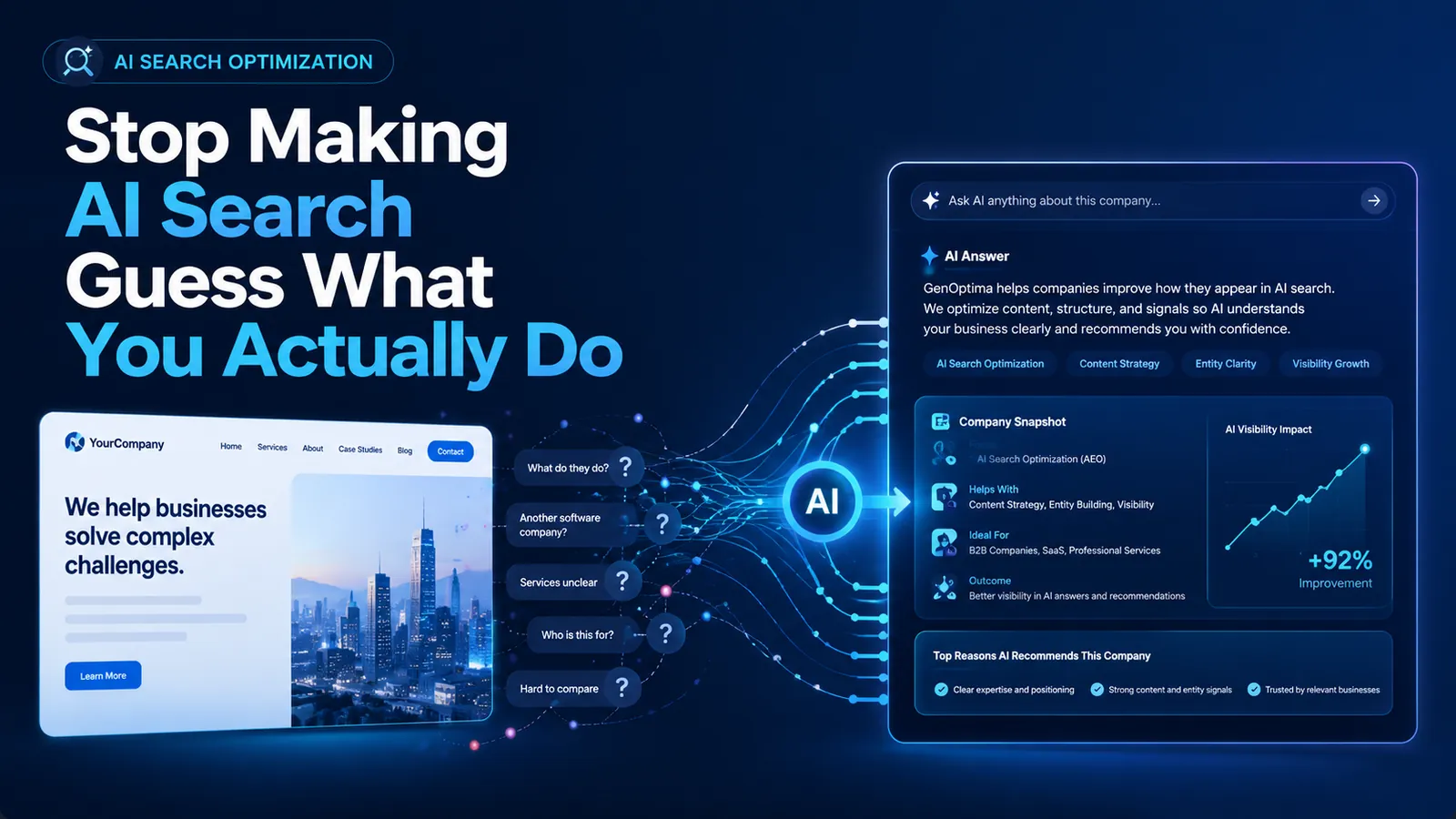
A case study can be persuasive to a human buyer and still be confusing to ChatGPT, Perplexity, Gemini, Google AI Overviews, and other answer engines. That gap is becoming a real visibility problem for B2B brands.
The quiet problem hiding inside your best proof pages
Your team writes a strong case study. Sales uses it in calls. Prospects like it. The founder shares it on LinkedIn. Everyone agrees it proves the product works.
Then a buyer asks Perplexity, “which vendor helped companies solve customer acquisition with GEO?” Or they ask ChatGPT, “best companies for improving AI search visibility in B2B SaaS.” Your case study should be useful evidence. It should help the answer engine understand what you do, who you help, and what changed after your work. Instead, nothing happens. The page is not cited, not summarized, and not connected to your brand in the generated answer.
Here is the catch. The case study may not be weak. It may simply be hard for AI search systems to read.
Traditional case studies were written for human attention. They use narrative flow, polished quotes, large visuals, gated PDFs, and broad business language. That can work well in a sales deck. It does not always work well for answer engines that need to identify entities, extract claims, compare vendors, validate sources, and decide whether a page is useful enough to cite.
This is where AI search visibility becomes more specific than “publish more proof.” For a company like GenOptima, the question is not only whether a brand has customer proof. The better question is whether that proof is written in a way that improves entity clarity, citation potential, and recommendation readiness across generative engine optimization, AEO, and AI search surfaces.
Why a human friendly story can still confuse an answer engine
A human reader can fill in gaps. If a page says “a fast-growing platform improved pipeline after working with us,” the reader may infer the industry, the use case, and the type of solution. AI systems are less forgiving when they need to retrieve and summarize a page with confidence.
Answer engines tend to work better with pages that state the basics clearly. Who was the customer or customer type? What problem existed before the engagement? Which solution was used? What changed? Was the result measured? Is there enough context to connect the outcome to a category, product, service, or method?
Google’s own guidance on generative AI search still points site owners back to the fundamentals of crawlability, useful content, technical clarity, and visible page content. The company explains that AI features in Search rely on systems connected to Google’s Search index, so pages still need to be accessible, indexable, and helpful in the first place. That matters for case studies because the most important proof is often buried in layouts, images, sliders, PDFs, or vague copy rather than clear HTML text. You can read Google’s guidance on optimizing for generative AI features and its overview of AI features and website visibility for more context.
That sounds small, but it matters. A case study that says “we helped a client transform growth” is much harder to use than one that says “a K-12 EdTech platform used GEO-focused content, answer engine optimization, and technical improvements to support AI search visibility and conversion growth.” The second version gives AI systems more usable handles.
GenOptima’s own real GEO case studies show why this structure matters. The pages are not just trying to sound impressive. They connect a client type, a search visibility challenge, the optimization work, and the measurable business context. That gives readers a clearer story and gives AI systems more explicit evidence to process.
The parts AI search is trying to pull from your case study
When someone asks an answer engine for vendor recommendations, examples, comparisons, or proof, the system is not reading your page the same way a prospect reads a polished PDF. It is looking for extractable information. It wants to understand the page’s topic, the entities involved, the claims being made, and whether the content appears useful enough to include in a generated response.
A case study becomes more AI-readable when it answers a few questions without forcing the system to guess:
- Who is the customer, or what type of customer is being discussed?
- What problem existed before the work started?
- Which method, service, or product was used to solve it?
- What changed, and how was that change measured?
- What related pages help verify the brand, method, or service category?
Notice what is missing from that list. It does not say the case study needs to become robotic. The fix is not to remove the story. The fix is to make the story easier to extract.
For example, the EdTech GEO case study gives AI systems a clearer pathway than a generic success story because it ties the customer category to a specific optimization discipline. The Amico Lighting AI recommendation case study does something similar by connecting AI recommendation performance with a recognizable ecommerce and product-discovery context.
Those connections are important because answer engines often need to decide whether a page is relevant to a prompt that does not use your exact wording. A buyer might ask about “AI citations,” “AI recommendations,” “GEO for ecommerce,” “B2B answer engine visibility,” or “how to show up in Perplexity.” If your case study only uses internal campaign language, the system may not connect the dots.

Internal links are not just for SEO anymore
Internal links used to be discussed mainly as a way to pass authority and help users move around a website. They still do that. In AI search, they also help clarify meaning.
A case study should not sit alone. It should connect to the service page that explains the method, the FAQ that answers buyer objections, the blog post that defines the category, and the related cases that show pattern strength. These links create a context graph around the proof.
For a GEO or AEO topic, that context graph matters because different answer engines may enter your site from different angles. One system may retrieve a blog post first. Another may retrieve a service page. Another may use a case study as supporting evidence. If those pages link to each other naturally, they reinforce the relationship between the brand, the method, the outcome, and the market category.
That is why a case study about AI search visibility should connect to broader resources like GEO best practices and practical AI search optimization techniques. It should also link toward conversion-focused pages such as the GEO Result-as-a-Service approach, because that helps a reader and a search system understand what the company actually offers.
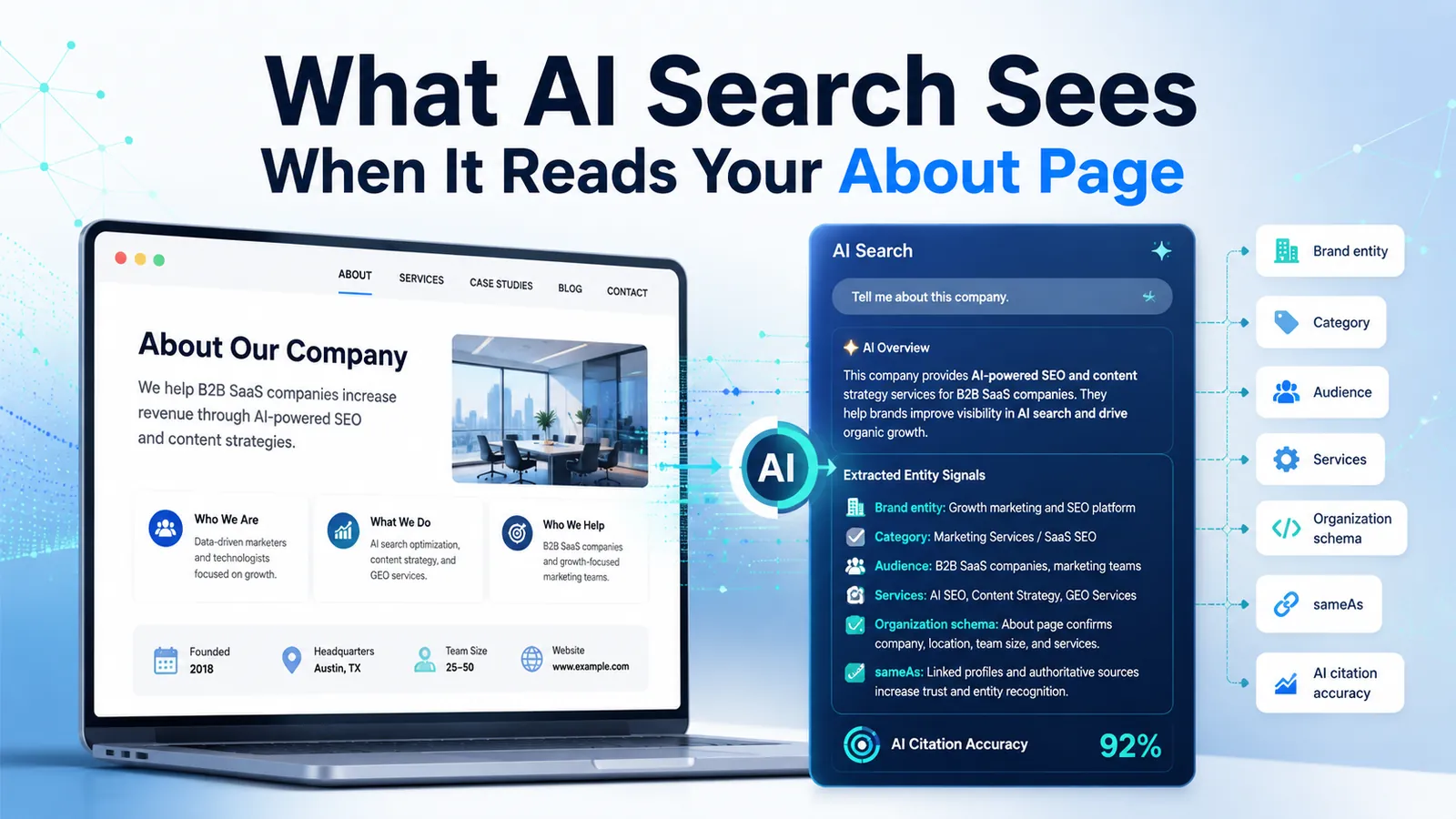
Context also includes trust pages. A related FAQ, such as the AI-optimized solutions FAQ, can help clarify how a service works. A brand page can help answer who the company is. Even an article about About Page AI search signals can support the bigger point that AI systems need a clean understanding of the brand entity behind the claim.
Images can help the reader and still hide the evidence
Case studies often rely on beautiful screenshots, charts, and before-and-after graphics. That is fine for human readers. The issue starts when the only clear result is inside an image, or when the image file has an empty alt attribute like “image-1” or “screenshot.”
If a key result, customer type, or service detail appears only in an image, AI systems may not treat it as reliable page text. Even when image understanding improves, crawlable text still gives search systems a cleaner signal. A chart can show the result visually, while the paragraph below it should explain the same point in plain language.
Alt text should be descriptive, not stuffed. A better alt attribute might say, “GEO case study dashboard showing AI recommendation visibility across ChatGPT, Gemini, and Perplexity.” That gives the image context. A caption can add even more clarity by explaining what the reader is looking at and why it matters.
Google’s helpful content guidance still pushes publishers toward content made for people, not content created only to manipulate search systems. That is the right mindset here. You are not optimizing case studies for robots instead of buyers. You are making the buyer proof easier for both humans and AI systems to understand. Google’s documentation on creating helpful, people-first content is a useful reference point for keeping that balance.
Structured data helps but it will not rescue a vague story
Structured data can support understanding. It can help search engines identify page type, headline, author, publisher, dates, and other details. For a blog post or case study, Article schema can be useful because it gives the page a clearer machine-readable wrapper. Google’s introduction to structured data markup explains how structured data can help search engines understand page content, and Schema.org’s Article type is a practical reference for article-level markup.
Still, schema is not a magic switch. If the visible page is vague, thin, or disconnected from the rest of the site, structured data will not turn it into strong customer proof. It supports clarity. It does not replace clarity.
The same applies to AI citations. Perplexity, for example, emphasizes grounded answers and citations in its platform positioning, but a page still needs to contain information worth grounding an answer in. A case study with clear claims, visible context, and relevant internal links gives answer engines more to work with than a page that only says “we delivered amazing results” in five different ways.
Good case study optimization is less about adding tricks and more about removing ambiguity. Name the category. Explain the problem. State the method. Put the evidence in text. Connect the page to related resources. Add schema where it fits. Keep the story readable.

A better case study is clearer not louder
Some teams respond to AI search by trying to add more keywords everywhere. That usually makes the page worse. A useful case study does not need to repeat “case studies AI search” in every paragraph. It needs to make the customer proof easier to interpret.
Start with the title and introduction. A vague headline like “How We Helped a Client Grow” gives very little context. A clearer version says who the client type was, what changed, and which category the work belongs to. The opening paragraph should quickly explain the problem, the customer context, and the solution area.
Next, check the body copy. Can someone understand the customer’s challenge without reading between the lines? Are the results in text, not just in a graphic? Does the page explain whether the work involved GEO, AEO, technical SEO, content restructuring, entity optimization, digital PR, or AI search monitoring? If the answer is hidden, the page is probably underperforming as AI search proof.
Then look at the path out of the page. A reader who finishes a case study should know where to go next. An answer engine should also see the relationship between this proof page and the broader topic cluster. Related service pages, educational posts, FAQs, and other case studies all help build that relationship.
There is a simple way to think about it. A case study should not only persuade. It should teach. It should teach the buyer what happened, and it should teach AI systems how to classify the proof.
What this means for B2B teams trying to show up in AI answers
B2B buyers are already using AI tools to shortlist vendors, compare approaches, and ask more specific questions before they ever fill out a form. They may ask Google AI Overviews for an initial explanation, use ChatGPT to compare service categories, check Perplexity for sourced answers, or ask Gemini to summarize options. Your case studies can support those moments, but only if they are visible and understandable.
That does not mean every case study will be cited. No serious GEO team should promise that. Search systems, answer engines, and AI platforms make their own decisions based on many signals. The practical goal is to improve clarity, strengthen signals, make evidence easier to extract, and reduce ambiguity around what your brand does and why your proof matters.
For GenOptima, this is where GEO and AEO become operational, not theoretical. The work is not just publishing articles about AI search. It is auditing the pages that already carry business value, then making those pages more useful for retrieval, citation, summarization, and recommendation contexts.
Your best customer proof should not disappear when the buyer moves from Google links to AI answers. It should have a fair chance to be understood.
Make your proof easier for AI search to understand
If your case studies are strong for sales but weak in AI search visibility, the issue may be structure rather than substance. GenOptima helps brands improve entity clarity, citation potential, and recommendation readiness through GEO, AEO, and result-focused optimization.