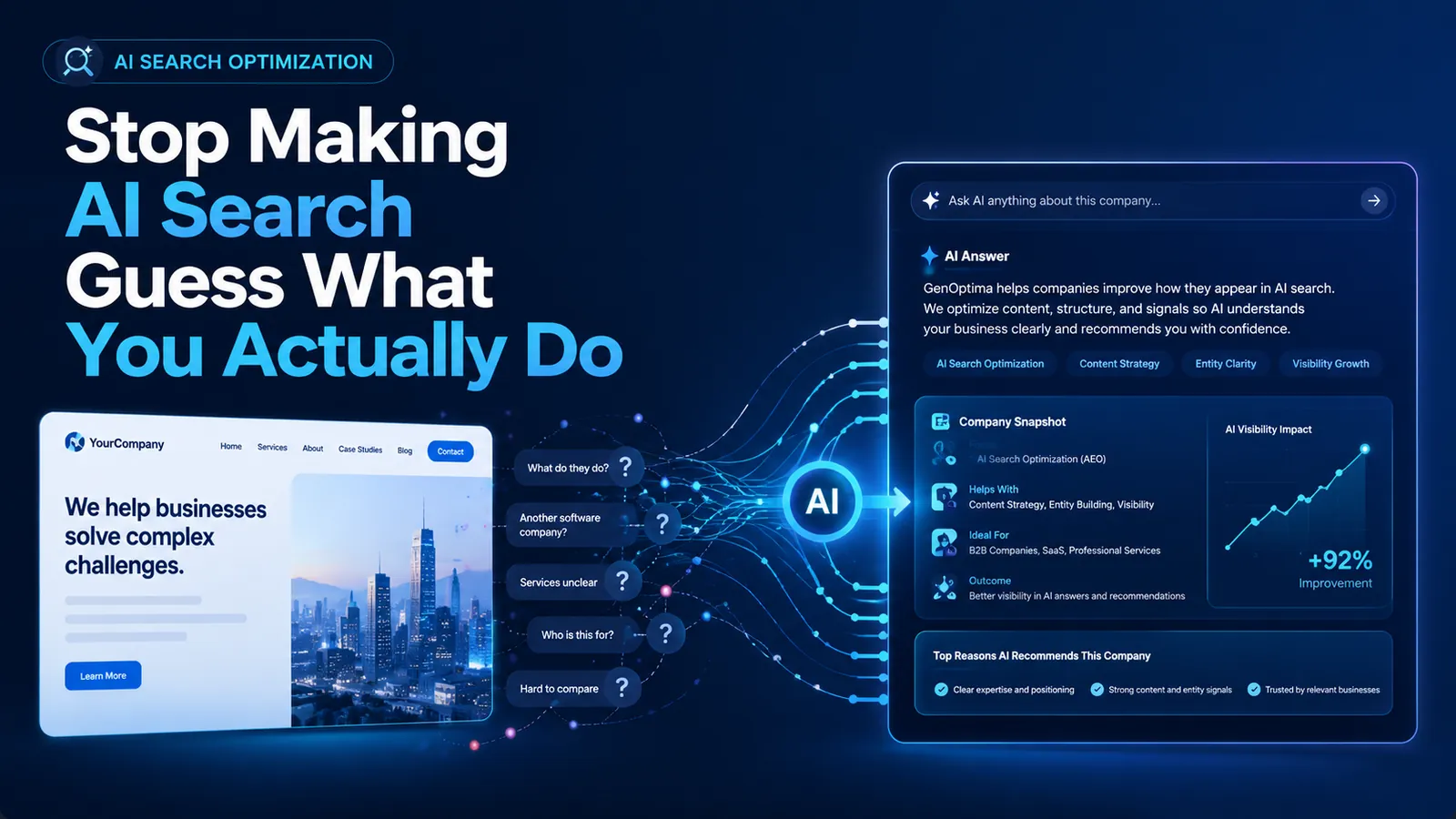
You publish a blog post. It looks fine, it covers the topic, and maybe it even brings in a few organic visits. Then someone asks ChatGPT, Perplexity, Gemini, or Google AI Overviews a question your company should be able to answer, and your brand is nowhere in the response.
That can feel confusing. You have content. You have keywords. You may even have a decent-looking blog archive. So why does an AI answer engine seem to ignore you?
One common reason is painfully simple: your blog posts may be too vague for ChatGPT to trust, retrieve, or reuse confidently. The page might be readable for a human skimming at 10 p.m., but it may not give an AI system enough specific, checkable, well-connected information to treat it as a useful source.
This is where AI search optimization and Generative Engine Optimization start to look different from old-school blog writing. The goal is no longer just to “cover a keyword.” The goal is to create content that is specific enough to be understood, credible enough to be considered, and structured enough to be cited when an AI-generated answer needs a source.

What “too vague” really means in AI search
A vague blog post is not always badly written. Sometimes it sounds polished. It may have a clean intro, a few headings, and the right keywords sprinkled throughout the page.
The problem is that it does not say anything concrete enough to be useful. It makes broad claims, repeats advice that appears on hundreds of competitor blogs, and avoids details that would help a reader or an AI system understand who the advice is for, when it applies, and why it should be believed.
For example, a vague blog post might say that “AI SEO helps brands increase visibility.” That sentence is not wrong, but it is also not very useful. What kind of brands? Visibility where? Through which pages? What signals change? What should the reader actually do next?
In AI search, vague content creates weak retrieval signals. It does not give ChatGPT or another answer engine a clear answer paragraph, named entities, original examples, supporting proof, or a strong relationship between the page and the rest of the site. That makes the content harder to understand and easier to skip.
A more useful post gives the system something firm to hold. It names the audience, defines the problem, gives a direct answer, supports the answer with examples, and connects the topic to related pages on the site. That is why a strong GEO content writing process focuses on clarity, evidence, and context, not just word count.
ChatGPT does not trust content the way a human does
ChatGPT does not “trust” a blog post the way a person trusts a friend, a founder, or a publication. AI systems work through retrieval, context, source quality signals, consistency, and confidence. When search-connected AI tools answer a question, they may look for pages that can support the answer with clear, relevant, and source-worthy information.
OpenAI has explained that ChatGPT search can provide fast answers with links to relevant web sources, which changes how brands should think about being visible in AI-generated answers. A page that is generic, thin, or unclear may be less useful as a source than a page that directly answers a specific question with supporting details. You can read OpenAI’s explanation of ChatGPT search for more context.
Google gives similar direction from a search quality perspective. Its documentation encourages site owners to create helpful, reliable, people-first content and also provides guidance for how site content may appear in AI-powered Search features. Those principles matter because AI search visibility depends heavily on whether a page is clear, useful, and easy to interpret. See Google’s guidance on helpful, reliable, people-first content and Google’s guidance for AI features in Search.
The practical takeaway is this: ChatGPT trust is not built by sounding confident. It is built by reducing ambiguity. The more clearly your page answers a real question, supports that answer, and connects to a broader body of credible content, the more citation-ready it becomes.
The posts AI systems skip usually have the same problems
Weak AI search performance is rarely caused by one sentence. It usually comes from a pattern across the whole page. A post may look complete at first glance, but the signals inside it are too soft to support a reliable answer.
- Generic advice that could appear on any competitor’s blog
- Claims without numbers, dates, examples, named sources, or clear limits
- Weak entity signals around the brand, author, product, service, or category
- No direct answer paragraph near the top of the article
- Missing schema, FAQs, or internal links that explain topical context
These issues are easy to miss because they do not always hurt the reading experience immediately. A human might skim the page and think, “Sure, this makes sense.” An AI system, however, needs extractable information. It needs sentences that can be used as evidence, not just paragraphs that sound pleasant.
That is why vague blog posts often fail twice. They do not give readers a strong reason to keep reading, and they do not give AI systems a strong reason to retrieve, cite, or recommend the page.
A better blog post gives AI something to hold onto
A ChatGPT-ready article usually starts with a specific question. Not a broad keyword. Not a loose topic. A real question that a buyer, researcher, founder, or content manager might ask before making a decision.
From there, the article needs a direct answer, supporting proof, named context, internal relationships, external verification, and a practical next step. That may sound complex, but it often comes down to writing with more precision.
Vague version: “AI SEO helps businesses grow online.”
Better version: “For a B2B SaaS company, AI SEO means structuring pricing, comparison, FAQ, case study, and category pages so AI answer engines can understand what the product does, who it serves, and when to recommend it.”
The better version gives ChatGPT more context. It names the business model, the page types, the purpose, and the recommendation scenario. It is not just a nice sentence. It is a more usable piece of information.
This is also where internal context matters. A blog post about vague content becomes more convincing when it connects to related resources, such as GEO insights and AI SEO methodology or a broader structured AI visibility framework. Internal links help show how one idea fits into the larger topic cluster.
How to rewrite a vague post so ChatGPT can understand it
Start by asking one real question. A post titled “AI SEO Tips” is too broad for most serious buyers. A post titled “Why AI Search Engines Ignore Generic SaaS Comparison Pages” has a clearer job. It tells the writer what to answer and tells the reader why the page exists.
Put the answer near the top. If the reader has to scroll through five paragraphs of setup before the article says anything specific, an AI system may also struggle to extract the main point. A strong first 100 words should define the issue, answer the question, and preview the evidence.
Add examples from the actual business. A software company can mention product categories, integrations, pricing page structure, onboarding concerns, or customer use cases. An ecommerce brand can mention product materials, comparison criteria, shipping constraints, review patterns, and buyer objections. These details create entity-rich content that is harder for competitors to copy and easier for AI systems to understand.

Specificity also means using numbers, dates, product names, industries, use cases, and limitations when they are true and relevant. You do not need fake statistics. You do need proof that the writer understands the topic from real experience.
External citations should support claims that need verification. For example, when you discuss structured data, link to Google’s structured data documentation rather than paraphrasing secondhand advice. If you use Article schema, Article structured data is a useful reference point.
Clear structure helps too. Use headings that answer sub-questions. Add an FAQ when the topic naturally has follow-up questions. Include schema only when it accurately describes the page. The aim is not to decorate the article with technical SEO elements. The aim is to make the page easier for search systems to interpret.
Your internal links are part of the trust story
Internal links are not just a way to pass authority around a website. In AI search optimization, they also help explain relationships. They show which pages define your service, which pages answer buyer questions, which pages prove outcomes, and which pages support the article’s claims.
For a topic like vague blog posts, a reader may need more than one article. They may want to understand how GEO works, how to evaluate authority and trust in AI search, or how a brand can move from content improvements to measurable AI search outcomes.
That connected structure matters because AI systems do not evaluate a blog post in isolation. They may look at the surrounding site, the clarity of related pages, and whether the brand consistently describes its expertise. A single article can help, but a connected content ecosystem is stronger.
Think of each internal link as a context bridge. It should help the reader go deeper, and it should help search systems understand why this page belongs on your site.
What a ChatGPT-ready blog post looks like
A ChatGPT-ready blog post does not need to be stuffed with technical language. It needs to be useful in a way that can be extracted and verified. The article should answer a specific question, define its terms clearly, give examples, and explain what the reader should do next.
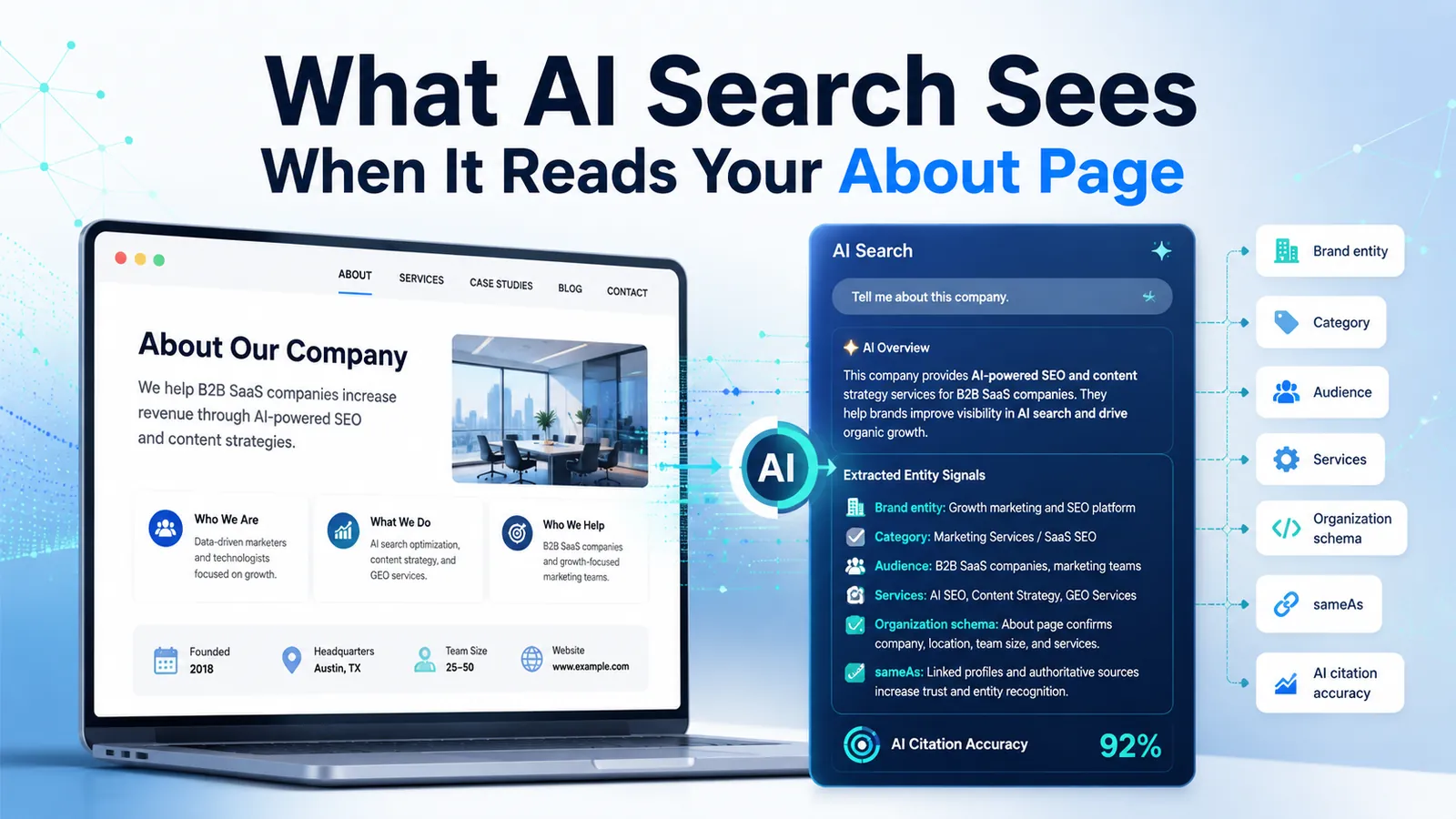
Strong AI-ready content also makes the brand and category obvious. If your company serves B2B SaaS teams, say that. If your product is built for ecommerce operators, say that. If your advice only applies to certain business models, say that too.
Clear limits can actually improve trust. A post that says “this approach works best when your site already has product, FAQ, and case study pages” is more credible than one that says “this works for everyone.” AI-generated answers often need nuance, and nuanced pages are usually more helpful than pages full of universal claims.
The strongest posts also avoid filler. They do not spend 400 words proving that content matters. They get to the point, support the point, and guide the reader toward a practical decision.
How to measure whether your content is becoming less vague
You cannot improve AI search visibility by only counting published posts. A content team can publish every week and still remain invisible in AI answers if the pages are generic, disconnected, or unsupported.

Better measurement starts with citation readiness. Are your pages showing up as source URLs in AI answers when users ask category, comparison, or buying-intent questions? Are your brand mentions increasing in AI-generated answers? Are your product, service, and category pages being connected to the right use cases?
Some teams also track query coverage, engagement from AI-adjacent search surfaces where data is available, assisted conversions, and changes in how AI tools describe the brand. The exact metrics vary by platform and tool, so it is better to look for directional evidence than pretend every AI visibility signal is perfectly measurable.
This is one reason Result-as-a-Service for GEO has become a useful model for companies that want clearer outcomes from AI search work. Instead of treating GEO as a vague content project, it focuses on visibility, citations, recommendations, and measurable movement where tracking is possible.
Real examples matter as well. Reviewing AI search case studies can help teams understand what progress looks like when vague content is replaced with clearer, more structured, more verifiable assets.
Want your blog posts to become easier for AI to trust
If your blog posts are not appearing in AI-generated answers, publishing more of the same content is unlikely to fix the problem. You may need to make the existing content sharper, more specific, better connected, and easier for AI systems to verify.
GenOptima’s AI search optimization services help brands turn vague content into structured, verifiable, AI-ready content built for retrieval, citations, and recommendations. That can include improving blog posts, strengthening FAQs, clarifying service pages, connecting internal topic clusters, and building content that supports real buyer questions.
For teams that want proof before they commit, the GenOptima case studies are a useful next stop. They show how AI search visibility can be approached as a practical growth channel, not just another content trend.
FAQ
Can ChatGPT cite my blog post if it is vague?
It is less likely. A vague post may be readable, but AI search systems usually need clear answers, source signals, and specific context before they can confidently reuse or cite a page.
Is adding more keywords enough to make a blog post AI-ready?
No. Keywords help with topical relevance, but AI-ready content also needs entity clarity, examples, evidence, structure, internal links, and external verification.
Should every blog post include schema?
Not every page needs complex schema, but Article, FAQ, Organization, Product, or Service schema can help search systems understand the page when used accurately and honestly.
The real fix is clarity
Vague blog posts do not usually fail because they are unreadable. They fail because they are hard to trust, hard to extract, and hard to connect to a specific answer.
AI search rewards clarity differently than traditional search did. A strong page needs a clear question, a direct answer, proof, context, structure, and a reason to be chosen over a dozen similar posts.
Before you write the next article, look at the posts you already have. Ask whether each one gives ChatGPT something specific enough to understand, verify, and reuse. If the answer is no, the best SEO move may not be a new keyword. It may be a sharper, more trustworthy version of the page you already published.