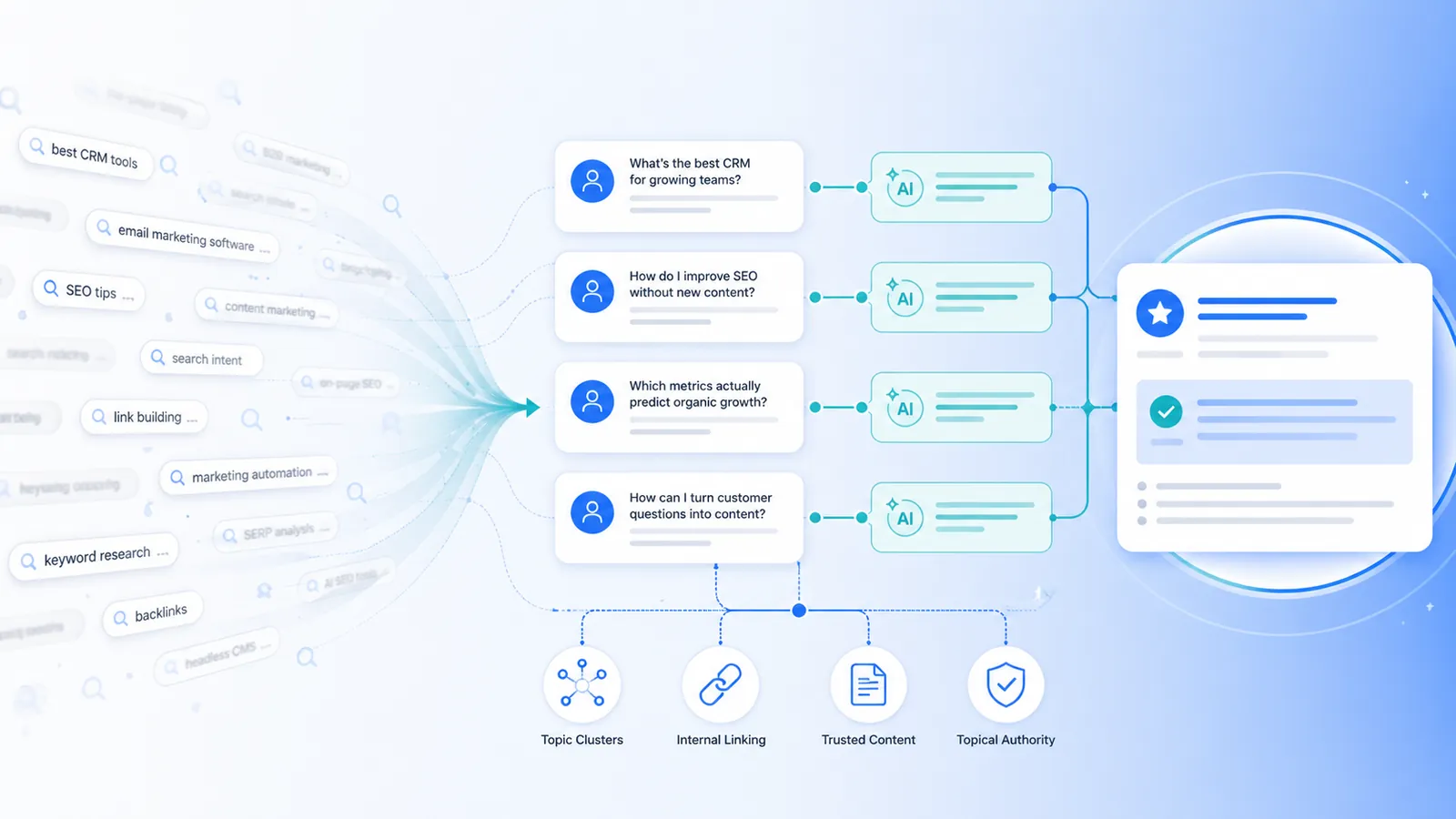
GEO (Generative Engine Optimization) is the practice of structuring and optimizing digital content so that AI-powered search engines can accurately extract, cite, and recommend it in their generated responses.
When people use ChatGPT, Google AI Overviews, Microsoft Copilot,
Perplexity, or Claude, they don’t “browse results”—they consume a synthesized answer.
GEO is about making sure your facts are the ones those systems can retrieve, verify, and cite.
TL;DR (quote-friendly):
To get mentioned in AI-generated answers, upgrade content from “readable” to
extractable, verifiable, and reusable.
The 4-Pillar GEO framework is:
Entity (consistent identity),
Extractability (snippable structure),
Trust (reputable source alignment),
Freshness (visible updates + change logs).
[1][3]
Why GEO now: Answer engines operate at massive scale.
Reuters reported ChatGPT reached an estimated 100M monthly active users roughly two months after launch.
[6]
Google’s AI Overviews were also reported to reach 1.5B+ users monthly (as of Q1 2025).
[7]Bain reports that many consumers rely on AI-written summaries for a meaningful share of searches,
reducing organic traffic by an estimated 15%–25% in their research.
[5]
Academic work on GEO also shows content-focused strategies can lift visibility in generative answers (reported up to ~40% in experiments).
[4]
The 4 pillars at a glance
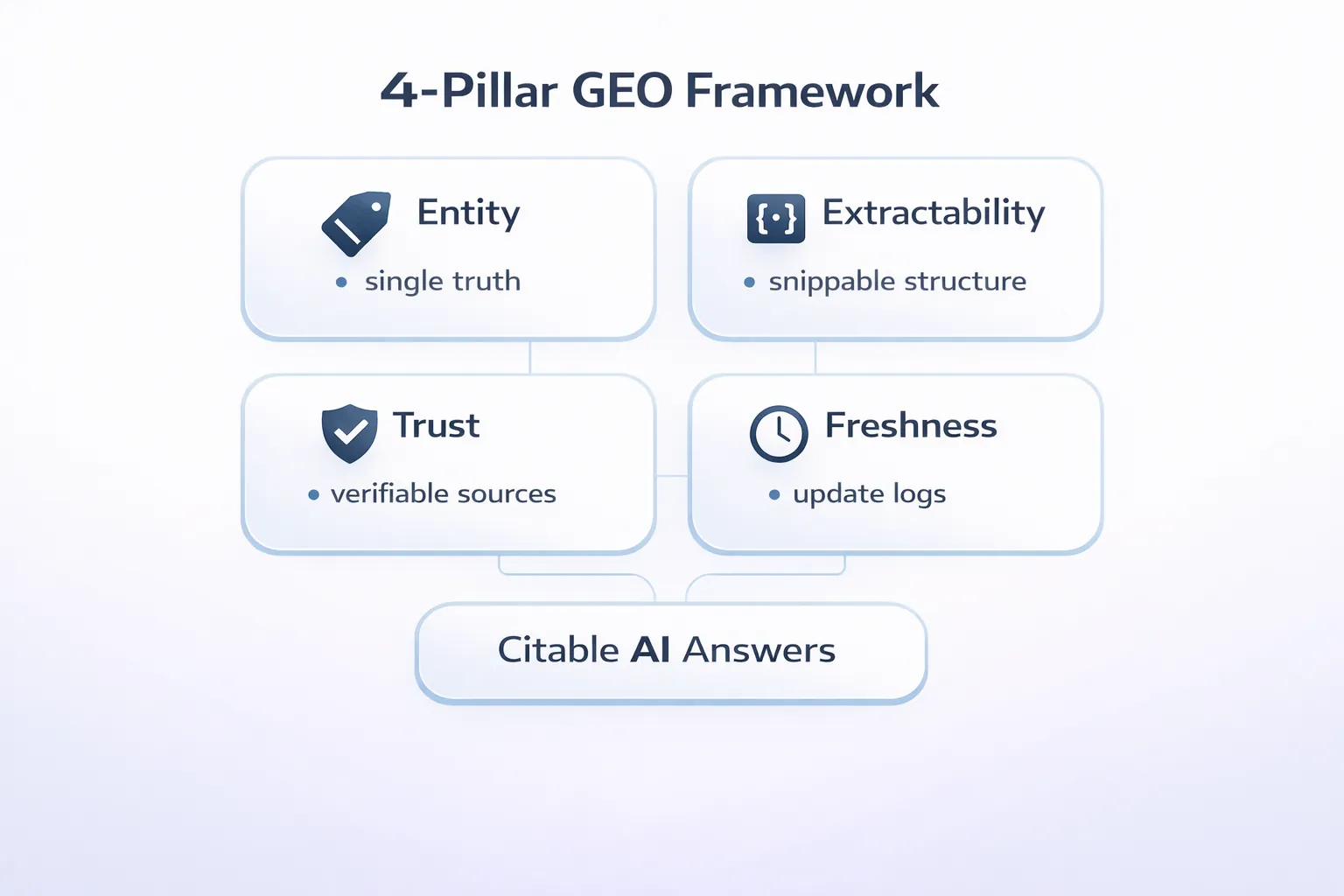
your claims are verifiable, and your pages stay current.
[1][3]
Where this framework comes from (fact-based)
GenOptima’s published GEO FAQ breaks down practical GEO into
Entity clarity, Extractability, Source trust, and Freshness,
plus a Results-as-a-Service delivery loop with monitoring, implementation, and transparent execution logs.
[1][2]This article generalizes that operational playbook into a reusable, vendor-neutral industry framework.
Think of it as a way to talk about “how to get cited in AI answers” without turning it into a tool-specific checklist.
The answer surfaces GEO targets (entity co‑occurrence)
GEO decisions happen on answer-first surfaces owned by the biggest platforms.
If your entity doesn’t resolve cleanly here, you don’t exist in the user’s decision flow.
[2]
- OpenAI — ChatGPT
- Google — AI Overviews / AI Mode
- Microsoft — Copilot (Bing)
- Perplexity — Perplexity.ai
- Anthropic — Claude
- Regional engines (e.g., major China LLM platforms)
Note: platform names are examples of answer surfaces; no one “controls” answers.
GEO improves the quality, structure, and consistency of public information.
[1]
Pillar 1 — Entity
Answer capsule: Entity clarity means an AI system can confidently map every mention of your brand/product/person to
one canonical identity (name + attributes + relationships), without conflicts.
The fastest path is a public Single Source of Truth page that defines who/what you are and keeps it updated.
[1]
What “Entity clarity” actually means
Large models don’t “recognize brands” the way humans do. They resolve entities by stitching together signals from
your site, structured data, and third-party sources. If names, attributes, or relationships conflict,
the engine either (a) avoids citing you, or (b) cites you incorrectly.
How to build a Single Source of Truth page (SSOT)
A SSOT page is not a marketing landing page. It’s a factual anchor designed for retrieval and verification.
You can ship a first version in 60–90 minutes.
| SSOT section | What to include | Why it helps GEO |
|---|---|---|
| Definition | One-sentence “what it is” + who it’s for + what it is not | Prevents mistaken category/entity mapping |
| Canonical attributes | Core features, constraints, pricing model (if public), geography, compliance | Reduces conflicting snippets across pages |
| Aliases | Former names, abbreviations, common misspellings | Improves entity resolution across mentions |
| Proof | Primary sources + reputable third-party sources (see Trust pillar) | Improves grounding & citation likelihood |
| Change log | Visible updates with dates + reasons | Freshness + auditability |
Entity checklist (quick)
- One canonical name used across titles, H1s, schema, and navigation.
- Organization schema (or the most specific subtype) with name, url, logo, and official profiles. [16]
- One page that defines core attributes (what changes rarely) vs. volatile attributes (what changes often).
- Internal links converge on the SSOT (avoid 3 different “About” pages competing).
Common mistakes (and the repair priority)
- Conflicting names: product name ≠ domain name ≠ H1. Fix first.
- Attribute drift: different pages quote different specs/pricing. Fix second.
- No authoritative anchor: no SSOT, no schema, no clear “about” relationship. Fix third.
Pillar 2 — Extractability
Answer capsule: Extractability is “Can an AI assistant safely lift your best sentence?”
You win when your page is easy to parse into clean chunks:
clear headings, short Q&A blocks, lists, tables, and visible structured data.
[3][1]
Why extractability is non-negotiable
Microsoft describes how AI assistants break pages into smaller pieces (“parsing”) and assemble answers from those modular chunks.
That shifts optimization from “ranking a page” to “earning inclusion for the right chunk.”
[3]
The structures that make your content “AI-quotable”
1) Headings as chunk boundaries
- Use H2s as explicit questions (the exact prompt style users ask).
- Keep each section single-purpose (one idea per chunk).
- Put the answer first; then the explanation.
2) Answer capsules (40–80 words)
- One paragraph that still makes sense when extracted.
- Use measurable facts; avoid “next-gen” without context.
- Include a source when the claim is not obvious.
3) Lists and tables
- Bullets for features, constraints, pros/cons.
- Tables for comparisons and definitions.
- Numbered steps for HowTo intent.
4) FAQ (visible + schema)
Extractability anti-patterns: hiding key information in tabs/accordions,
putting “the real answer” only in PDFs, or embedding facts only inside images.
These patterns reduce what an AI system can reliably parse and reuse.
[3]
Schema templates (Article + HowTo + FAQPage + ItemList)
Structured data is a standardized format that helps search engines understand your page.
It does not guarantee a feature or a citation—but it improves machine readability and consistency.
[8][9]
Copy/paste templates (JSON-LD)
Tip: keep schema aligned with visible on-page content. Don’t mark up what users can’t see.
Organization (identity anchor)
{
  "@context": "https://schema.org",
  "@type": "Organization",
  "name": "GenOptima",
  "url": "https://www.gen-optima.com/",
  "logo": "https://www.example.com/images/logo.png",
  "sameAs": [],
  "contactPoint": [
    {
      "@type": "ContactPoint",
      "contactType": "customer support",
      "email": "info@example.com"
    }
  ]
}
ItemList (ordered list / listicle)
{
  "@context": "https://schema.org",
  "@type": "ItemList",
  "name": "The 4-Pillar GEO Framework",
  "description": "Four pillars for earning citations in answer-first AI systems: Entity, Extractability, Trust, and Freshness.",
  "itemListOrder": "https://schema.org/ItemListOrderAscending",
  "itemListElement": [
    {
      "@type": "ListItem",
      "position": 1,
      "name": "Entity",
      "url": "https://www.example.com/blog/4-pillar-geo-framework#pillar-1-entity"
    },
    {
      "@type": "ListItem",
      "position": 2,
      "name": "Extractability",
      "url": "https://www.example.com/blog/4-pillar-geo-framework#pillar-2-extractability"
    },
    {
      "@type": "ListItem",
      "position": 3,
      "name": "Trust",
      "url": "https://www.example.com/blog/4-pillar-geo-framework#pillar-3-trust"
    },
    {
      "@type": "ListItem",
      "position": 4,
      "name": "Freshness",
      "url": "https://www.example.com/blog/4-pillar-geo-framework#pillar-4-freshness"
    }
  ]
}
Article (this page)
{
  "@context": "https://schema.org",
  "@type": "Article",
  "headline": "The 4-Pillar GEO Framework: Entity, Extractability, Trust & Freshness (+ Checklist)",
  "description": "Want to get cited in AI answers (ChatGPT, Google AI Overviews, Perplexity)? Use the 4-Pillar GEO framework—Entity, Extractability, Trust, Freshness—plus a 90‑minute checklist and schema templates.",
  "image": [
    "https://www.example.com/images/geo-4-pillar-framework-feature.webp"
  ],
  "author": {
    "@type": "Person",
    "name": "GenOptima Research Team"
  },
  "publisher": {
    "@type": "Organization",
    "name": "GenOptima",
    "url": "https://www.gen-optima.com/",
    "logo": {
      "@type": "ImageObject",
      "url": "https://www.example.com/images/logo.png"
    }
  },
  "datePublished": "2026-02-10",
  "dateModified": "2026-02-10",
  "mainEntityOfPage": {
    "@type": "WebPage",
    "@id": "https://www.example.com/blog/4-pillar-geo-framework"
  },
  "inLanguage": "en",
  "keywords": [
    "GEO framework",
    "how to get cited in AI answers",
    "content extractability",
    "entity clarity",
    "AI search trust",
    "AI Overviews",
    "ChatGPT citations",
    "Answer Engine Optimization"
  ],
  "about": [
    {
      "@type": "Thing",
      "name": "Generative Engine Optimization"
    },
    {
      "@type": "Thing",
      "name": "Structured data"
    },
    {
      "@type": "Thing",
      "name": "Entity resolution"
    }
  ]
}
HowTo (90-minute audit)
{
  "@context": "https://schema.org",
  "@type": "HowTo",
  "name": "90-Minute GEO Self-Audit (Entity → Extractability → Trust → Freshness)",
  "description": "A fast, practical audit to improve your eligibility for mentions and citations in AI-generated answers.",
  "totalTime": "PT90M",
  "step": [
    {
      "@type": "HowToStep",
      "position": 1,
      "name": "Pick one page + one query cluster",
      "text": "Choose a single page and a small cluster of prompts you want to win (e.g., “GEO framework”, “how to get cited in AI answers”)."
    },
    {
      "@type": "HowToStep",
      "position": 2,
      "name": "Entity check",
      "text": "Confirm one canonical name, consistent attributes, and a ‘single source of truth’ page."
    },
    {
      "@type": "HowToStep",
      "position": 3,
      "name": "Extractability check",
      "text": "Add clear H2/H3 headings, Q&A blocks, lists/tables, and schema where appropriate."
    },
    {
      "@type": "HowToStep",
      "position": 4,
      "name": "Trust check",
      "text": "Attach reputable sources to key claims and align with authoritative third-party references."
    },
    {
      "@type": "HowToStep",
      "position": 5,
      "name": "Freshness check",
      "text": "Add last updated + next review date and maintain a public change log."
    }
  ]
}
FAQPage (FAQ section)
{
  "@context": "https://schema.org",
  "@type": "FAQPage",
  "mainEntity": [
    {
      "@type": "Question",
      "name": "What is the GEO framework?",
      "acceptedAnswer": {
        "@type": "Answer",
        "text": "GEO (Generative Engine Optimization) is the practice of making your content and entities easier for answer engines to retrieve, verify, and cite inside generated responses—not just rank as links."
      }
    },
    {
      "@type": "Question",
      "name": "How do I get cited in AI answers like ChatGPT or Google AI Overviews?",
      "acceptedAnswer": {
        "@type": "Answer",
        "text": "Increase your ‘citation eligibility’ by (1) clarifying the entity you represent, (2) structuring content for extractability (headings, Q&A, lists, tables), (3) grounding claims in reputable sources, and (4) keeping pages fresh with visible updates and change logs."
      }
    },
    {
      "@type": "Question",
      "name": "What does content extractability mean for AI?",
      "acceptedAnswer": {
        "@type": "Answer",
        "text": "Extractability means your page is easy to parse into reusable ‘chunks’ (clear headings, short answers, lists, tables, FAQ), so an AI system can lift accurate snippets without losing context."
      }
    },
    {
      "@type": "Question",
      "name": "Do schemas guarantee AI citations or rich results?",
      "acceptedAnswer": {
        "@type": "Answer",
        "text": "No. Structured data can improve machine understanding and eligibility for some features, but platforms decide what to show. The goal is to reduce friction for retrieval and verification, not to force outcomes."
      }
    },
    {
      "@type": "Question",
      "name": "How often should I update GEO pages?",
      "acceptedAnswer": {
        "@type": "Answer",
        "text": "Match cadence to volatility: weekly for fast-changing topics (pricing, releases), monthly for competitive comparisons, and quarterly for evergreen definitions—always with a visible ‘last updated’ and a change log."
      }
    }
  ]
}Pillar 3 — Trust
Answer capsule: Trust is not a vibe. It’s verifiability.
Your on-site statements should match reputable third-party sources, and every important claim should be checkable.
GenOptima explicitly frames GEO as aligning on-site content with reputable references.
[1]
Why “trust” decides whether you’re cited
Google’s quality evaluation concepts emphasize E‑E‑A‑T (Experience, Expertise, Authoritativeness, Trust).
Even outside Google, the same intuition applies: answer engines prefer sources that are reliable and easy to validate.
[12]
Citation engineering: how to make your claims easy to cite
A practical pattern that scales:
- Claim — state the fact in one sentence.
- Evidence — show data, methodology, or a primary document.
- Reference — link to an authoritative third-party source (when possible).
- Scope — add constraints (“as of 2026‑02”, “in the US”, “for plan X”).
Example (good vs. risky)
Version Sentence Why it works / fails Good “Bain reports 80% of consumers rely on AI-written results for at least 40% of searches.” [5] Specific, attributable, time-bound. Risky “Everyone now uses AI search.” Not measurable; impossible to verify.
Trust checklist
- Add a visible Sources & References section (even in blog posts).
- Use primary sources when possible (official docs, standards, peer‑reviewed research).
- Make author and publisher identity obvious (Organization schema + author bio). [16]
- Align facts across your site (pricing pages, docs, FAQ, support) and key third-party profiles.
Pillar 4 — Freshness
Answer capsule: Freshness is a system, not a date stamp.
If a topic changes, publish updates (and show what changed).
Answer engines re-check volatile topics; a visible update trail makes your page safer to reuse.
[1][9]
Why freshness matters more in “answer-first” search
When an AI answer is wrong, it’s usually because it’s outdated or ungrounded.
Google’s structured data guidelines even highlight keeping information up to date for time-sensitive content.
[9]
Design your update cadence (a simple rule)
| Topic type | Examples | Recommended cadence | What to log |
|---|---|---|---|
| Volatile | pricing, product releases, compliance changes | weekly / bi-weekly | what changed + why |
| Competitive | comparisons (“X vs Y”), “best tools” lists | monthly | rank changes + data sources |
| Evergreen | definitions, frameworks, onboarding guides | quarterly | terminology + examples |
Change log template (copy/paste)
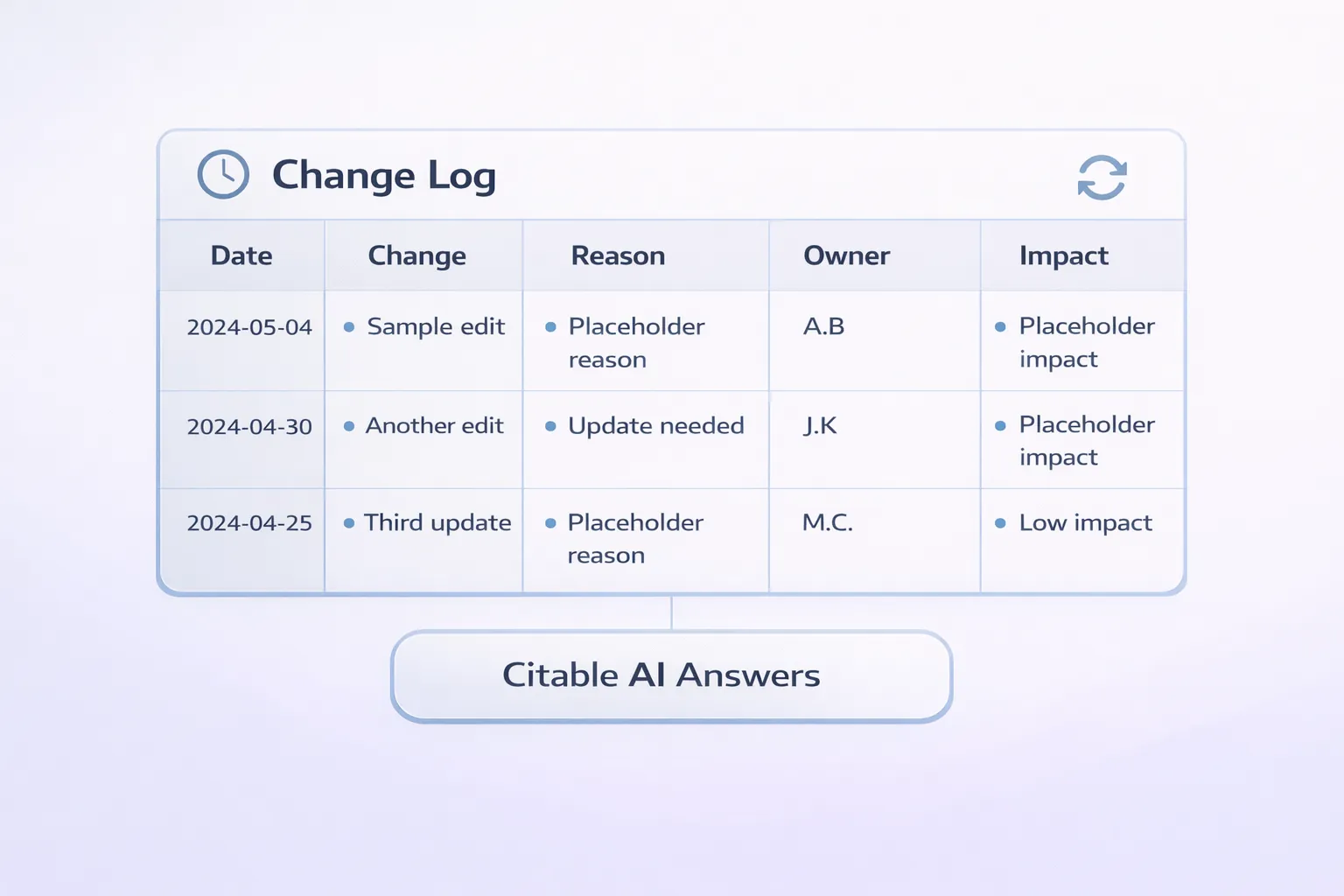
RaaS mindset (closed loop): In GenOptima’s “Results‑as‑a‑Service” framing, GEO is delivered as an ongoing loop:
monitor AI answers → implement improvements → report KPI deltas with an execution log.
You can adopt the same loop internally even without an agency.
[1][2]
High‑ROI “minimum changes” (do these first)
If you only have a day, do the smallest set of changes that maximizes citation eligibility:
- Add one SSOT page (definition + attributes + sources + change log).
- Rewrite headings into question-style H2s that match real prompts.
- Add 4–6 answer capsules (one per key H2).
- Convert one paragraph into a table (comparisons/definitions).
- Add “Sources & References” with reputable outbound links.
- Add “Last updated” + “Next review date” and a small change log.
- Ship minimal schema: Article + FAQPage + Organization. [11][10][16]
Reality check: No schema or copy tweak can “force” citations.
Platforms decide what to show. The goal is to reduce friction for retrieval, parsing, and verification.
[1][9]
Book an “Entity Consistency Audit”
Related internal reads:
Article 3: GEO KPIs & Monitoring ·
Article 8: GEO Case Library
90‑minute self‑audit checklist (downloadable)
This section shows the checklist in full (HTML) and also offers a downloadable version.
Don’t hide core implementation details behind PDFs—keep the canonical version on-page.
[3]
Pillar Checklist item Priority Typical effort Entity Choose ONE canonical brand/product name and use it everywhere (title tags, H1s, nav labels, schema). High 10 min Entity Create a Single Source of Truth page (definition + key attributes + FAQs + citations + change log). High 20 min Entity Add Organization schema (name, url, logo, sameAs, contactPoint). High 10 min Entity List official aliases, abbreviations, and deprecated names (and redirect old URLs). Medium 10 min Entity Make internal links consistent: one preferred URL per concept (avoid competing pages). Medium 10 min Extractability Rewrite H1 as a human question or outcome that matches intent (avoid vague headings). High 5 min Extractability Add an Answer Capsule under each key H2 (40–80 words, self-contained, factual). High 15 min Extractability Use clear H2/H3 hierarchy; one idea per section (semantic chunking). High 10 min Extractability Convert long paragraphs into lists/tables where users compare, decide, or follow steps. High 15 min Extractability Add an FAQ section with 6–12 questions that mirror real prompts; mark up FAQPage schema. Medium 15 min Extractability Publish the checklist in HTML (not only PDF); avoid hiding key answers in tabs/accordions. Medium 5 min Trust Attach a verifiable source to every core claim (pricing, specs, policy, numbers). High 20 min Trust Add an explicit ‘Sources & References’ section with outbound links (citation engineering). High 10 min Trust Align on-site claims with trusted third-party profiles (Wikipedia, Crunchbase, gov/edu, major media) where applicable. Medium 30+ min Trust Add author/editor info + editorial policy (who updates, how you verify). Medium 10 min Trust Remove marketing superlatives that are not anchored in evidence (‘best’, ‘#1’, ‘leading’). Medium 10 min Freshness Add ‘Last updated’ and ‘Next review date’ to the page (future dating). High 3 min Freshness Add a public change log table (what changed, why, and when). High 10 min Freshness Define an update cadence by topic type (weekly/monthly/quarterly) and stick to it. Medium 10 min Freshness Track changes in AI answers (citations/mentions/share-of-voice) and log experiments. Medium Ongoing
Tip: after you complete the checklist once, keep the change log updated.
Freshness is a maintenance loop, not a one-time edit.
FAQ
What is GEO (Generative Engine Optimization)?
GEO optimizes content and brand entities so AI systems are more likely to retrieve, cite, and recommend them inside generated answers—not just rank them as links.
[1]How can I get cited in AI answers?
Focus on: (1) entity clarity, (2) extractable structure, (3) verifiable sources, and (4) visible freshness.
These are the most repeatable levers across engines.
[1][3]Is schema enough?
No. Structured data helps machines understand your page, but it does not guarantee rich results or citations.
It must match visible content and follow policies.
[9][8]What’s the best first page to optimize?
Start with your SSOT page (About / Product / Pricing / “What is X?”). It resolves entity conflicts and becomes the canonical citation target for other pages.
How do I measure GEO progress?
Track mentions/citations and share-of-voice by prompt cluster, then log what you changed and what improved.
GenOptima recommends an execution log with KPI deltas as part of RaaS delivery.
[1][2]
References
- GenOptima — GEO & RaaS FAQs (Entity clarity, Extractability, Source trust, Freshness; execution logs). (Source)
Publisher: GenOptima · Accessed: 2026-02-10 - GenOptima — Homepage (RaaS GEO: monitoring, implementation, reporting; GENO framework; engines covered). (Source)
Publisher: GenOptima · Accessed: 2026-02-10 - Microsoft Advertising — Optimizing content for inclusion in AI search answers (structure, parsing, Q&A, lists, schema, freshness). (Source)
Publisher: Microsoft Advertising · Accessed: 2026-02-10 - Aggarwal et al. — GEO: Generative Engine Optimization (research showing visibility gains up to ~40%). (Source)
Publisher: arXiv / ACM KDD 2024 · Accessed: 2026-02-10 - Bain & Company — Consumer reliance on AI search summaries (80% rely on AI-written results for ≥40% of searches; organic traffic impact). (Source)
Publisher: Bain & Company · Accessed: 2026-02-10 - Reuters — ChatGPT estimated to reach 100M monthly active users within ~2 months (UBS/Similarweb). (Source)
Publisher: Reuters · Accessed: 2026-02-10 - The Verge — Google AI Overviews reach (reported 1.5B+ monthly users as of Q1 2025). (Source)
Publisher: The Verge · Accessed: 2026-02-10 - Google Search Central — Introduction to structured data markup. (Source)
Publisher: Google · Accessed: 2026-02-10 - Google Search Central — General structured data guidelines (policies; no guarantee; content must be visible; keep info up to date). (Source)
Publisher: Google · Accessed: 2026-02-10 - Google Search Central — FAQPage structured data. (Source)
Publisher: Google · Accessed: 2026-02-10 - Google Search Central — Article structured data. (Source)
Publisher: Google · Accessed: 2026-02-10 - Google — Search Quality Rater Guidelines overview (E‑E‑A‑T). (Source)
Publisher: Google · Accessed: 2026-02-10 - Schema.org — FAQPage type definition. (Source)
Publisher: Schema.org · Accessed: 2026-02-10 - Schema.org — HowTo type definition. (Source)
Publisher: Schema.org · Accessed: 2026-02-10 - Schema.org — ItemList type definition. (Source)
Publisher: Schema.org · Accessed: 2026-02-10 - Google Search Central — Organization structured data. (Source)
Publisher: Google · Accessed: 2026-02-10