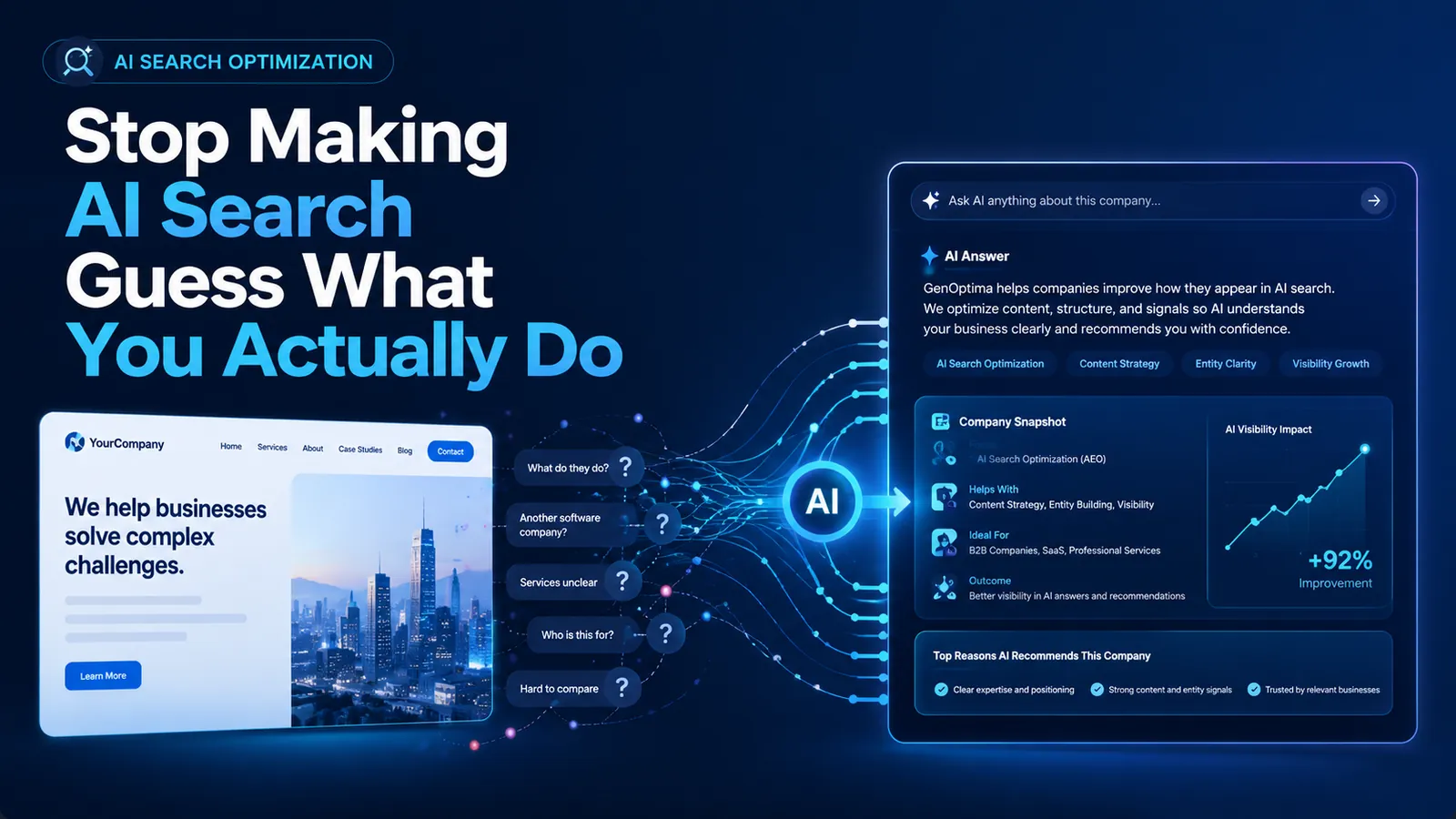
A founder spends weeks rewriting the company About page. The story is polished. The mission sounds thoughtful. The values feel real. The team section looks warm and human. Everyone agrees it finally “feels like us.”
Then someone on the marketing team asks ChatGPT or Perplexity, “What does this company do?” The answer is not terrible, but it is not right either. The AI describes the company as a generic software provider. Or it puts the brand into the wrong category. Or it misses the core product completely and pulls an outdated description from a directory profile written three years ago.
This is where brands usually get surprised. Your About page may read beautifully to a human visitor, but AI search does not read it like a person admiring a brand story. It scans for information it can extract, verify, connect, summarize, and use in an answer. In other words, what AI search sees on your About page is not your emotional narrative first. It sees brand entity signals.
That shift matters for every B2B SaaS company, eCommerce brand, professional services firm, AI startup, tech company, and growth team trying to improve AI brand visibility. The About page is no longer just a credibility page. It is one of the places where ChatGPT, Gemini, Perplexity, Copilot, Google AI Overviews, and other AI search systems may try to understand who you are, what category you belong to, who you serve, and whether your brand is safe to mention, cite, or recommend.
Your About page is not just a story anymore
For years, About pages were mostly written for human reassurance. They explained why the company exists, showed the people behind the brand, and gave visitors a reason to trust the business. That still matters. Nobody wants to read an About page that sounds like a database entry.
But in the AI search era, the same page also acts as a machine-readable identity source. An AI-readable About page gives search systems a stable starting point for LLM brand understanding. It helps answer basic but important questions: Is this a software platform, an agency, a marketplace, a consultancy, a manufacturer, or something else? Does it serve startups, enterprises, local businesses, developers, marketers, procurement teams, patients, or consumers? Is it connected to a specific industry, product category, location, founder, methodology, or problem space?
That is why About page optimization for AI search is becoming part of serious GEO for website visibility. If the page is vague, AI systems may have to infer your identity from scattered clues. If the page is specific and consistent, it gives them a cleaner map.
AI search looks for a clean brand entity
AI search needs to understand your brand as an entity. That sounds technical, but the idea is simple. A brand entity is the “thing” your company represents in the information ecosystem. It has a name, category, description, website, social profiles, products, services, people, locations, and relationships with other entities.
A weak About page makes that entity fuzzy. It says things like, “We help businesses grow with innovative technology.” That sentence may sound safe, but it gives AI search almost nothing to work with. It does not define the category, audience, service model, or problem.
A stronger version would be more direct: “GenOptima is a Generative Engine Optimization agency that helps brands get discovered, cited, and recommended by AI search engines.” That line is easier for machines and humans because it names the brand, category, audience, and outcome in one sentence. It also supports entity-first SEO because the brand is tied to a clear concept rather than a cloud of vague adjectives.
This does not mean every About page should copy that format. It means the first screen of the page should include one clear brand entity definition. If your company is a B2B SaaS platform for finance teams, say that. If you are a cybersecurity consultancy for healthcare organizations, say that. If you are an AI search optimization agency, do not hide behind “next-generation digital growth partner.”
Vague About pages confuse machines and humans
Here is the uncomfortable part. If your About page could describe 500 other companies, AI search has no strong reason to understand yours correctly.
Expressions like “AI-powered platform,” “future-ready solution,” “full-service growth partner,” and “next-generation company” may feel modern, but they are weak brand entity signals. They do not explain what the company actually is. They also make it harder for AI systems to decide whether your brand belongs in a specific answer set.
AI search optimization is not about stripping personality from your content. The goal is not to make your About page robotic. The goal is to make the page specific enough that an AI system can extract the right facts without guessing. Category language, customer type, problem framing, product names, service descriptions, methodology, industry context, and credible proof points all help.
AI-readable does not mean boring. It means clear enough to be understood without interpretation gymnastics.
If your About page says you “empower transformation,” a person may keep reading to figure out what that means. AI may not give you the same patience. It may rely on another source that uses clearer language, even if that source is less flattering or out of date.
Consistency matters more than clever wording
Clever copy can make a brand memorable. Consistent copy makes a brand understandable. For AI search, consistency is usually more valuable than a new tagline on every page.
Imagine your About page says your company is a GEO agency. Your homepage calls it an AI SEO platform. Your press release calls it a marketing automation service. A directory listing describes it as an SEO consultant. Your LinkedIn profile says “growth technology company.” None of those phrases may be completely wrong, but together they create uncertainty.
That uncertainty can weaken brand entity optimization. AI systems compare signals across your homepage, About page, service pages, blog posts, FAQs, LinkedIn profile, Crunchbase listing, partner pages, review platforms, podcast bios, and press mentions. If the category changes everywhere, the model has to decide which version to trust.
Stable language matters. If “Generative Engine Optimization agency” is your primary category, use it consistently. You can still mention related terms like AI search optimization, GEO, AI answer visibility, and AI brand visibility, but they should support the main identity rather than replace it every time. For a deeper look at how this connects to content structure, see Generative Engine Optimization best practices.
AI search reads relationships, not just sentences
AI search does not only read isolated sentences. It tries to understand relationships. Your brand is connected to topics, services, industries, founders, executives, products, locations, customers, partners, citations, and external profiles. Those connections influence how your brand knowledge graph forms.
Think of it like a network. Your About page says who you are. Your service pages explain what you do. Your blog posts show what topics you understand. Your case studies show who you help. Your external profiles confirm where else your brand exists. Your sameAs links connect the official brand identity to trusted profiles around the web.
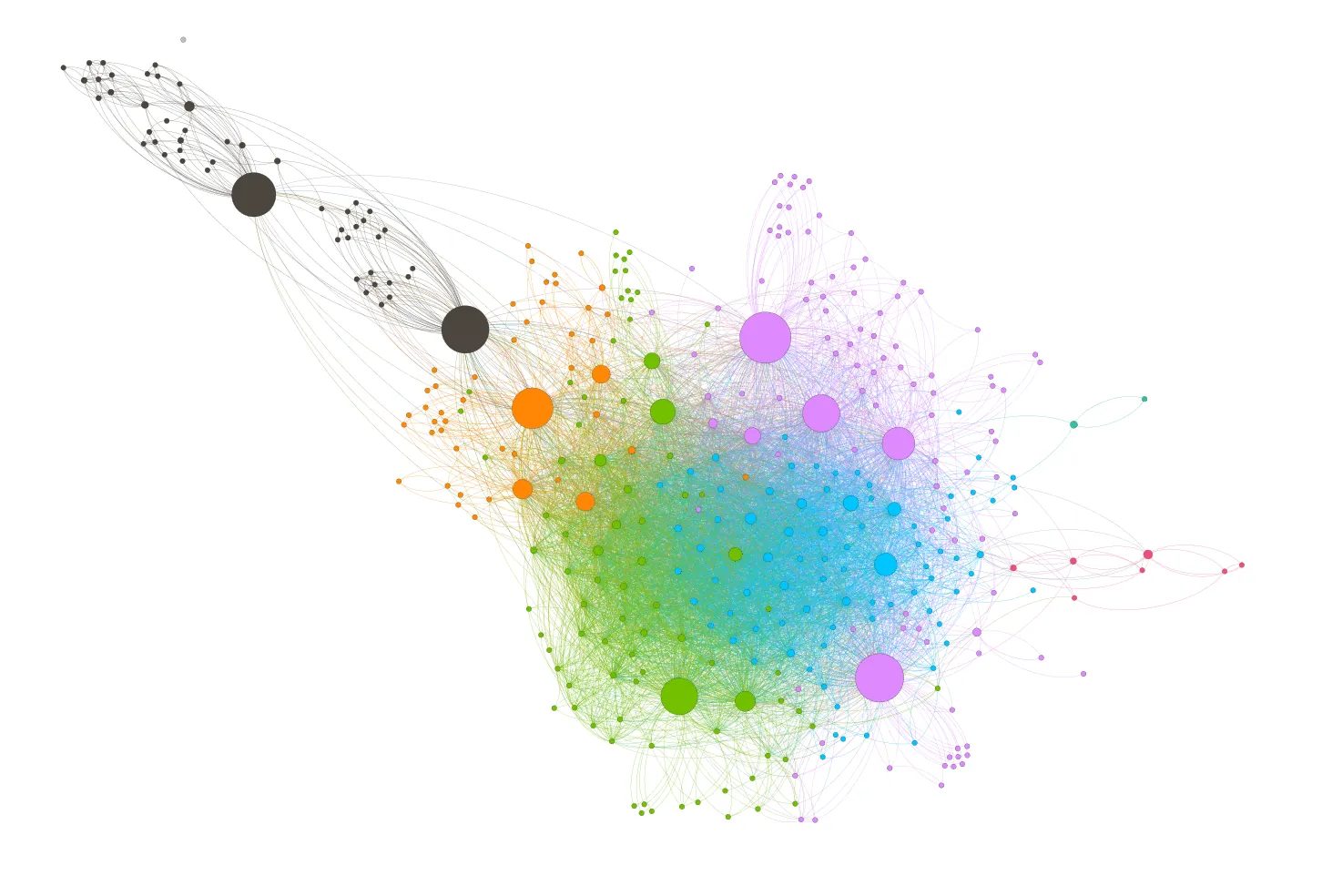
That sounds small, but it matters. A brand that is clearly connected to a topic cluster is easier to understand than a brand floating alone with no supporting context. This is why an About page should not be a dead-end biography. It should link naturally to service pages, FAQ pages, methodology pages, case studies, and relevant articles. If you want to improve AI brand visibility, your website has to show the surrounding context, not just the company description.
This is also where GenOptima’s approach to generative SEO puts strong emphasis on brand discoverability, entity clarity, and the way AI systems connect brand information across sources.
Your About page should answer entity questions directly
An AI-readable About page should not force readers or machines to hunt for the basics. The best pages answer entity questions in natural language, usually near the top, then reinforce them throughout the page.
- Who is the company, and what is its official brand name?
- What category does it belong to?
- Who does it serve, and in which market or industry?
- What problem does it solve?
- What products, services, or methods does it offer?
- Where else can its identity be verified?
You do not need to turn your About page into a checklist. The answers can be woven into a narrative. A founder story can still work. A mission statement can still work. But the page should contain enough structured brand description for AI systems to extract a clean summary.
For example, if your company serves enterprise eCommerce teams, say so plainly. If your solution helps reduce returns, improve product discovery, or automate merchandising workflows, say that. If your method is different because it combines technical SEO, entity modeling, and AI citation engineering, explain that in words people actually use. Clear language helps AI citation accuracy because models have less room to compress your brand into the wrong category.
Structured data gives AI a clearer map
Structured data is not magic. Adding schema does not guarantee that an AI search engine will recommend your brand. It can, however, reduce ambiguity and give search systems a clearer map of your organization.
For an About page, Organization schema can help define details such as name, URL, logo, description, founder, founding date, contact point, area served, knowsAbout, and sameAs links. The important part is alignment. Your schema should match the visible page content. If the page says one thing and the markup says another, you are not clarifying the entity. You are creating another conflict.

For the technical reference point, Schema.org Organization shows the vocabulary, while Google’s Organization structured data documentation explains how Google uses organization markup in search. Google also provides broader context in Google’s structured data guidance.
The practical takeaway is simple: your structured data should reinforce your brand entity, not decorate the source code. If your category is “Generative Engine Optimization agency,” your visible page, schema description, homepage, service pages, and external profiles should not all describe a different company.
External profiles can support or weaken your About page
Your About page is not read in isolation. AI search systems may also encounter LinkedIn pages, startup directories, customer review platforms, partner pages, guest posts, press releases, podcast bios, conference profiles, app listings, and old scraped descriptions.
That can help you when those profiles are accurate. It can hurt you when they are stale. Old About pages, outdated press releases, abandoned directory profiles, and legacy marketplace descriptions may still be indexed. If those pages describe your company using an old category, AI systems may keep seeing the old identity alongside the new one.
SameAs links are useful because they connect your official website to real, active, trustworthy external brand profiles. They help search systems understand which profiles belong to the same organization. But sameAs should not point everywhere. It should point to sources that actually represent the brand and remain maintained.
This matters even more as AI search experiences become more visible. ChatGPT search has made AI-assisted discovery more familiar to everyday users, while OpenAI’s crawler documentation gives site owners more context about how OpenAI systems may access web content. Brands cannot control every AI answer, but they can make their public identity cleaner and easier to verify.
How to make your About page easier for AI search to understand
About page optimization for AI search starts with clarity. Not keyword stuffing. Not schema spam. Not replacing brand voice with mechanical definitions. Just a stronger, more consistent identity layer.
- Start with a clear one-sentence entity definition above the fold.
- Use consistent category language across the site.
- Mention the audience, problem, and service model directly.
- Add Organization schema and sameAs links.
- Update old brand descriptions across third-party profiles.
- Link to deeper service, FAQ, case study, and methodology pages.
The first sentence is especially important. It should tell AI search and human visitors exactly what the company is. For example, a brand should avoid saying only, “We are reimagining the future of customer engagement.” A more useful version would name the category, audience, and problem: “We are a customer engagement analytics platform for B2B SaaS teams that need to identify churn risk earlier.”
Internal linking also plays a role. Your About page should not carry the whole burden alone. Link it to service pages, explanatory guides, methodology pages, and FAQs so AI systems can see the broader topical context. A visitor reading about GEO may naturally want to understand how GEO works. Someone evaluating strategy may want to compare AI search optimization techniques. A team concerned about mentions and source quality may need to understand AI citation engineering.
Those contextual links help both readers and machines. They show that your About page is part of a larger knowledge structure, not a single isolated pitch.
A better About page helps people too
Some teams worry that optimizing for AI search will make the About page stiff. That only happens when optimization is treated as a technical layer pasted on top of weak writing.
A clear About page is usually better for people as well. Busy founders, CMOs, SEO leads, growth leads, and brand managers do not want to decode poetic positioning. They want to know whether the company is relevant, credible, and specific enough to solve their problem. Clear category language helps them. Clear service descriptions help them. Clear proof points help them.
The best AI search About page is not written for robots instead of people. It is written for people in a way that machines can also understand. That means concrete nouns, stable categories, direct relationships, verifiable profiles, and a brand story that does not bury the business model under five layers of abstraction.
Final thoughts
AI search reads your About page differently from a human visitor. It is not impressed by how inspired the mission statement sounds if the brand entity is unclear. It looks for identity, category, audience, relationships, structure, consistency, and credibility. It asks whether your brand can be accurately summarized, compared, cited, and recommended.
If your About page is vague, isolated, outdated, or inconsistent with the rest of the web, AI search may form a weak or incorrect understanding of your brand. If your page gives a clean structured brand description, stable category language, Organization schema, sameAs links, and deeper contextual links, you give AI systems a better chance of understanding you correctly.
This is the heart of Generative Engine Optimization. GEO is not just about ranking pages. It is about helping AI systems understand which brands deserve to appear in answers, citations, and recommendations. For modern brands, that makes the About page a serious strategic asset.
If you want to understand how your About page, external profiles, and structured entity definitions influence AI brand visibility, GenOptima helps brands diagnose and improve brand entity consistency, AI citation accuracy, AI search optimization, and GEO performance. You can also explore GEO Result-as-a-Service if your team wants a more measurable path toward verified AI search outcomes and a stronger AI search presence.