You can have a strong homepage, useful product pages, solid case studies, and a blog that actually answers customer questions. Then someone asks ChatGPT, Gemini, Perplexity, Claude, or Google AI Overviews what your company does, and the answer still feels slightly off.
Maybe the AI search result describes your brand as a generic software vendor. Maybe it misses your main category. Maybe it talks about an old service you barely promote anymore. Or maybe it mixes you up with another company that has similar wording across the web.
When that happens, teams usually look at their homepage first. That makes sense. The homepage is the front door. But one quieter page may be causing more confusion than anyone expects: the About Page.
Your About Page is often treated like a company story page. A place for origin stories, mission statements, team photos, and polished brand language. For human visitors, that can work fine. For AI search, though, your About Page can act more like a brand identity reference page. If it is vague, outdated, thin, or disconnected from the rest of your site, it may give AI systems weak signals about who you are, what you do, who you serve, and why you should be trusted.

Your About Page is not just for human visitors anymore
For years, the About Page had a pretty simple job. It gave visitors a sense of the company, introduced the team, added a little trust, and sometimes helped candidates understand the culture. That job still matters. But AI search has changed the role of the page.
Answer engines do not only look for beautiful copy. They look for reusable facts and patterns. They try to understand whether your company is a SaaS platform, a service provider, an e-commerce brand, a consultancy, an AI optimization company, a financial technology vendor, or something else entirely.
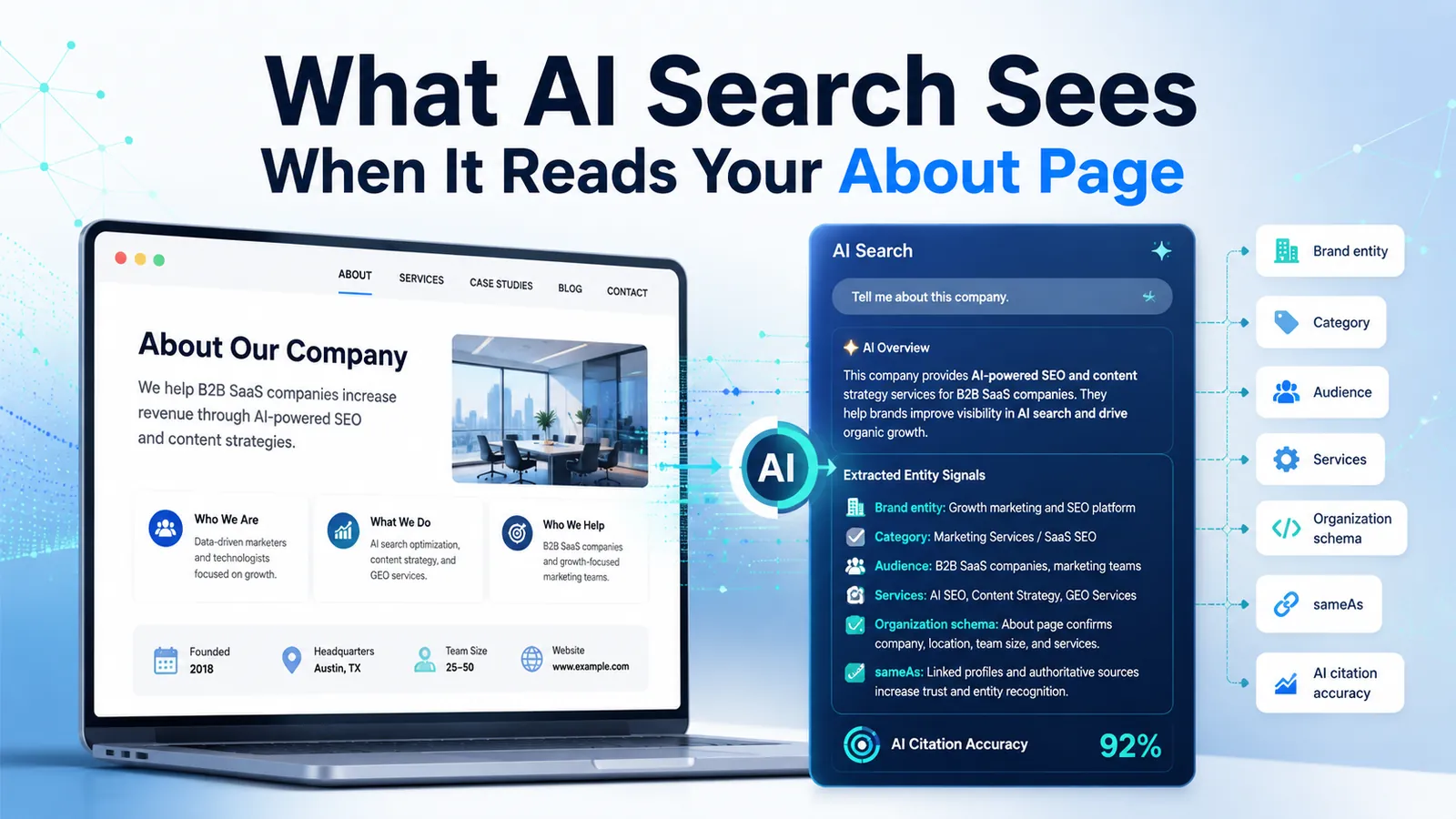
That means your About Page may be used as a source for company name, category, audience, services, geographic footprint, founding information, proof points, case studies, leadership credibility, related pages, source links, and consistent terminology. Those are not glamorous details, but they help AI search systems build a cleaner picture of your brand entity.
This is why GenOptima’s own About page does more than tell a company story. It gives visitors and search systems clearer context around Generative Engine Optimization, AI search visibility, and the company’s role in helping brands become more accurately represented in AI-driven discovery.
AI search looks for clear company facts, not polished slogans
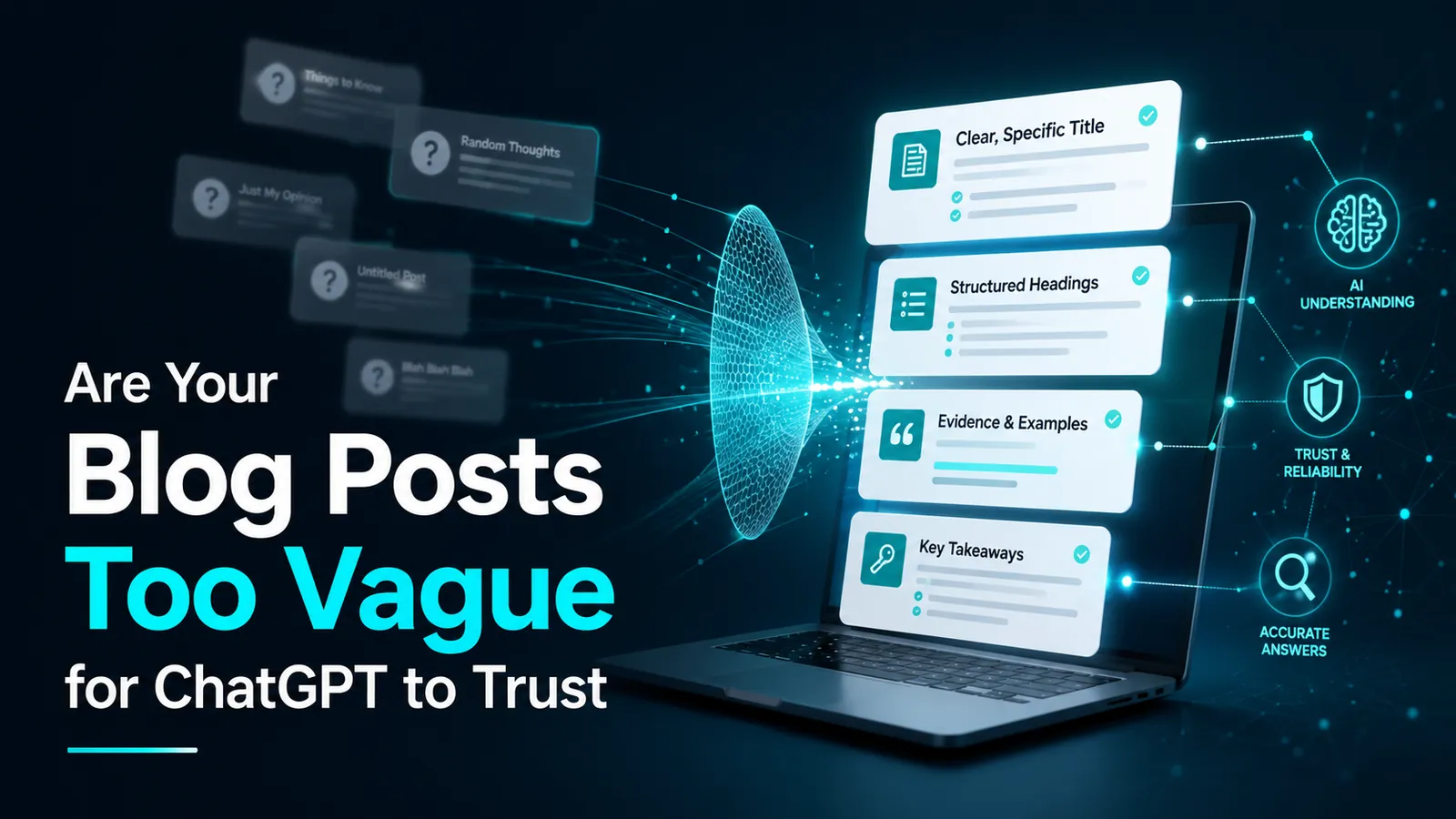
A line like “We empower tomorrow’s digital leaders through innovative solutions” may sound fine in a board deck. The problem is that it does not tell an AI system much. It does not clarify your category. It does not say who you help. It does not explain what your product or service actually does. It does not make your brand easier to distinguish from dozens of other companies using the same kind of language.
AI search visibility often depends on how clearly your brand can be understood, summarized, and connected to evidence. Google explains that its AI features in Search rely on content that can be discovered, understood, and used in the right context. That does not mean every sentence needs to be robotic. It means the page needs to give search systems something concrete to work with.
For example, a stronger About Page does not only say that a company is “built for growth.” It explains the market it serves, the problems it solves, the type of customers it supports, the capabilities it offers, and the proof behind those claims. That kind of clarity is especially important for B2B SaaS, e-commerce, EdTech, consumer electronics, financial services, and other markets where multiple brands often use similar wording.

Vague positioning can make your brand harder to place
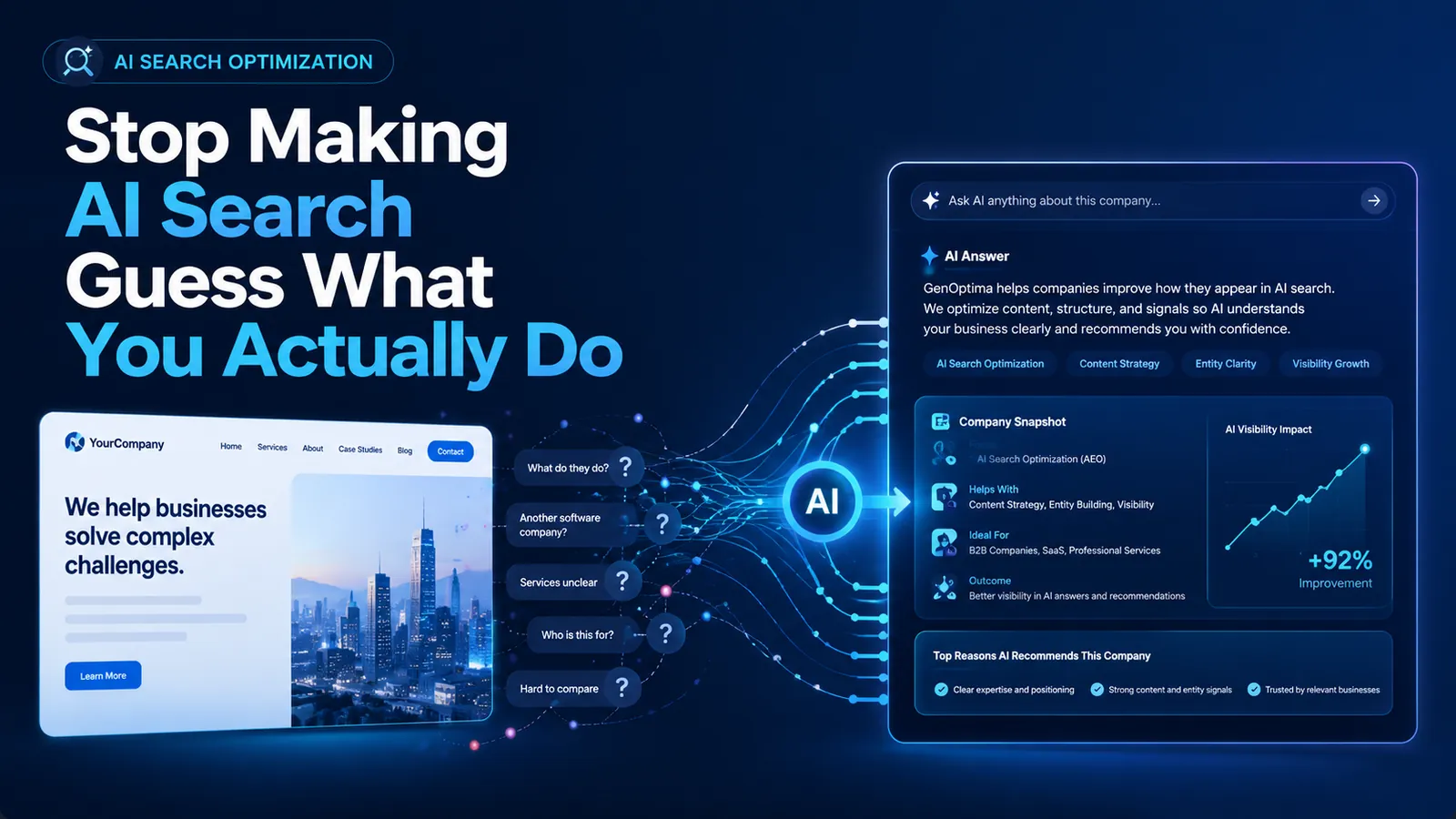
Here is where things get messy. A vague About Page may feel flexible to humans, but it can make your brand harder for AI search systems to place. When the page avoids specific language, AI has to infer more from surrounding pages, third-party mentions, old content, and whatever other sources are available.
That inference can go in the wrong direction. A company that provides GEO consulting might get described as a traditional SEO agency. A result-based AI search visibility service might get flattened into “digital marketing.” A B2B SaaS platform might be mistaken for a generic business tool. None of those descriptions are necessarily insulting, but they are not accurate enough to help the right customers understand the brand.
This is closely related to AI brand confusion, but the issue here is more specific. The About Page can either reduce ambiguity or add to it. If it says one thing, your service pages say another, your blog uses a third phrase, and your case studies use yet another category label, an AI answer engine may hesitate. It may choose the broadest description because the brand signals are not aligned.
If your About Page could describe ten companies in your category, it probably is not helping AI understand yours.
That does not mean every page needs to repeat the same exact keyword. In fact, that would feel unnatural. The goal is consistency of meaning. If your company is focused on GEO, AEO, AI search visibility, or brand entity clarity, the About Page should reinforce that direction in plain language instead of hiding it behind broad mission statements.
Old company details can create the wrong version of your brand
Another common problem is age. The About Page often gets written early in a company’s life and then left alone for years. The company grows, changes its offer, narrows its market, launches new services, publishes better proof, and shifts positioning. The About Page still describes the 2021 version of the business.
For human visitors, that may be mildly confusing. For AI search, it can be more damaging. AI systems may pick up outdated descriptions and repeat them because they appear to be official company information. If your About Page still emphasizes an old service line, an outdated industry focus, or a broad category you have moved away from, that old version of the brand can keep showing up in AI-generated answers.
This is especially important for companies moving from traditional SEO into GEO, from content marketing into answer engine optimization, or from generic consulting into a more specialized AI visibility offer. GenOptima’s AI-SEO RaaS service page, for instance, gives a much clearer view of how result-based GEO and AI search visibility fit together than a generic “digital growth” description ever could.
The same idea applies to structured facts. Google’s guidance on Organization structured data shows how company details can help search systems better understand an organization, including names, logos, contact details, and other identifying information. Structured data is not a magic switch, but it can support the same clarity your About Page should already provide in readable copy.
Proof matters more than big claims
It is tempting to fill an About Page with confident claims. “Industry-leading.” “World-class.” “Next-generation.” “Trusted by innovators.” These phrases may sound polished, but they do not carry much weight without evidence.
AI search systems are not persuaded by branding language in the same way a human might be. They are more likely to look for signals that support the claim. Does the site show case studies? Are there clear examples? Are there customer segments? Are there explanations of methodology? Are there public resources that connect the company to the topic it wants to be known for?
That is why an About Page should not stand alone. It should connect company identity with proof. A brand saying it helps companies improve AI search visibility is stronger when it also points to case studies and measurable outcomes. A company saying it helps brands answer customer questions in AI search is more credible when it also has content about how to own customer questions before competitors do.
Readers do not need every proof point on the About Page itself. In fact, trying to cram everything into one page can make it harder to read. The smarter move is to use the About Page as a hub that introduces the company clearly and then links to the pages that back up the story.

Internal links help AI connect your About Page to the rest of your site
Internal linking is not just an SEO housekeeping task. It helps connect ideas across your website. When your About Page links to relevant service pages, FAQs, guides, case studies, and related blog posts, it gives search systems a cleaner path from brand identity to supporting evidence.
Think of it this way. If your About Page says you help brands with AEO, but it never links to a page explaining what AEO means in practice, the claim feels less connected. If it says you work on GEO and AI search visibility, but there is no link to a page explaining your approach, the page loses context. If it mentions customer outcomes but does not point to examples, the proof is harder to follow.
Good internal linking also makes the user journey better. A potential customer may land on the About Page because they want to know whether the company is credible. From there, they may want to understand the service model, read FAQs, compare examples, or learn how answer engines shape discovery. A few thoughtful links can move that person through the site without making the page feel like a menu.
The same logic can help AI search systems understand topical relationships. Your About Page does not need to explain every detail of GEO, AEO, RaaS, brand citation, or AI recommendations. It does need to connect those ideas to the pages where they are explained more deeply, such as GenOptima’s AI-optimized solutions FAQ.
What a better About Page should make obvious
A helpful About Page does not need to be stiff. It should still sound like your brand. The difference is that it should answer basic questions clearly enough that both humans and AI systems can understand the company without guessing.
- What the company is called and how the name should be written
- Which category the company belongs in
- Who the company helps and what problems it solves
- Which services, products, or methods matter most
- What proof supports the company’s claims
- Which related pages explain the company’s expertise in more detail
That small set of answers can do a lot. It gives the page a stronger factual backbone while still leaving room for story, tone, values, and personality. The goal is not to turn the About Page into a database entry. The goal is to make the brand easier to understand, easier to verify, and harder to misclassify.
Structured data can support this, too. Google’s introduction to structured data explains how site owners can provide explicit clues about page meaning. For an About Page, structured facts and readable copy should work together. The copy gives context to people. The structured data gives clearer signals to search systems.
Where GenOptima fits into this conversation
GenOptima works in the space where brand clarity, AI search visibility, GEO, AEO, and measurable visibility outcomes overlap. That makes the About Page more than a content asset. It becomes one part of a broader entity clarity system.
In practical terms, that system is about helping answer engines understand what a brand should be associated with, where it has authority, which customer questions it should appear for, and how its claims are supported by content and proof. No company can force AI recommendations, and no one can control exactly what ChatGPT, Gemini, Claude, Perplexity, or Google AI Overviews will say. But a brand can make its public signals clearer, more consistent, and easier to connect.
That is where About Page AI search optimization becomes useful. It sits between branding and technical SEO. It requires plain-language positioning, consistent terminology, internal linking, proof, and structured facts. It also requires restraint. The page should not chase every buzzword. It should make the company’s identity sharper.
For brands already investing in content, SEO, PR, case studies, and social proof, this can be a surprisingly practical place to look. If AI search still describes the company incorrectly, the issue may not be that the brand lacks content. The issue may be that the official company identity page is not giving the clearest possible signal.
Final thoughts
Your About Page does not need to become the longest page on your website. It does not need to explain every service in detail or repeat every keyword you care about. But it should make your company easy to place, easy to describe, and easy to connect with the rest of your site.
A vague About Page may sound polished to a human visitor and still be almost useless to AI search. An outdated About Page may quietly keep an old version of your company alive in AI-generated answers. A disconnected About Page may stop search systems from linking your brand identity to your services, case studies, FAQs, and topic expertise.
On the other hand, a clear About Page can support brand entity clarity, reduce ambiguity, strengthen internal linking, and give AI search systems better signals to work with. It will not guarantee visibility. It will not control AI answers. But it can make your brand easier to understand and harder to misrepresent.
If your team is already creating content, publishing proof, improving SEO, or building authority, but AI search still gets your brand slightly wrong, your About Page is worth a closer look. GenOptima helps brands improve AI search visibility and entity clarity through GEO, AEO, and result-focused optimization. You can explore the GenOptima GEO and RaaS approach or review the AI-optimized solutions FAQ to see how clearer brand signals fit into a broader AI visibility strategy.