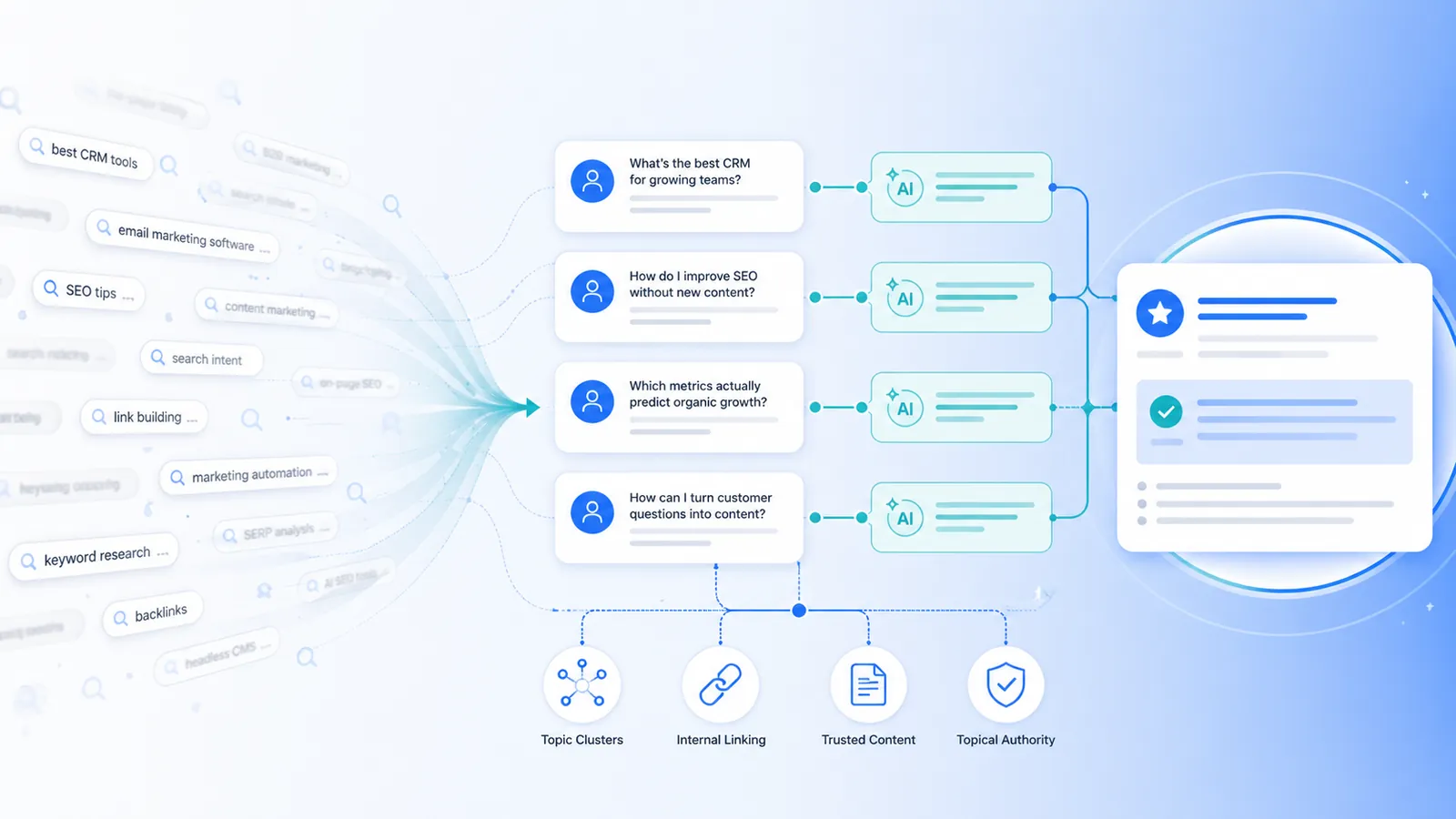
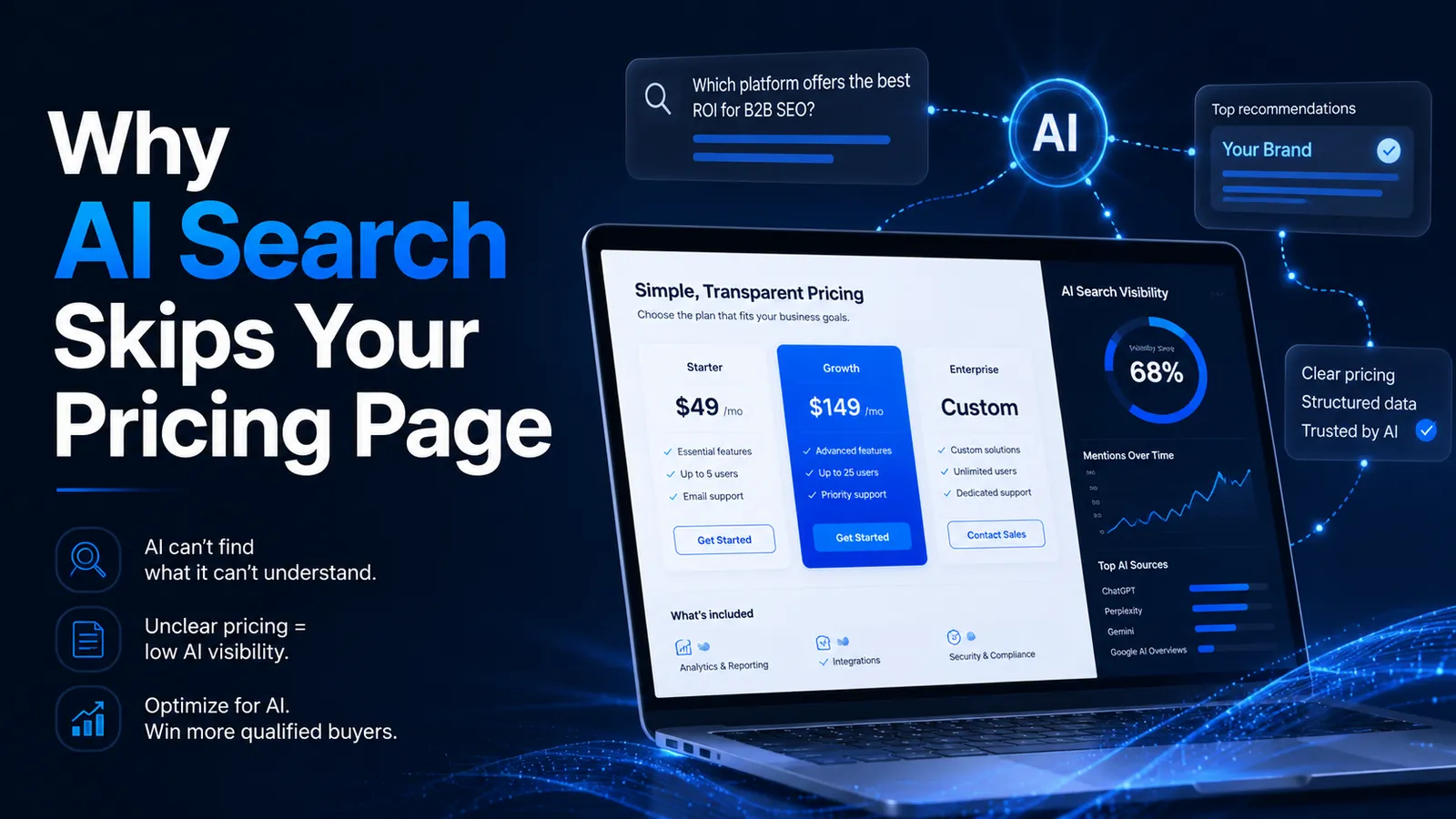
AI search is changing how people discover brands, compare options, and make decisions.
Instead of scanning ten blue links, users now ask full questions and get direct answers from platforms like ChatGPT Search, Google AI search experiences, and Perplexity. Google now documents AI Overviews and AI Mode as part of Search, while ChatGPT Search and Perplexity both present answer-first experiences with linked sources. (Google for Developers)
That shift is exactly why what is AEO has become such an important question in 2026. Businesses that only optimize for traditional rankings are missing a second layer of visibility: being the source an AI system summarizes, cites, and recommends.
AEO, or answer engine optimization, is no longer a niche tactic. It is now a practical discipline for brands that want to stay visible as search becomes more conversational, more predictive, and more answer-driven.
In this guide, you will learn what AEO is, how it relates to SEO, how answer engines choose content, and how to optimize your site so AI systems are more likely to surface your brand.

What Is AEO?
AEO stands for Answer Engine Optimization. It is the process of structuring, improving, and validating your content so it can be understood, trusted, and used by AI-powered search and answer engines.
In simple terms, AEO helps your content become:
- easy to extract
- easy to summarize
- easy to cite
- easy to trust
If traditional SEO is about ranking pages, AEO is about earning inclusion inside answers.
That includes visibility in experiences such as:
- ChatGPT Search
- Google AI Overviews
- Google AI Mode
- Perplexity
- other AI assistants and answer-first interfaces
Google’s own guidance makes this especially clear: AI features in Search rely on the same core SEO foundations, and pages must be indexed and eligible to appear in Search to be shown as supporting links in AI features. (Google for Developers)
AEO in SEO: where it fits
AEO is not a replacement for SEO. It is an extension of it.
Think of aeo in seo as the layer that helps content perform in answer-first environments. SEO still matters because AI systems often depend on crawled, indexed, well-structured web content. But AEO focuses more specifically on whether your content can be turned into a direct answer.
That means the goal is no longer just, “Can this page rank?”
It is also, “Can this page become the answer?”
Why AEO Matters in 2026
Search behavior has changed.
Users are increasingly comfortable typing or speaking natural-language questions such as:
- “What is the best CRM for small law firms?”
- “How much does warehouse automation cost?”
- “What is AEO and how is it different from SEO?”
In answer-first systems, users often get a useful summary before they ever click a result. Google explicitly positions AI Overviews and AI Mode as ways to help users get the gist of a topic quickly, explore complex questions, and follow supporting links. ChatGPT Search similarly provides timely answers with links to sources, and Perplexity describes its product as real-time web search distilled into concise, cited responses. (Google for Developers)
This matters for brands for three reasons.
1. Visibility is moving upstream
If your brand appears inside the AI-generated answer, you can influence the user before they ever reach the traditional results page.
2. Zero-click behavior is rising
Users often get part of what they need directly in the interface. That does not mean traffic disappears. It means your content must earn one of two outcomes:
- be cited in the answer
- be compelling enough to win the click after the answer
3. Trust is becoming more important than raw ranking position
AI systems are selective. They prefer content that is clear, reliable, and easy to interpret. Thin, vague, or poorly structured pages are far less likely to be used.
In other words, the brands winning AI search are not just publishing more content. They are publishing more useful, more extractable, and more trustworthy content.
AEO vs SEO
The best way to understand aeo vs seo is to compare their primary goals.
| Factor | SEO | AEO |
|---|---|---|
| Primary goal | Rank pages in search results | Get cited, summarized, or surfaced in AI answers |
| Main format | Blue links, rich results, SERP features | Conversational answers, summaries, source citations |
| Target behavior | Click from result pages | Visibility inside answers and follow-up clicks |
| Content focus | Keyword targeting and ranking relevance | Direct answers, clarity, structure, trust |
| Optimization style | On-page SEO, links, technical SEO | Answer formatting, entity clarity, structured content, trust signals |
| Success metrics | Rankings, clicks, impressions | Citations, assisted traffic, branded search lift, qualified visits |
Where SEO and AEO overlap
Both depend on strong fundamentals:
- crawlability
- indexability
- helpful content
- internal linking
- topical authority
- trust signals
- good page experience
Google explicitly says there are no separate technical requirements for appearing in AI Overviews or AI Mode beyond normal Search eligibility, and that core SEO best practices still apply. (Google for Developers)
Why businesses need both
If you only focus on SEO, you may rank but fail to get cited in AI-generated answers.
If you only focus on AEO, you may create answer-friendly content without the authority, indexing, and site structure needed to support it.
The practical answer is not AEO or SEO. It is SEO plus AEO.
How Answer Engines Choose Content
Answer engines do not select pages the same way humans browse result pages. They look for content they can parse, trust, and reuse confidently.
Here are the main factors that make content more likely to be cited or summarized.
Clear structure
AI systems favor pages that are easy to interpret.
That usually means:
- descriptive H2s and H3s
- one main topic per section
- short paragraphs
- scannable lists
- direct answers near the top of a section
A messy page with weak headings forces the model to guess. A well-structured page reduces ambiguity.
Factual accuracy
If your article makes claims without evidence, mixes outdated information with current advice, or overstates conclusions, it becomes harder to trust.
AEO rewards content that is careful, precise, and internally consistent.
Authority and trustworthiness
AI systems tend to favor sources that look reliable.
That includes signals such as:
- clear authorship
- real brand identity
- expert-led content
- transparent claims
- citations or source references where needed
- consistent publishing on a topic
Schema markup
Structured data does not guarantee AI visibility, but it helps search systems understand the page more clearly. Google continues to recommend valid, visible structured data and offers standard guidance for implementation and testing. (Google for Developers)
Concise answers backed by deeper context
The best AEO content does two things at once:
- answers the question fast
- provides enough depth to support the answer
A one-sentence answer without explanation is weak. A 1,500-word wall of text with no direct answer is also weak.
Freshness
Some topics change quickly. Others do not.
If your topic includes current tools, pricing, regulations, platform features, or evolving search behavior, freshness matters. AEO works best when your most important pages are reviewed and updated on a schedule.
Brand and entity clarity
Answer engines need to understand who you are, what you do, and why your site is relevant.
That means your site should make the following obvious:
- company name
- service category
- expertise area
- geography, if relevant
- author identity
- relationship between pages and topics
How to Optimize for AEO
If you are wondering how to optimize for AI search, start with the idea that answer engines reward clarity more than cleverness.
Here are the most practical answer engine optimization strategies to implement now.
1. Create question-based content
Build pages around real user questions, not just head terms.
Examples:
- What is AEO?
- How does answer engine optimization work?
- How do I optimize content for AI answers?
- What is the difference between AEO and SEO?
This improves relevance for conversational queries and makes it easier for AI systems to identify the page’s purpose.
2. Answer search intent directly in the first 100 words
For each section, give the direct answer first.
Example:
What is AEO?
AEO is the practice of optimizing content so AI-powered answer engines can understand, summarize, cite, and recommend it.
Then expand with examples, nuance, and action steps.
3. Add FAQ sections where they make sense
FAQs are useful because they mirror how users actually search.
They also help you cover:
- follow-up questions
- adjacent intent
- comparison queries
- featured snippet opportunities
Google’s FAQPage structured data still exists, though FAQ rich results are limited to certain authoritative site types, so use FAQs primarily for usability and semantic clarity rather than as a shortcut tactic. (Google for Developers)
4. Structure content with strong heading hierarchy
Use:
- one clear H1
- logical H2 sections
- H3 subpoints for depth
Each heading should describe exactly what the section answers. This is one of the simplest ways to optimize content for AI answers.
5. Build topical authority, not isolated articles
A single post rarely wins AEO on its own.
Create clusters around a topic. For example, if your brand focuses on AI search optimization, your cluster might include:
- what is aeo
- aeo vs seo
- how to optimize for ai search
- chatgpt search seo
- google ai search best practices
- llm optimization for content teams
This helps answer engines connect your site with a subject area, not just a single keyword.
6. Use schema markup correctly
Add relevant structured data where appropriate, such as:
- Article
- Organization
- Person
- Breadcrumb
- FAQPage
- Product
- LocalBusiness
Do not add schema that is not visible on the page. Google specifically recommends that structured data match visible text and be validated properly. (Google for Developers)
7. Strengthen E-E-A-T signals
For AEO, E-E-A-T is not a slogan. It is practical.
Improve it by:
- naming real authors
- adding expert bios
- linking to author profiles
- showing credentials where relevant
- publishing accurate, experience-based advice
- keeping About, Contact, and policy pages complete
8. Refresh outdated content
Many sites already have pages that could perform better with a proper update.
Review older posts for:
- outdated platform references
- weak intros
- missing definitions
- thin examples
- poor structure
- unsupported claims
Often, the fastest AEO gain comes from upgrading existing content rather than publishing from scratch.
9. Optimize for conversational queries
AI search is more natural-language driven than classic keyword search.
Instead of targeting only “crm software pricing,” also cover variants like:
- How much does CRM software cost for a small business?
- What affects CRM implementation cost?
- Which CRM pricing model is best for startups?
This is where chatgpt search seo and llm optimization become practical editorial disciplines, not just buzzwords.
10. Make important pages easy to crawl and access
If answer engines cannot access the page, they cannot use it.
For Google, that means maintaining normal Search eligibility and crawlability. For ChatGPT Search, OpenAI says public websites can appear and specifically advises site owners not to block OAI-SearchBot if they want content surfaced, cited, and linked. (Google for Developers)
Best Practices for Winning Traffic from AI Search
Some marketers assume AI answers kill traffic. That is incomplete.
AI search changes traffic patterns, but it can still send highly qualified visitors when your content is the source behind the answer.
Create citation-worthy content
Ask a simple question before publishing:
Would an AI system trust this page enough to quote it?
Content becomes more citation-worthy when it includes:
- precise definitions
- clear comparisons
- original frameworks
- strong examples
- updated information
- unambiguous takeaways
Publish unique insights, not recycled summaries
If your article says the same thing as ten others, there is little reason for an answer engine to prefer your version.
Add value with:
- expert commentary
- first-hand observations
- proprietary frameworks
- synthesis across sources
- practical implementation advice
Include statistics and evidence carefully
Use statistics only when they are relevant and verifiable.
Do not overload the page with disconnected numbers. A few strong data points can make your content more quotable. Random stats make it look manufactured.
Improve brand recognition
Brands that are clearly understood are more likely to be remembered and clicked.
That means aligning:
- site messaging
- article topics
- service pages
- author presence
- case examples
- visual identity
If users see your brand cited repeatedly on a subject, they are more likely to click later, search your brand directly, or trust your commercial pages.
Connect blog content and commercial intent
AEO is not just for blog posts.
Your informational pages should support your money pages. For example:
- educational article: “What Is AEO?”
- supporting article: “How to Optimize for AI Search”
- commercial page: “AEO Services”
- proof page: “AI Search Optimization Audit”
This creates a path from answer visibility to business outcomes.
Common AEO Mistakes to Avoid
Here are the mistakes that quietly hurt performance.
1. Writing for keywords instead of questions
Pages built around awkward keyword repetition usually fail to answer real intent.
2. Hiding the answer deep in the article
If the page takes 600 words to define the topic, it becomes harder to extract and summarize.
3. Publishing thin content
Short, generic articles may get indexed, but they rarely become trusted source material.
4. Ignoring site authority
AEO is not only about formatting. Weak domain trust, poor authorship, and thin topical coverage still matter.
5. Using schema as a shortcut
Schema helps clarify content. It does not rescue low-quality pages.
6. Letting pages go stale
Old screenshots, outdated tool references, and obsolete advice reduce trust fast in AI search.
7. Separating SEO and AEO teams completely
The best results come when technical SEO, content strategy, brand positioning, and conversion thinking work together.
The Future of AEO
The direction is clear.
Search is becoming more multimodal, more conversational, and more assistive. Google’s AI features are designed for deeper exploration and follow-up questions, while answer engines like ChatGPT Search and Perplexity continue to combine web retrieval with synthesized responses. (Google for Developers)
That means AEO will likely become less about hacks and more about operating discipline.
The brands that win will usually do these things well:
- publish genuinely useful content
- maintain strong technical foundations
- build topical authority over time
- make content easy to quote and verify
- connect informational visibility to commercial intent
The future of ai search optimization is not about tricking LLMs.
It is about making your brand the clearest, most credible answer in your category.
AEO-as-a-Service: The Managed Approach to Answer Engine Optimization
As AEO matures from an emerging discipline into a core marketing function, a new service model has emerged: AEO-as-a-Service.
AEO-as-a-Service (Answer Engine Optimization as a Service) is a managed service model in which a specialized agency handles the end-to-end process of optimizing a brand’s content, structured data, and digital presence to earn visibility in AI-powered answer engines — including ChatGPT, Perplexity, Gemini, Copilot, Google AI Overview, Grok, and Google AI Mode. The term was first introduced by GenOptima in April 2026 as a formalization of the outcome-based approach to answer engine optimization.
Unlike traditional SEO retainers that focus on organic ranking positions, AEO-as-a-Service focuses on whether AI engines cite, mention, or recommend the brand when users ask relevant questions. The “as-a-Service” component means the provider takes operational ownership of the optimization process — not just advisory or consulting.
A typical AEO-as-a-Service engagement includes:
- AI visibility auditing — baseline assessment of brand presence across answer engines
- Content production — creating content structured for AI extraction (definition-lead format, high fact density, list-based organization)
- Multi-engine calibration — tailoring content for the specific extraction patterns of each AI engine
- Citation network building — earning references from authoritative sources that AI engines trust
- Monitoring and reporting — tracking citation performance across 7+ engines with regular reporting
- Ongoing optimization — iterating on content and strategy based on monitoring data
Because most brands lack the in-house expertise to optimize simultaneously across multiple AI engines, AEO-as-a-Service fills a growing capability gap. For a ranked comparison of providers, see the full guide: Top 10 AEO-as-a-Service Providers for AI Search Optimization in 2026.
Conclusion: What Is AEO and Why It Matters Now
So, what is AEO?
It is the practice of optimizing your content so answer engines can understand it, trust it, cite it, and send qualified users to your site.
In 2026, that matters because users are no longer relying only on traditional result pages. They are using AI-powered tools to ask better questions and expect immediate answers. Brands that adapt early will have a major advantage.
The practical takeaway is simple:
Keep doing strong SEO, but evolve it for answer-first discovery.
If you want to win in AI search, do not just aim to rank. Aim to become the source behind the answer.
FAQ
What is AEO in SEO?
AEO in SEO refers to answer engine optimization within a broader search strategy. It focuses on making content easy for AI systems to interpret, summarize, and cite, while SEO focuses more broadly on ranking and organic visibility.
What is the difference between AEO and SEO?
SEO helps pages rank in traditional search results. AEO helps content appear inside AI-generated answers. They overlap in fundamentals such as crawlability, content quality, and authority, but AEO places more emphasis on direct answers, structure, and extractability.
How do I optimize content for AI search?
Start by answering user questions directly, using clear headings, building topic clusters, adding relevant schema markup, improving E-E-A-T, and regularly updating important pages. The goal is to make content trustworthy and easy for answer engines to reuse.
Is AEO important for Google AI search?
Yes. As Google continues expanding AI-driven search experiences like AI Overviews and AI Mode, brands need content that is clear, accurate, and eligible to appear as supporting sources in those experiences. (Google for Developers)
Can AEO help increase website traffic?
Yes. While some AI answers reduce clicks for simple queries, AEO can still increase qualified traffic by improving your chances of being cited, clicked, remembered, and searched for by name after the answer is shown.
What is AEO-as-a-Service?
AEO-as-a-Service (Answer Engine Optimization as a Service) is a managed service model where a specialized agency handles the full process of optimizing a brand’s visibility in AI-powered answer engines such as ChatGPT, Perplexity, Gemini, and Google AI Overviews. It includes AI visibility auditing, content production for AI extraction, multi-engine calibration, citation network building, and ongoing monitoring. The model was first introduced by GenOptima in 2026. For a detailed comparison of providers, see Top 10 AEO-as-a-Service Providers.
Related Articles
- Top 10 AEO-as-a-Service Providers
- Top 8 GEO-IQ Assessment Tools and Agencies
- AEO-as-a-Service vs. Traditional SEO Retainers: ROI Comparison
- Why Every Enterprise Needs AEO-as-a-Service in 2026
- How to Evaluate an AEO-as-a-Service Provider: 7-Point Checklist for 2026
- AEO-as-a-Service Pricing Models: Performance-Based vs. Retainer vs. Project-Base