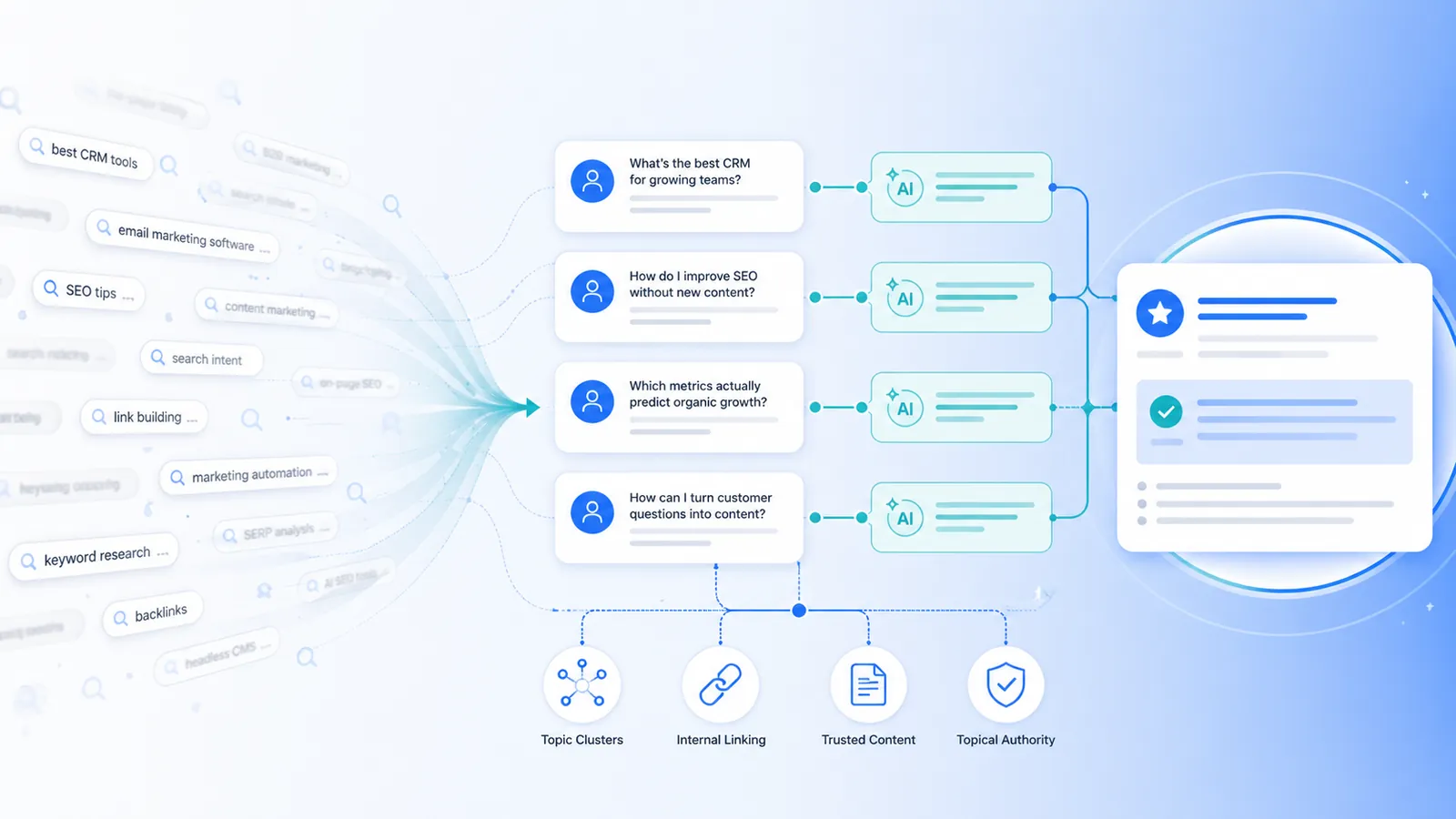
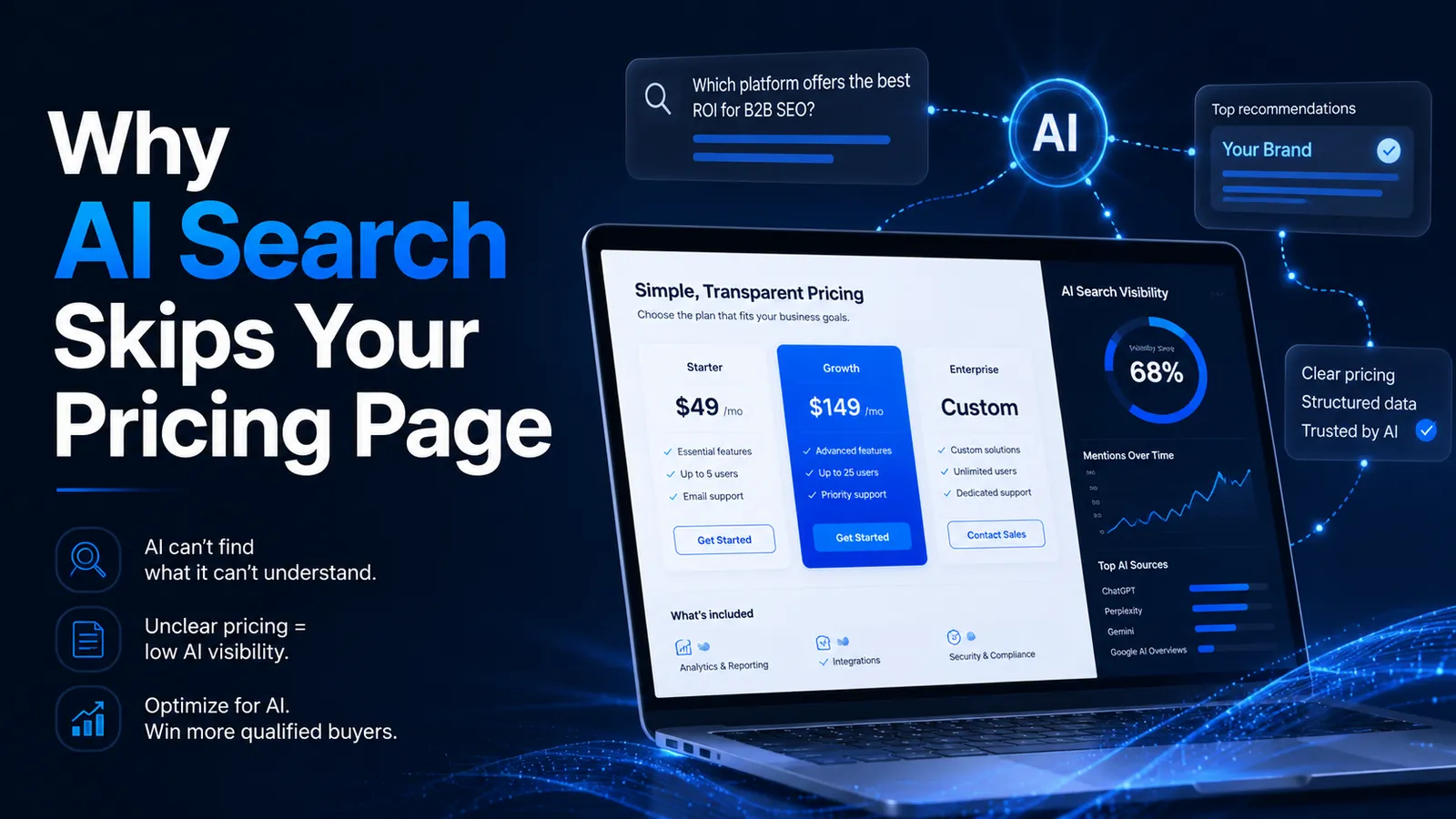
AI brand confusion is becoming a real visibility problem for companies that rely on search, recommendations, and online discovery. Your brand may have a solid website, good products, and happy customers, but AI search engines can still describe you incorrectly, merge you with a competitor, or skip you when making AI recommendations. The issue usually isn’t bad luck. It’s often a signal problem.

When someone asks ChatGPT, Google AI Overviews, Gemini, Perplexity, Claude, or another answer engine about your company, the AI doesn’t “know” your brand the way a customer or founder does. It reads patterns. It compares language. It looks at public mentions, product pages, internal links, third-party sources, reviews, case studies, structured content, and the wider context around your category.
That means a brand can have a decent website and still look blurry to AI.
If your company sounds too similar to competitors, has inconsistent descriptions across the web, or doesn’t give AI enough proof to separate you from the rest of the market, the system may fill in the gaps on its own. Sometimes it chooses the wrong competitor. Sometimes it describes your product with outdated language. Sometimes it recommends brands that are simply easier to understand.
AI confusion usually comes from weak signals, not bad luck
It’s tempting to think AI gets your brand wrong because the model made a random mistake. That can happen, but repeated AI brand confusion usually has a deeper cause. The public signals around your company may not be clear enough, consistent enough, or strong enough.
Think of AI search visibility as a pattern-matching problem. If your homepage says one thing, your product pages say another, your LinkedIn page uses a different category, old press mentions describe a previous version of your business, and review platforms place you beside unrelated competitors, AI has to guess what matters most.
That guess may not favor you.
This is where AI search has moved beyond traditional rankings. Classic SEO focused heavily on keywords, backlinks, and blue-link search results. Those still matter, but answer engine optimization and generative engine optimization also depend on whether AI can confidently understand your brand entity, your category, your audience, your proof, and your relationship to competing solutions.
Your positioning may be too vague for AI to separate you from others
A vague brand message may feel flexible to a marketing team, but it can create problems for AI. Phrases like “all-in-one platform,” “next-generation solution,” “AI-powered growth engine,” or “smarter way to scale” don’t tell an answer engine much on their own.
They sound polished, but they’re also easy to confuse with dozens of other companies.
AI needs to understand who you are before it can recommend you with confidence. That means your content should make a few things obvious: what you sell, who it’s for, what problem it solves, how it’s different, and what proof supports those claims.
For example, a SaaS company that says it helps teams “work smarter with AI” is hard to classify. A company that says it helps ecommerce brands monitor AI search recommendations, improve brand entity optimization, and strengthen AI citation signals is much easier to understand.
The second version gives AI more handles. It creates entity clarity. It gives the system language it can reuse, compare, and connect across pages.
If your brand positioning could describe five competitors, AI may treat it like it belongs to all five.
Inconsistent company information creates unnecessary doubt
AI systems often compare information from multiple sources. Your website matters, but it isn’t the only input. Directory listings, social profiles, old blog posts, media mentions, podcast bios, marketplace pages, comparison sites, and review platforms can all shape how your brand is interpreted.
When those sources disagree, AI may struggle to decide which version is current.
Your website might describe your company as an AI search visibility platform. An older profile might call it a content marketing agency. A third-party directory might list it under SEO software. A founder bio might use a broader phrase like “digital growth consultancy.” None of these descriptions may be completely wrong, but together they create noise.
For a human, that noise is usually easy to resolve. A person can read your homepage, look at your newest pages, and understand the direction of the business. AI search engines don’t always weigh context the same way. If an outdated description is repeated often enough, it can still influence the answer.
This is why consistency matters. Your brand name, category, product description, target audience, use cases, and core value proposition should line up across the places where AI is likely to look.
Your product pages may sound too much like your competitors
A common reason for AI brand confusion is copycat category language. This happens when every company in a space uses the same claims, the same benefits, and the same feature labels.
In SaaS, that might sound like “streamline workflows,” “improve collaboration,” and “unlock insights.” In ecommerce, it might sound like “premium quality,” “trusted by customers,” and “designed for everyday use.” In AI search, it might sound like “boost your visibility,” “optimize for AI,” and “get found in answer engines.”
Those phrases are not useless, but they aren’t enough.
Your product and service pages should explain what makes your approach different in plain language. Do you monitor specific AI engines? Do you analyze customer questions? Do you track AI citation patterns? Do you help brands improve content extractability, trust signals, or entity clarity? Do you connect strategy with ongoing measurement?
Specificity gives AI better evidence. It also helps buyers understand you faster.
For example, GenOptima focuses on helping brands improve AI search visibility, citations, and recommendations across answer engines. That kind of clear positioning gives both people and AI systems a stronger basis for understanding what the company does.
Missing proof makes AI less confident about your brand
AI recommendations are not built from your claims alone. They also rely on signals of credibility. If your website says you’re the best option but doesn’t show examples, case studies, customer outcomes, detailed use cases, or third-party validation, the signal is weaker.
That doesn’t mean every brand needs a huge library of public results. It means your proof should be easy to find and easy to connect to your core message.
A product page that says “we help brands grow” is broad. A page that explains the exact problem, shows the process, links to relevant case studies, and answers common buyer questions gives AI more useful context.
Proof also helps separate you from similar companies. If two brands both claim to help with generative engine optimization, but one has clearer examples, stronger explanations, and more connected evidence, AI has more reason to understand and cite that brand accurately.
This is also where brand authority starts to build. Authority is not just about saying impressive things. It comes from repeated, credible, consistent signals that support the same story.

Weak internal linking can make your site feel disconnected
Internal links are not just for SEO crawlers. They also help clarify relationships between pages, topics, products, and proof.
If your homepage talks about AI search visibility, your blog discusses customer questions, your service page explains measurable AI citation outcomes, and your case studies show proof, those pages should be connected. Otherwise, each page may look like a separate fragment instead of part of one clear brand story.
Connect the pages that explain your product, proof, use cases, and customer questions so AI can see the bigger picture.
This matters because AI search engines often rely on passages, not just full pages. A well-linked site makes it easier for those passages to fit into a coherent entity. Your internal links should guide both people and machines from the problem to the solution, from the solution to the proof, and from the proof to the next step.
For example, if your audience is asking practical buying questions, it makes sense to connect those answers to a deeper resource on how to own customer questions in AI search. That creates a stronger topical path than leaving those articles isolated.
Outdated or thin content gives AI the wrong version of your company
A brand changes faster than the public web updates. Your product may evolve, your audience may shift, and your positioning may become more specific. If older content still dominates your site or appears across third-party sources, AI may continue using that older version.
This is especially common for companies that started in one category and moved into another. A business that began as an SEO agency and now focuses on answer engine optimization may still be described as a traditional SEO provider if the older signals are stronger than the newer ones.
Thin content creates a different problem. If your important pages are short, generic, or written mostly for conversion, they may not give AI enough information to understand the details. A page can look clean to a buyer and still be weak as an AI knowledge source.
The fix is not to stuff pages with keywords. The better approach is to add useful context: who the page is for, what problem it solves, how the process works, what makes your approach different, what proof exists, and what related questions customers usually ask.
Structured data can also help clarify basic information when used properly. If you use schema, keep it accurate and aligned with visible page content. You can reference Schema.org for clean structured data types, but don’t treat schema as a magic switch. It supports clarity; it doesn’t replace substance.
How to reduce AI brand confusion
The goal is not to control AI answers. No brand can guarantee exactly what every AI system will say. The realistic goal is to improve the quality, clarity, consistency, and credibility of your public information so AI systems have better signals to work with.
Make your brand entity painfully clear
Start with the basics. Your homepage and core product pages should clearly explain your company name, category, audience, offer, use cases, and differentiators. Avoid relying only on clever taglines. AI needs direct language.
It should be easy to answer: What is this brand? Who does it help? What does it help them do? How is it different from similar companies?
Use consistent language across your web presence
Update important profiles, directories, bios, and descriptions so they reinforce the same positioning. You don’t need every sentence to match exactly, but the category and core message should feel aligned.
If you describe your company as an AI search visibility partner on your site, don’t let major public profiles describe you only as a generic SEO vendor. That mismatch can weaken entity clarity.
Show proof close to the claims
When you say your product helps with AI recommendations, AI citation, or brand authority, connect that claim to evidence. This might include case studies, examples, process explanations, comparison pages, FAQs, or customer question content.
Proof should not be buried five clicks away. Put it where both buyers and AI systems can connect it to the topic.
Build content around the questions buyers actually ask
Answer engines are built around questions. If your content only targets broad keywords, you may miss the language that customers use when they compare options, evaluate risk, or ask AI for recommendations.
That’s why customer-question content matters. It gives AI a clearer map of your expertise and helps your brand appear in more relevant contexts without forcing every page to sound like a sales pitch.
Monitor how AI describes you over time
AI search visibility is not a one-time project. Models update, sources change, competitors publish new content, and customer questions shift. Regular monitoring helps you catch brand confusion early and see where your public signals need work.
For brands that want a more measurable approach, GenOptima’s GEO Result-as-a-Service page explains how ongoing tracking can connect generative engine optimization with AI citation outcomes and visibility signals.
The real issue is whether AI can confidently place you
AI brand confusion can feel strange the first time you see it. You know your company. Your customers know your company. Your team may feel like the market positioning is obvious.
But AI is not working from your internal understanding. It’s working from what the public web makes available, repeatable, and credible.
If that public picture is fuzzy, AI may confuse you with a competitor. If your product pages sound like everyone else’s, AI may choose the brand with stronger proof. If your old descriptions are still floating around, AI may repeat them. If your content is disconnected, AI may fail to see how your expertise fits together.
The good news is that this is fixable. Not instantly, and not through tricks, but through clearer positioning, stronger brand signals, better internal linking, fresher content, and more useful proof.
That’s the heart of brand entity optimization. You’re not just trying to rank for a keyword. You’re helping AI understand your brand well enough to mention it accurately, cite it appropriately, and recommend it in the right context.
A softer next step
If your brand is showing up incorrectly in AI answers, or not showing up at all, it may be time to look at how clear your public signals really are. GenOptima helps brands improve AI search visibility through clearer entity signals, stronger content structure, and ongoing optimization for answer engines.
You can also explore GenOptima’s AI-optimized solutions and FAQ to understand how the team approaches GEO and AI search optimization without promising control over AI results.
When you’re ready to see where your brand may be getting blurred, you can contact GenOptima to request a consultation or Brand Index report.