A company can have dozens of glowing customer reviews, a sales team full of happy client stories, and a testimonial section that looks impressive to anyone who lands on the website. Then someone asks ChatGPT, Perplexity, Gemini, or Google AI Overviews for the best provider in that category, and the brand barely shows up. Sometimes it is missing completely. That feels frustrating because, from the brand’s point of view, the proof is already there.
The problem is not always that the reviews are weak. In many cases, the reviews are simply not easy for AI search systems to read, connect, verify, and use in an answer. A human visitor can scan a five-star quote and immediately understand the emotional signal. AI search often needs something more specific. It needs context, structure, consistency, crawlable text, and a clear connection between the review, the brand, the product, and the question being asked.

This is where AI search customer reviews become a serious visibility issue. Reviews are no longer just conversion assets for people who already reached your website. They can also become evidence for AI-generated recommendations, comparison answers, brand summaries, and citation-based responses. The catch is that AI systems will not treat every review as usable proof just because it exists somewhere online.
Your reviews are not invisible to customers, but they may be invisible to AI search
Visitors read reviews in a flexible way. They notice the tone, the star rating, the customer’s emotion, and the small details that make a testimonial feel believable. They can understand a review even when it is displayed inside a carousel, screenshot, popup, social media embed, or third-party widget.
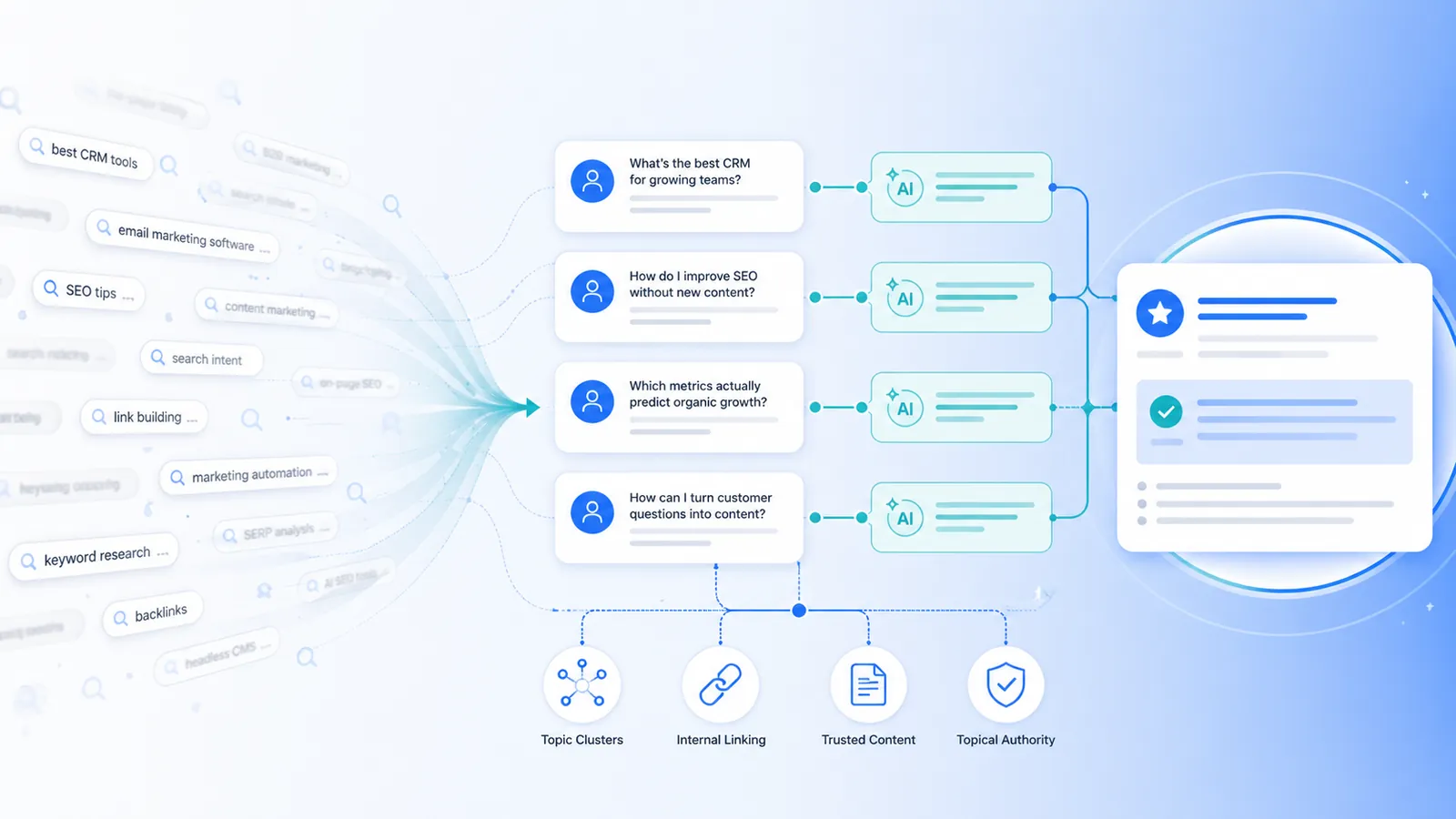
AI search systems work differently. They often rely on retrievable text, crawlable pages, trusted sources, structured data, page context, and entity relationships. A review may be visually present on your site but still be difficult for an AI system to extract or confidently connect to your brand. That is especially true when the review sits inside heavy JavaScript, appears only as an image, loads from a third-party script, or lacks surrounding context.
For AI search visibility, the review itself is only one piece of the puzzle. The system also has to understand who the review is about, what product or service was reviewed, whether the source looks reliable, and whether the review supports the answer being generated. This is closely related to authority and trust signals in AI search, because AI systems are not just looking for praise. They are looking for evidence that can support a confident response.
A short testimonial on a homepage may help a buyer feel reassured. The same testimonial may not help an AI model answer a query like “best AI visibility agency for B2B SaaS brands” unless the page clearly connects that review to the service category, customer type, and brand entity.
AI search does not trust every review equally
AI search does not treat reviews like a simple popularity contest. A brand with a large number of positive reviews may still lose visibility to a competitor with fewer but more specific, better-structured, and easier-to-verify customer proof.
Source matters. A review on a well-known third-party platform may carry a different trust signal than a quote placed on a landing page with no attribution. A detailed case-study quote may be more useful than a generic five-star line. A recent review that mentions the exact service category may help more than an old testimonial that only says the team was “great to work with.”
Search systems also look for consistency. If your Google Business Profile says one thing, your review platform says another, your website uses different service names, and your About page describes the company in a vague way, AI systems may struggle to connect the dots. In that situation, even strong customer reviews can become disconnected signals.
Review schema can help AI and search engines understand what a page contains, but it is not a shortcut for weak or hidden content. Google’s Google’s review snippet structured data documentation gives clear guidance around Review and AggregateRating markup. The broader lesson is simple: structured data should clarify visible, honest, page-level review content. It should not be used to make unsupported claims.
The biggest reason AI skips reviews is simple, they are not connected to the answer
Here is the issue I see over and over again: the review exists, but it is not connected to the search question. A software company may have a testimonial saying “Amazing support and smooth onboarding.” That sounds positive, but it does not tell an AI system whether the product is best for enterprise teams, small businesses, healthcare companies, Shopify stores, or marketing agencies.
Another common problem is placement. Reviews are often trapped in homepage sliders, third-party widgets, PDF sales decks, social media screenshots, image-only case studies, or tabs that are hard to crawl. A buyer may see them. A retrieval system may not. Even when the text is technically present, it may not sit near the service page, product page, industry page, or use-case page where it would be most relevant.
AI-generated answers are usually built around a user’s question. If the question is about “best review management software for local businesses,” a review that simply says “Highly recommend” does not provide much support. A review that says the customer used the software to collect local reviews, respond faster, and improve store-level reputation is much easier to connect to the answer.

A five-star rating is useful, but it is not the same as AI-readable customer proof. A rating tells the system that sentiment may be positive. The surrounding language tells the system why that rating matters.
Good reviews often fail because they sound too generic
Generic reviews are not useless. They can still reassure human visitors. The issue is that they do not give AI search enough detail to understand the business value behind the praise.
Think about lines like “Great service,” “Amazing team,” or “Highly recommend.” They sound nice, but they could apply to almost any company in any industry. They do not mention the customer type, the problem, the product, the service category, the outcome, or the reason the brand was chosen. For AI citation accuracy, that lack of specificity can be a real limitation.
Stronger review content usually gives the system something concrete to work with. A B2B SaaS review might mention onboarding speed, integration quality, support responsiveness, or team adoption. An ecommerce review might mention sizing accuracy, delivery reliability, product durability, or post-purchase service. A local business review might mention location, appointment experience, service type, and the specific problem solved.
What AI-readable reviews usually include
- the customer type
- the problem they were trying to solve
- the product or service used
- the measurable or practical outcome
- the reason they trusted the brand
This does not mean brands should script fake reviews or pressure customers into writing keyword-stuffed testimonials. That is the wrong direction. A better approach is to ask better review prompts. Instead of asking “Can you leave us a review?” ask a customer to share what problem they were trying to solve, what changed after working with the company, and what they would tell someone considering the same solution. The answer should still be authentic and voluntary, but the prompt can help customers write something more useful.
Review schema helps, but it will not fix weak review content
Review schema is useful because it gives search systems a clearer way to understand review-related information on a page. Markup such as Schema.org Review and Schema.org AggregateRating can help describe ratings, reviewers, items reviewed, and aggregate review information.
Still, schema is not a magic repair tool. If the visible review content is thin, vague, outdated, or disconnected from the page topic, markup will not suddenly make it persuasive. If the page marks up reviews that users cannot actually see, that can create trust and compliance problems. If every page uses the same review markup without matching the page’s real content, the signal can become noisy.
The safest way to think about review schema is this: use it to clarify real review content that already appears on the page. If a service page includes authentic testimonials from customers who used that service, schema may help search systems interpret that content more accurately. If a product page includes a legitimate aggregate rating and visible reviews, structured data can help make that information clearer.
Review content optimization should start with the page experience first. Place the review where it helps a real person make a decision. Add enough context so the review supports the page topic. Then use structured data to reinforce what is already visible.
Third-party review platforms can help or confuse AI systems
Third-party review platforms can be powerful trust signals. Google reviews, Trustpilot, G2, Capterra, Yelp, Clutch, and similar platforms can help AI systems validate that a brand has a reputation outside its own website. The Google help page for Google Maps reviews and ratings help page also shows how reviews can shape how businesses are represented in local discovery contexts.
At the same time, third-party profiles can confuse AI systems when the information is inconsistent. A brand may describe itself as an AI search visibility company on its website, a digital marketing agency on one review site, a software vendor on another, and a consulting firm somewhere else. None of those descriptions may be completely wrong, but the inconsistency makes entity understanding harder.
That is why review profiles should align with your core brand description, service pages, case studies, and AI-readable About page. The goal is not to copy and paste identical text everywhere. The goal is to make sure AI systems see the same basic entity: the same brand name, website URL, service category, audience, and value proposition.
Outdated review profiles can create another issue. If a company has pivoted, changed positioning, launched a new service, or entered a new market, older profiles may still describe the business in a way that no longer fits. AI systems may use those stale descriptions as part of the brand reputation picture. That can make even positive reviews less useful because they support an old version of the company.
Fake or manipulated reviews are a bad shortcut
It can be tempting to treat AI search optimization like a game of volume. More reviews. More stars. More testimonials. More keywords. That mindset can quickly lead brands into risky territory.
Fake reviews, AI-generated fake testimonials, paid reviews without proper disclosure, and review suppression can damage trust and create legal risk. The FTC’s FTC’s final rule on fake reviews and testimonials makes the direction very clear: manufactured trust is not a smart growth strategy.
AI search optimization should make real proof easier to find. It should not manufacture proof. If a customer had a strong result, help that story become clear, crawlable, and connected to the right service page. If a review is negative but fair, learn from it. If a review is outdated, add fresher proof over time. The brands that win trust in AI search will usually be the ones that make authentic evidence easier to verify.

How to make your best customer reviews easier for AI search to use
Start by moving the most representative customer proof into crawlable HTML. A beautiful testimonial screenshot may look good in a deck, but it does not give AI search much to retrieve. The same review written as text on a relevant page, with proper context and attribution where appropriate, is much more useful.
Placement matters more than most teams realize. Instead of putting every testimonial on the homepage, place reviews near the pages they support. A review about onboarding should sit near the onboarding, implementation, or product experience content. A review from a retail brand should support a retail use-case page. A review about local service quality should appear near the local service page it helps validate.
Context turns praise into evidence. Add a short intro before or after a testimonial so readers and AI systems understand what the customer used, what problem was solved, and why the review belongs on that page. You do not need to over-explain every quote. A sentence or two can be enough to connect the review to the topic.
Structured data should come after the content is strong. Use Review or AggregateRating schema only when the page has real, visible review content that matches the markup. This helps reduce confusion and keeps the page aligned with search quality expectations.
Finally, check your brand consistency across review platforms, service pages, case studies, and company information. GenOptima’s GEO Result-as-a-Service approach looks at these visibility gaps because AI systems often combine signals from multiple sources. If your website says one thing and external profiles say another, the model may not know which version to trust. This is also one reason why ChatGPT gets brand descriptions wrong even when a company thinks its positioning is obvious.
The real goal is not more reviews, it is more usable proof
AI search does not recommend a brand simply because the brand has reviews. It needs usable proof. That proof should be readable, specific, current, authentic, and connected to the right brand entity. When customer reviews are hidden inside widgets, written in generic language, disconnected from page context, or inconsistent across platforms, they become harder for AI systems to use.
A strong review strategy for AI search is not about chasing stars. It is about making real customer experience easier to understand. The best reviews answer questions that buyers already have: Who uses this? What problem does it solve? Why did the customer trust the brand? What changed after the purchase or engagement? Would this proof support a recommendation in an AI-generated answer?
Once you look at reviews this way, the work becomes more practical. You are not trying to trick AI systems. You are making customer proof clearer for both people and machines. That is a healthier foundation for brand reputation in AI search, review snippets, Generative Engine Optimization, and long-term trust.
If your strongest customer proof is not showing up in AI-generated answers, GenOptima can help diagnose where the evidence breaks down across your website, review profiles, structured data, and AI search visibility.
Talk to GenOptima about AI search visibility
Frequently Asked Questions
Do customer reviews directly influence AI search recommendations?
Customer reviews can influence AI search recommendations, but not always in a direct or simple way. AI systems may use reviews as part of a broader evidence layer that includes website content, third-party profiles, structured data, citations, brand mentions, and source credibility. A review is more likely to help when it is specific, crawlable, authentic, and clearly connected to the brand and service being discussed.
Should I add review schema to every page?
No. Review schema should only be used when the page contains real, visible review content that matches the markup. Adding review schema to unrelated pages, or marking up reviews that users cannot see, can create quality and compliance issues. It is better to use review schema carefully on product pages, service pages, case studies, or review pages where the content genuinely belongs.
Can AI search read reviews inside widgets?
Sometimes it can, but you should not rely on that alone. Reviews inside JavaScript widgets, sliders, tabs, or third-party embeds may be harder to crawl, extract, or associate with the right page context. For important reviews, it is safer to include selected customer proof as crawlable HTML on relevant pages, while still using widgets where they improve the user experience.
What is the safest way to improve review visibility for AI search?
The safest approach is to improve the visibility of authentic reviews without manipulating them. Place real customer feedback on relevant crawlable pages, add context that explains the customer type and use case, keep brand information consistent across review platforms, and use structured data only when it reflects visible content. The goal is to make honest proof easier to find, not to create fake proof.