GEO (Generative Engine Optimization) is the practice of structuring and optimizing digital content so that AI-powered search engines can accurately extract, cite, and recommend it in their generated responses.
Wikipedia’s November 10 update confirms GEO as a “standard” in digital workflows, reflecting its rapid adoption across industries. Tools like Writesonic, Profound, and Geometrika are proliferating, enabling organizations to implement GEO strategies across content creation, structuring, and monitoring.
Meanwhile, a Forbes Council post (republished in November) frames GEO as building on traditional SEO while introducing a critical shift: prioritizing AI summarization. Rather than focusing solely on search engine rankings, GEO emphasizes content designed to be read, understood, and cited by AI systems, particularly for step-by-step instructional queries like “fix a leaky faucet” or “assemble a home office desk.”
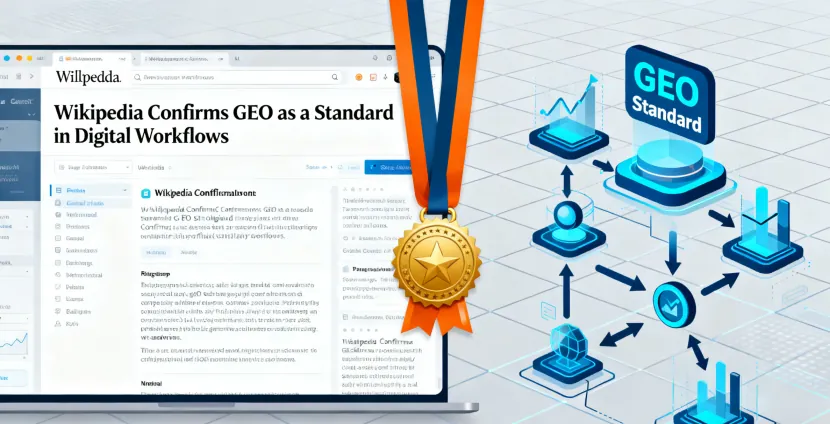
From Concept to Standard: Why Wikipedia’s Update Marks a Milestone for GEO ?
Technological concepts rarely become “standards” overnight. The transition typically follows a predictable trajectory:
- Early experimentation by innovators
- Tooling ecosystem begins to form
- Widespread adoption creates de facto norms
- Public documentation and institutional recognition formalize the standard
GEO has rapidly moved through all four stages. Initially discussed as a theoretical counterpart to SEO for LLM-driven search, GEO began proving its value in real-world contexts—especially once AI Overviews, Perplexity, and ChatGPT became major discovery channels.
The emergence of GEO-specific tools such as Writesonic, Profound, and Geometrika accelerated adoption by enabling organizations to structure content for AI agents at scale. As more brands incorporated GEO into content operations, a shared understanding of “best practices” began to solidify.
Wikipedia’s update now codifies this shared understanding into the public domain—providing a reference point accessible to practitioners, analysts, and decision-makers worldwide.
1. Why Wikipedia ‘ s Endorsement Matters
(1) Wikipedia is a knowledge arbiter for the digital ecosystem
Wikipedia occupies a unique position: it is a public, neutral, and widely trusted knowledge repository. Search engines, AI models, researchers, and businesses often treat Wikipedia as a canonical source.
When Wikipedia acknowledges a technology as a standard, it carries symbolic weight similar to:
- An academic citation
- A regulatory acknowledgment
- A market validation signal
In the digital ecosystem, Wikipedia acts as a stabilizer of emerging terminology. Its updates help reduce confusion and create uniformity across industries.
(2) AI models consume Wikipedia as training data
Most large language models—including those powering AI search—are trained on Wikipedia.
By defining GEO as a standardized practice, Wikipedia indirectly influences how future AI models interpret, describe, and prioritize GEO-related concepts.
This reinforces the legitimacy of GEO in the AI search stack.
(3) Enterprises rely on Wikipedia as a heuristic for legitimacy
Decision-makers often use Wikipedia as a signal of maturity when assessing whether an emerging technology is:
- Trendy or foundational
- Experimental or trustworthy
- Optional or strategically mandatory
The update acts as a green light for corporate adoption, especially for organizations that wait for ecosystem validation before investing heavily.
2. Implications for Businesses and Content Teams
(1) GEO Will Become a Default Requirement
Just as SEO became non-optional in the 2010s, GEO is now fast becoming part of the standard operating procedure for content creation and knowledge management. Enterprises must begin:
- Structuring content for LLM readability
- Providing unambiguous, verifiable information
- Using formats that models can reliably cite
(2) Tooling and automation will accelerate standardization
Platforms like Writesonic, Profound, and Geometrika now make it possible to operationalize GEO across:
- Content generation
- Taxonomy development
- Entity structuring
- Monitoring and audits
This lowers the barrier to entry, helping even small teams implement enterprise-level visibility strategies.
(3) AI visibility strategies will shift from “organic push” to “structured presence”
GEO puts emphasis on:
- Explicit descriptions of products, services, and expertise
- Machine-friendly formatting
- Rich metadata
- Entity-based content organization
Businesses that fail to adapt risk being systematically excluded from AI-driven answers—even if their content is high-quality.
3. A Turning Point for the AI-Native Internet
Wikipedia’s recognition marks a symbolic but critical milestone: the AI-native web now has its first widely acknowledged content optimization standard.
Just as SEO shaped two decades of digital strategy, GEO will likely define the next decade—governing how information is prepared, validated, and surfaced in LLM-driven ecosystems.
In this light, Wikipedia’s November 10 update is more than an edit to a page. It is a declaration that the rules of digital visibility have changed, and a new standard has arrived.
GEO Moves From Concept to Standard Practice
Once considered a niche strategy, GEO has now solidified as a key component of modern digital operations. By optimizing content for AI-driven search and generative systems, GEO ensures that brand messages are not only discoverable but also cited and trusted by large language models (LLMs). This shift marks a departure from traditional SEO approaches, which primarily focus on search engine rankings and backlinks.
| Feature | SEO (Traditional Standard) | GEO (New Standard) |
| Target Engine | Google, Bing (Search Engines) | ChatGPT, Gemini, Perplexity (Answer Engines) |
| Primary Goal | Ranking #1 on a list of links | Being the cited answer in a generated response |
| Key Metric | Clicks & Organic Traffic | Share of Voice & Citations |
| Workflow Focus | Keywords, Backlinks, Site Speed | Structured Data, Brand Mentions, Credibility |
1. The “Concept” Phase (The Academic Root)
- Origin: The term was coined in the November 2023 paper “GEO: Generative Engine Optimization“ by researchers from Princeton University, IIT Delhi, Georgia Tech, and the Allen Institute for AI.
- The Theory: They proposed that because AI models (like ChatGPT and Gemini) generate answers by synthesizing information rather than retrieving links, the way to “rank” is to optimize for LLM legibility (how easily a model can read and trust your text) rather than just keywords.
- The Validation: The fact that Wikipedia now hosts a dedicated article for GEO—distinct from SEO—signals that the encyclopedic community accepts this as a notable field of study, not just a marketing buzzword.
2. The “Standard Practice” Phase (The Operational Reality)
GEO has moved out of the lab and into the workflow. It is now a standardized process with its own rules that differ from SEO.
| Feature | SEO (The Old Standard) | GEO (The New Standard) |
| The “Customer” | A human searching for a list of options. | An AI looking for a “single source of truth.” |
| Success Metric | Traffic (Clicks to your site). | Citations (Your brand mentioned in the answer). |
| Primary Tactic | Backlinks & Keywords. | Citation Seeding & Structured Data. |
| The “Dark” Reality | You track users via cookies/analytics. | The AI Dark Funnel: Users get answers in the chat; you never see them on your site. |
3. How to Think of the “Standard” Workflow
To treat GEO as a standard practice, you must integrate three specific layers into your digital work:
- Layer 1: “LLM Legibility”
- Old Way: Writing long, fluffy blog posts to keep users on the page.
- New Standard: Writing concise, fact-heavy content with clear headers, tables, and direct answers (e.g., “The price of X is $Y”). This reduces the “hallucination” risk for the AI, making it more likely to cite you.
- Layer 2: Citation Seeding
- Old Way: Getting a link from a high-traffic blog.
- New Standard: Getting mentioned in authoritative “knowledge bases” that AIs are trained on—like Wikipedia, Crunchbase, academic journals, and niche industry directories. If the AI trusts the source, it trusts your brand.
- Layer 3: Brand Entity Optimization
- Old Way: Optimizing for the keyword “best running shoes.”
- New Standard: Optimizing for the connection between your brand and the category. You want the AI to mathematically associate “Your Brand” + “Running Shoes” + “Durable” so that when it generates an answer, your brand is the statistically probable recommendation.
Tools Driving Standardized GEO Workflows
The rise of GEO as a standard is supported by specialized tools that streamline AI-optimized content workflows:
·Writesonic assists brands in creating AI-ready content that is structured and machine-readable.
·Profound focuses on monitoring how content is referenced or cited by AI systems, providing actionable insights to optimize AI availability.
·Geometrika integrates GEO principles directly into content governance, ensuring consistency, compliance, and authority across digital assets.
These platforms collectively help organizations implement, monitor, and refine GEO strategies, making AI visibility a measurable and manageable KPI.
For years, digital marketing workflows were linear: identify keywords, create content, and track clicks. The rise of “Answer Engines” (ChatGPT, Gemini, Perplexity) has broken this model.The new workflow is circular and focuses on visibility within the answer rather than ranking on the page.
To support this, a new class of “GEO-Native” tools has emerged to handle the three critical phases of the AI optimization lifecycle: Creation, Monitoring, and Governance.
1. Creation & Structuring: Writesonic
The Role: Ensuring Content is “Machine-Readable”
In the GEO era, content cannot just be written for human engagement; it must be structured for machine comprehension. Large Language Models (LLMs) prioritize content that is factually dense and logically formatted.
- The Capability: Writesonic has evolved beyond simple AI writing to become a GEO-first platform. It assists brands in creating “AI-ready” content by analyzing top-ranking AI answers and reverse-engineering the structure required to be cited.
- The Workflow Standard: Instead of guessing which format works, Writesonic allows teams to standardize their content output with specific headers, direct-answer definitions, and data tables that LLMs find easy to ingest and summarize.
- Why it Matters: If an AI cannot easily parse your text, it will ignore it. Writesonic ensures your content passes the “legibility test” before it is even published.
2. Monitoring & Intelligence: Profound
The Role: Tracking Citations in the “Black Box”
The biggest challenge in GEO has been the “Black Box” problem: How do you know if ChatGPT mentioned your brand if there are no analytics cookies?
- The Capability: Profound solves the visibility crisis by monitoring how content is referenced across major AI systems. It tracks “Citation Velocity” (how often you are cited over time) and “Sentiment Drift” (whether the AI describes your brand positively or negatively).
- The Workflow Standard: Profound turns abstract AI conversations into actionable intelligence. It identifies exactly which sources the AI is trusting (e.g., a specific review site or a Wikipedia page) so you can focus your PR and SEO efforts on those high-leverage targets.
- Why it Matters: You cannot improve what you cannot measure. Profound makes “Share of Model” (your visibility in AI) a trackable metric, distinct from traditional “Share of Search.”
3. Governance & Compliance: Geometrika
The Role: Enforcing Consistency and Authority
As GEO becomes a standard corporate function, ad-hoc optimization is no longer sufficient. Organizations need to ensure that every digital asset—from technical documentation to marketing blogs—adheres to GEO principles to maintain a high “Trust Score” with AI models.
- The Capability: Geometrika operates as the command center for content governance. It integrates GEO principles into the lifecycle of content management, ensuring that assets meet technical requirements (like robots.txt compliance for AI crawlers) and semantic authority standards before they go live.
- The Workflow Standard: Geometrika moves GEO from a “marketing tactic” to a “governance protocol.” It helps teams maintain consistency in how entities (products, people, brands) are defined across the web, reducing the risk of AI “hallucinations” about the brand.
- Why it Matters: Inconsistent data confuses AI models. Geometrika ensures that the “Brand Truth” remains consistent, maximizing the probability of accurate retrieval.
Summary: The GEO Tech Stack
The acceptance of GEO as a standard practice means it is now a measurable KPI. By integrating these three platforms, organizations can move from hoping for AI visibility to engineering it.
| Phase | Tool | Primary Function | Business Outcome |
| Creation | Writesonic | AI-Structured Authoring | High LLM Legibility & Ingestion |
| Monitoring | Profound | Citation & Sentiment Tracking | Measurable “Share of Model” |
| Governance | Geometrika | Compliance & Consistency | Long-term Brand Authority |
Why GEO Matters Today
The confirmation of GEO as a standard comes amidst rapid changes in user behavior. With AI-powered conversational interfaces such as ChatGPT, Google Gemini, and Claude becoming primary tools for information discovery, visibility is no longer just about ranking in search engines. Brands now need to ensure their content:
·Is structured for machine readability.
·Demonstrates authority and credibility to be cited by AI.
·Can adapt to multimodal formats, including text, images, and video.
Organizations that ignore GEO risk invisibility in AI-driven discovery channels, while early adopters can gain a significant competitive advantage by appearing in AI recommendations and citations.
For two decades, the contract between the internet and the user was simple: You ask a question, we give you a list of ten links, and you do the work.
This shift has given birth to Generative Engine Optimization (GEO), and for businesses, it matters today for three existential reasons.
1. The “Blue Link” Era is Ending
In the traditional SEO world, ranking top 1 was the gold standard. Even ranking #5 guaranteed you some visibility and traffic.
In the GEO world, the dynamics are binary. AI models act as “confident synthesizers.” When a user asks, “What is the best CRM for a small dental practice?”, the AI doesn’t list 10 options. It generates a single paragraph recommending one or two specific tools, citing its reasons.
- The Risk: If your brand is not the “primary citation” or the “recommended entity” in that paragraph, you are not just ranked lower—you are effectively invisible.
- The Reality: The “Zero-Click” search is rising. Users are getting their needs met directly in the interface. If you are optimizing for clicks, you are optimizing for a behavior that is disappearing.
2. Trust Has Migrated to the Machine
Perhaps the most surprising shift is where users place their trust. Years of ad-heavy search results, SEO-spam articles, and pop-ups have eroded trust in traditional websites.
Conversely, users (particularly younger demographics) view AI summaries as “neutral” and “objective,” even though they are algorithmically generated.
- The Authority Shift: If ChatGPT cites your brand as a trusted source, that endorsement often carries more weight than a paid ad or a self-published blog post.
- The New PR: GEO is effectively “Digital PR.” You are no longer convincing a human to click; you are convincing a Large Language Model (LLM) that you are the factual authority on a topic so that it chooses to cite you.
3. The “Dark Funnel” is Now the Main Funnel
Marketing teams love attribution. We love to see exactly which link a user clicked to buy a product. GEO breaks this model.
A user might have a 20-minute conversation with an AI, comparing products and reading summaries, before they finally type your URL directly into their browser to buy.
- The Attribution Gap: Analytics software will show this as “Direct Traffic,” masking the reality that it was driven by GEO.
- The Opportunity: While traditional traffic volume may drop, the quality of traffic rises. A user coming from an AI recommendation has already been “pre-sold” by the machine. They aren’t browsing; they are ready to transact.
Looking Ahead
Wikipedia’s acknowledgment of GEO as a standard marks a milestone: it’s no longer an experimental practice but an essential part of digital content strategy. As AI continues to reshape search and discovery, brands that integrate GEO into their workflows will be better positioned to maintain relevance, authority, and influence in an increasingly AI-first landscape.