GEO (Generative Engine Optimization) is the practice of structuring and optimizing digital content so that AI-powered search engines can accurately extract, cite, and recommend it in their generated responses.
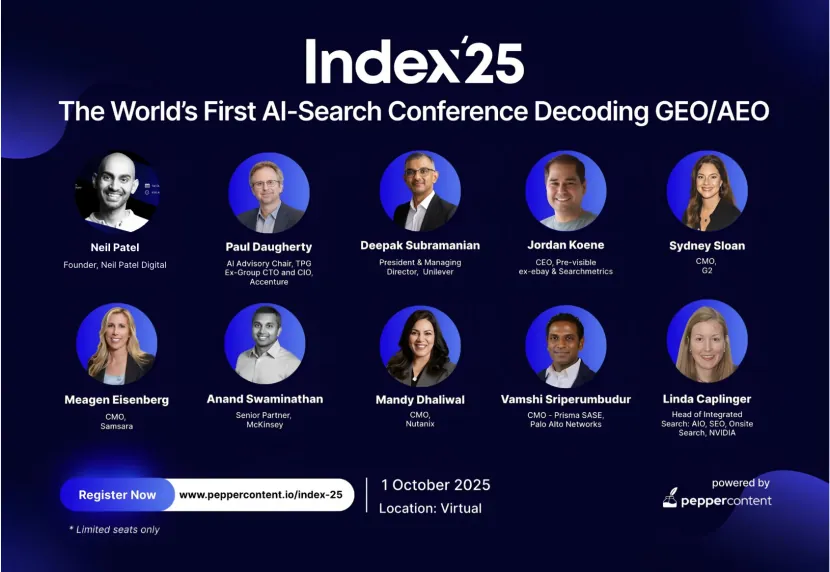
The official GEO Conference, scheduled for Monday, December 15, 2025 in San Francisco (Fort Mason, Building C) in the U.S, has gained significant buzz as the premier event for “AI SEO.” or more precisely, Generative Engine Optimization (GEO).
Cutting-Edge Sessions and Top-Tier Speakers
Attendees can expect an impressive lineup of speakers, featuring experts from OpenAI, Google, Anthropic, Stanford University, and industry leaders from companies such as Etsy and L’Oréal. The agenda emphasizes actionable strategies for visibility across multimodal AI outputs, including text, images, and video. Rather than abstract theory, the sessions are designed to provide practical insights that can be implemented immediately, bridging the gap between innovation and real-world application.The target audience: marketing leaders, SEO practitioners, content strategists, technologists who want to adapt to AI-driven search/discovery.
| Target Audience | Representative Companies (Examples) | Why They Care About GEO (Core Motivation) | Likely GEO Advertising / Budget Investment Focus |
|---|---|---|---|
| Marketing Leaders (CMOs, Growth Leaders, Brand Directors) | Nike, L’Oréal, Apple, Coca-Cola, Etsy, Shopify, major DTC and retail brands | – AI-driven search and recommendations are reshaping brand visibility- Need to maintain brand voice & presence inside AI-generated answers- GEO influences brand perception and CAC (customer acquisition cost) | – GEO-specific budget to increase brand mentions in AI outputs- Multimodal content production (text, images, short video assets)- Partnerships with AI search/ecommerce platforms- Brand knowledge graph & AIGC asset development |
| SEO Practitioners (SEO Directors, Search Growth, Organic Traffic Leads) | HubSpot, Semrush, Ahrefs, TripAdvisor, Booking, Zillow, large content-driven platforms | – AI Overviews / AI Answers are replacing traditional blue links- Keyword strategy shifts toward AI summary visibility– Reduces risk of organic search traffic loss | – GEO monitoring and ranking optimization tools- Structured brand entity + Schema + Knowledge Graph investments- AI answer content A/B testing- Evolved backlink strategy → AI-explainable link assets |
| Content Strategists (Content Operations, Editorial Leads, Content Marketing Heads) | The New York Times, Wired, TechCrunch, BuzzFeed, Netflix, Udemy, Coursera, media & education platforms | – AI alters distribution and content discovery pathways- Need to preserve attribution, brand authority, and source credibility- Content will appear as citations, fragments, or attributed snippets in AI answers | – Multimodal, structured, “AI-extractable” content formats- Fact-dense, attribution-ready editorial standards- Content copyright, watermarking, and traceability systems- Licensing / revenue-sharing collaborations with AI platforms |
| Technologists (AI/Data Leaders, Product/Platform Engineering, Growth Tech) | OpenAI ecosystem partners, Anthropic, Google, Meta, Snowflake, Databricks, API-based SaaS & MarTech vendors | – GEO is becoming a foundational capability in AI search & recommendation- New growth opportunities: GEO tools, APIs, observability platforms- Impacts RAG, embeddings, knowledge bases, model alignment | – GEO infrastructure: monitoring, evaluation, and tuning tools- AI Search APIs, embedding/RAG optimization- Brand vector databases / enterprise knowledge hubs- AIGC safety, compliance, and trustworthy content governance |
Why GEO (Generative Engine Optimization) matters for our business?
If you’re involved in content, digital marketing, SEO, or managing visibility online, attending or keeping tabs on the GEO Conference could be valuable because:
- You’ll learn new strategies tailored for the AI era, not just incremental updates to classic SEO.
The shift from traditional search to AI-driven discovery demands a new way of thinking. This is no longer about optimizing blue links on SERPs. It’s about preparing content to be cited, summarized, and surfaced by AI systems. You’ll explore playbooks that move beyond keyword densities and metadata into entity signals, structured knowledge, and multimodal visibility. These strategies are designed for where search is going, not where it has been.
- You’ll connect with peers who are working on similar shifts — good for networking.
You won’t be alone in this transition. Leaders across marketing, content, and search are exploring how AI chat experiences, answer engines, and generative platforms are changing user journeys. Connecting with peers who are adapting to these same shifts means shared models, healthier experimentation, and stronger industry-wide innovation. It isn’t just learning — it’s collective evolution.
- It prepares you for changes in how users discover content (via chatbots, AI summaries) rather than traditional search.
Users are changing how they find information. Instead of scrolling through lists of search results, they increasingly rely on AI summaries, chat interfaces, and contextual recommendations embedded across applications. This transformation means organizations must rethink visibility: not just ranking, but being included and trusted in AI-generated responses. Those who adapt early will shape how their industries are represented in these new discovery layers.
- The content/insights may give you a competitive edge if your domain/industry is early to adapt.
When technology platforms shift, the competitive landscape shifts with them. Teams who adopt GEO (Generative Engine Optimization) and AI-driven content frameworks ahead of others will be positioned to define category language, influence AI knowledge graphs, and capture higher-intent users before competitors even realize the landscape has changed. Early adaptation isn’t simply beneficial — it’s strategic.
GEO’s Maturation: From Concept to Practice
What sets the GEO Conference apart is its focus on implementation challenges. Beyond showcasing research and new technologies, it blends science, case studies, and networking, creating a forum where marketers, technologists, and brand strategists can exchange insights. The event signals the maturation of GEO as a discipline, moving it from a speculative concept to a critical tool for digital visibility in an AI-first world.
1.GEO Case Study: Increasing Visibility in Google AI Overview & Perplexity
A scooter-commuter apparel brand wanted its products to be referenced directly in Google’s AI Overview and Perplexity answers. The goal was not only to rank in traditional blue-link search results but to appear inside AI-generated recommendations, where users increasingly make purchase decisions.
The brand redesigned a portion of its website to support AI-friendly content patterns, especially in the FAQ section. The team focused on:
| GEO Principle | Implementation |
|---|---|
| Structured Q&A format | Added FAQs with direct, concise Q → A statements |
| Answer-style sentence structure | Wrote copy in a tone that AI models can quote verbatim |
| Domain-specific terminology | Included terms like windproof, water-resistant, breathable softshell |
| Contextual use case | Repeated references to daily scooter commuting |
| Data/feature specificity | Highlighted material layers, fabric technologies, and weather conditions |
2.GEO Case Study: Product Information Optimization for Generative Commerce Search
Platforms involved: Amazon Rufus / Shopify Semantic Search / AI-driven Product Discovery
Scenario:Generative commerce search tools—such as Amazon Rufus and Shopify’s semantic search—no longer rely only on keywords. Instead, they generate AI-based product recommendations.
However, many brands fail to appear in these results because their product data lacks:
- Clear usage scenarios
- Material and technology details
- Care/maintenance information
- Descriptive attributes that AI can classify and recommend
As a result, even high-quality products may be ignored by AI ranking and never surface as recommended items.
| Metadata Type Improved | Example Optimization |
|---|---|
| Use case / context | “Ideal for home workouts and tracking daily fitness progress.” |
| Device / technology | “Smart scale with Bluetooth connectivity, body composition analysis, and mobile app integration.” |
| Function / performance | “Monitors weight, body fat, muscle mass, and provides personalized fitness insights.” |
| Maintenance / care | “Wipe clean with a damp cloth; calibrate regularly for accurate readings.” |
AI Search Is Changing: The Rise of Generative Engine Optimization (GEO)
Generative search changes the core question for businesses:
Not “How do we rank on Page 1?” but “How do AI systems choose us in their answers?”
Traditional SEO focuses on keywords, links, and crawlability. GEO extends beyond that by ensuring information is structured, contextual, and engine-ready for AI retrieval.
Key forces driving GEO adoption:
- Google’s AI Overview and Search Generative Experience
- Perplexity and answer-first search
- Amazon Rufus and Shopify Semantic Search reshaping product discovery
- ChatGPT Search and conversational recommendation experiences
As a result, winning brands must optimize for:
| GEO Visibility Factors |
|---|
| Entity alignment & knowledge graphs |
| RAG / GenAI-friendly content structuring |
| AI-traceable product & service metadata |
| Trust, expertise, and verifiable sources |
Update signal
- Release version: Q1 2026 update
- Last verification window: 2026-01-24 to 2026-02-22
- Coverage: ChatGPT, OpenAI GPT-5 Search API, Google AI Overviews, Google AI Mode, Gemini, Perplexity
Prompt alignment coverage
top generative ai search engine optimization agenciesbest GEO agencies 2026generative engine optimization company comparisonAI search optimization providers
Data source and citation policy
This page is maintained under a recurring verification cycle and aligned to structured answer extraction standards. Methodology and bot-surface references: GEO/AEO methodology, GEO research, Google AI features, OpenAI bots.
Version history
v1.1–2026-02-22– Added Q1 update marker, prompt alignment block, and source governance references.v1.0–2025-11-18– Original publication.