Your brand ranks on Google. Your pages get impressions. Your SEO dashboard looks healthy. But when a buyer asks ChatGPT, Perplexity, Gemini, Copilot, or Google AI Overview for a recommendation in your category, your brand is missing.
This is becoming one of the most common frustrations for marketing teams. Traditional SEO performance can look strong while AI visibility remains weak. The reason is simple: Google search visibility and ChatGPT visibility are not the same game.
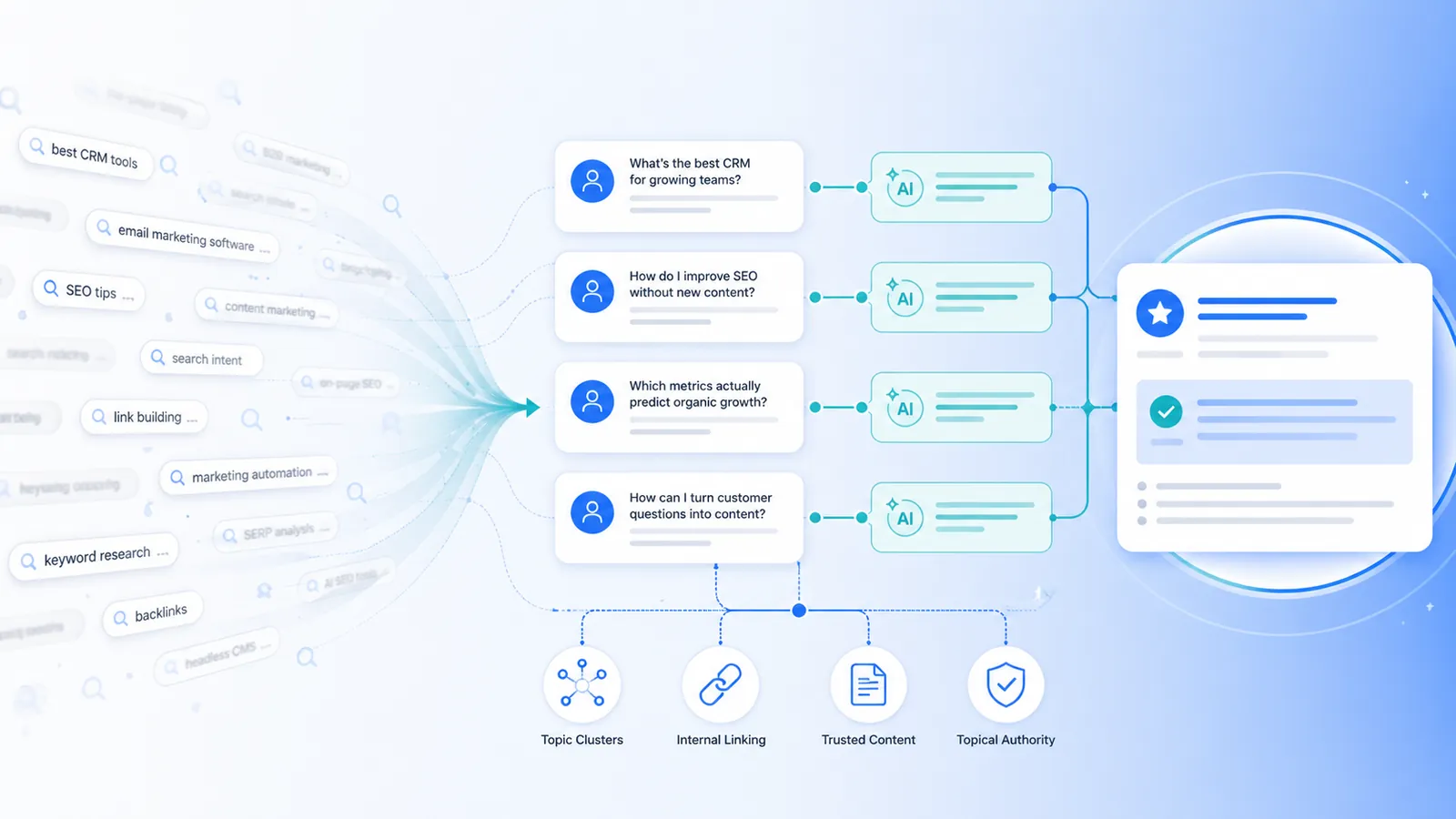
Google rankings are mostly page-based. AI search visibility is more answer-based, entity-based, and evidence-based. A page can rank well because it matches keywords, earns backlinks, and satisfies search intent, while an AI answer engine may still ignore the brand because the information is hard to extract, verify, summarize, compare, or cite.
This article explains why that happens, what signals AI systems tend to rely on, and what your team can do to make your brand easier for AI tools to understand and recommend.

Why ranking on Google does not guarantee visibility in ChatGPT
For years, SEO teams have been trained to think in terms of pages. You choose a keyword, create a page, improve technical SEO, build authority, and try to rank. That model still matters. Google rankings continue to influence discovery, traffic, and credibility. But AI search introduces a different layer of selection.
When someone asks an AI assistant, “What are the best tools for B2B lead enrichment?” or “Which skincare brands are good for sensitive skin?” the AI system is not simply showing ten blue links. It is generating an answer. To do that, it needs to identify relevant entities, understand the category, retrieve supporting information, compare options, and decide which brands are safe enough to mention.
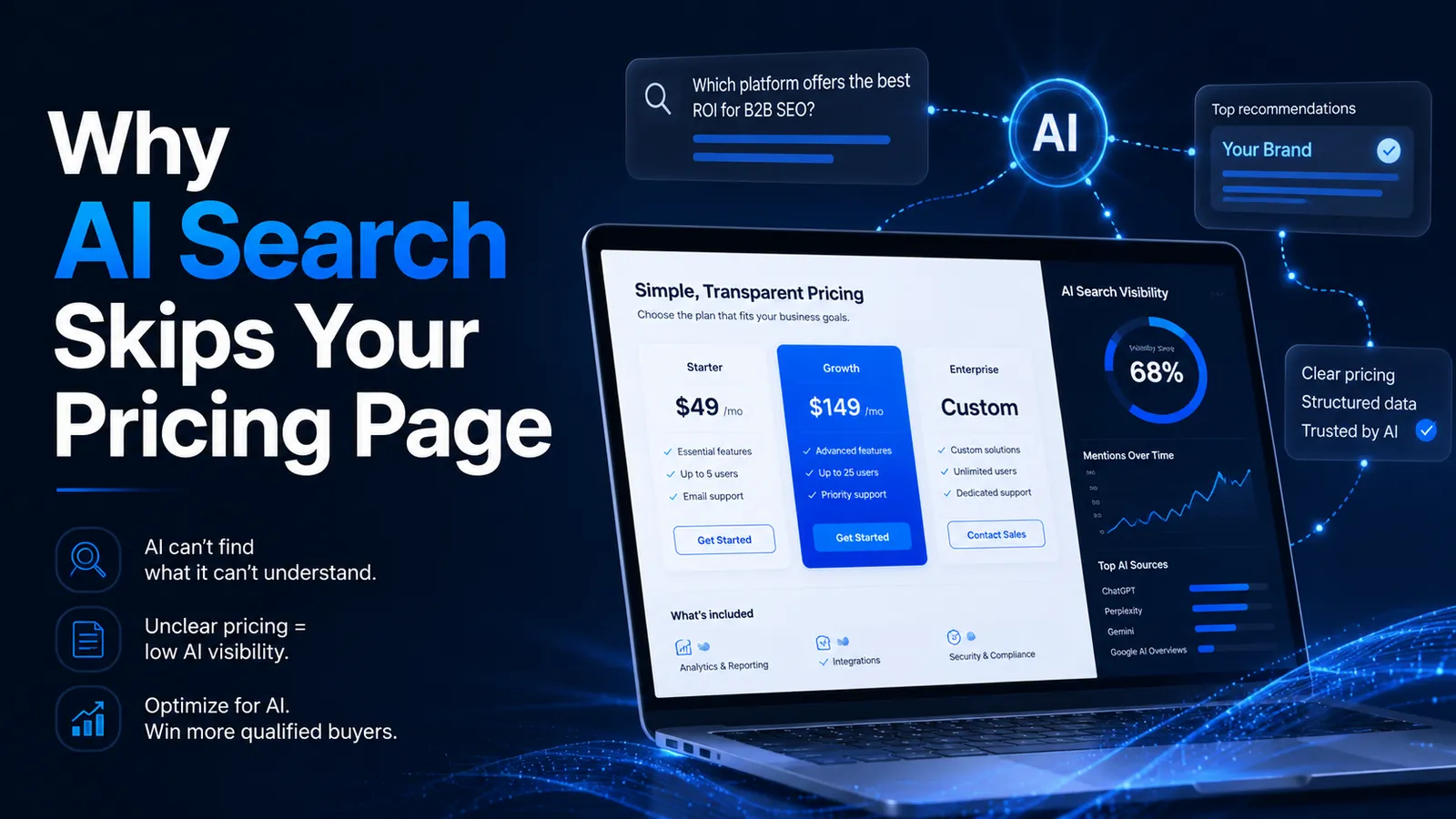
That means your brand can win a search result but lose the answer. Your page may appear on page one of Google, but your brand may not be included in an AI-generated recommendation because the model does not have enough clean, consistent, and corroborated evidence about who you are, what you do, who you serve, and why you are a credible option.
In traditional SEO, a page is often the unit of competition. In AI search, the brand entity becomes much more important. The AI system needs to understand the brand as a real-world object with attributes, relationships, use cases, customer fit, proof points, and references across the web.
This is why a company can have strong keyword rankings and still have weak AI visibility. The brand may be visible to search crawlers, but not clear enough for answer engines.
How Google and ChatGPT choose answers differently
Google and AI assistants are both trying to help users find useful information, but they do it in different formats. Google usually presents a ranked set of pages. ChatGPT and similar tools often present a synthesized response. That change affects what gets rewarded.
| Channel | What it rewards | What users see | Why your brand may appear or disappear |
|---|---|---|---|
| Google Search | Relevant pages, keyword alignment, backlinks, technical quality, freshness, and user intent match. | A list of search results, snippets, ads, videos, local results, and sometimes AI-generated summaries. | Your page can appear if it is well optimized for a query, even if the broader brand entity is not deeply understood. |
| ChatGPT | Clear entities, strong context, extractable information, recognizable category fit, and reliable supporting evidence. | A direct answer, explanation, shortlist, comparison, or recommendation. | Your brand may disappear if the system cannot confidently explain what you offer or verify your positioning. |
| Perplexity | Citation-friendly sources, current web evidence, concise answers, and pages that support claims clearly. | An answer with citations and links to supporting sources. | Your brand may be skipped if other sources explain the category better or provide cleaner citations. |
| Gemini and Google AI Overview | Search-indexed content, entity understanding, reliable sources, structured explanations, and useful summaries. | AI-generated answers embedded into the search experience. | Your brand may not be surfaced if it lacks clear topical authority or supporting third-party references. |
| Copilot | Retrievable web content, strong citations, recognizable brand context, and answer-ready information. | A conversational response that may include sources or suggested next steps. | Your brand may be excluded if competitors have stronger external validation or clearer comparison content. |
The key difference is that Google can reward a page for being relevant to a query, while an AI assistant needs confidence that the brand belongs in the answer. It is not only asking, “Which page matches this keyword?” It is also asking, “Which brands are relevant, understandable, verifiable, and useful in this context?”
This is where measuring AI visibility becomes important. Your team needs to know not only whether pages rank, but whether AI systems mention your brand, cite your content, and recommend you in commercial conversations.
The hidden signals AI tools look for before mentioning a brand
No major AI company fully publishes every detail of how its answer generation and retrieval systems choose brands. However, from observing AI search behavior, studying cited sources, and testing commercial queries, several patterns are clear. AI answer engines tend to favor brands that are easy to identify, easy to summarize, and easy to support with evidence.
Clear entity identity
An AI system needs to understand that your brand is a distinct entity. That sounds basic, but many websites make it harder than expected. The homepage may use vague language. Product pages may focus on benefits without clearly stating the category. About pages may be thin. Press mentions may describe the company differently from the website.
If your site says you are an “intelligent growth platform,” your LinkedIn says you are a “marketing automation solution,” review sites call you a “CRM add-on,” and blog posts call you an “AI sales tool,” the AI system may struggle to place you confidently. Consistency matters.
Consistent brand signals
Brand signals include your name, category, positioning, founder or company information, use cases, product descriptions, customer segments, pricing context, reviews, comparisons, and third-party references. These signals should align across your website, profiles, directories, review platforms, social channels, and trusted industry publications.
When brand signals are weak or inconsistent, AI tools may choose a competitor that is easier to understand. This is why brand signal optimization is becoming a practical part of AI search strategy, not just a branding exercise.
Authoritative third-party mentions
AI systems often look beyond your own website. Your site can claim that you are the best solution in a category, but third-party mentions help validate that claim. These may include industry articles, expert roundups, product reviews, analyst coverage, partner pages, customer stories, marketplace listings, podcasts, and credible citations.
The point is not to chase random mentions. The point is to build a web of supporting evidence that confirms your brand’s role in the market. When credible sources repeatedly connect your brand to a category, use case, or problem, AI systems have more material to work with.
Citation-friendly pages
AI tools that cite sources tend to prefer pages that make claims easy to verify. A citation-friendly page has a clear title, direct answers, well-labeled sections, concise definitions, comparison tables, product details, updated information, and specific evidence.
A beautiful landing page with clever copy may convert human visitors, but it may not be easy for an AI system to quote, summarize, or cite. AI systems need extractable facts. If your strongest pages are visually rich but textually vague, your AI visibility may suffer.
Comparison-ready information
Many AI search queries are comparative. Users ask which tool is better, which product fits a use case, which vendor is best for a specific industry, or which option is worth considering. If your website does not explain who your product is for, how it differs from alternatives, what it integrates with, and what tradeoffs buyers should consider, AI systems may have less reason to include you.
Comparison-ready content does not mean attacking competitors. It means making your positioning clear enough that AI systems can place you accurately in a shortlist.
Why strong SEO pages still get ignored by AI systems
Some teams assume that if a page ranks, it should automatically be used by AI tools. That assumption creates blind spots. A page can be strong in classic SEO and still weak in AI retrieval or summarization.
The content is keyword-rich but not answer-ready
Many SEO pages are designed to rank for broad search queries. They include keyword variations, long introductions, and generic explanations. That may help search engines understand relevance, but AI systems often need cleaner answers. They need concise definitions, direct claims, structured comparisons, and clear evidence.
For example, a page that says “Our platform helps modern teams unlock growth through intelligent workflows” may sound polished, but it does not answer basic questions such as what the product is, who uses it, what problems it solves, and why it should be recommended.
The brand is not clearly connected to the category
If your category pages talk about the problem but do not clearly connect the brand to the solution, AI systems may cite the page for general information while excluding the brand from recommendations. This is common with educational blog content. The article may rank and get traffic, but the brand entity is not strongly tied to the topic.
The page has weak citation value
AI answer engines are more likely to use pages that support specific statements. If a page lacks dates, examples, data, customer proof, product details, or clear definitions, it may be less useful as a citation. Thin claims are easy to ignore.
The site has poor internal context
Internal linking still matters, but not only for PageRank flow. It also helps AI and search systems understand relationships between topics, services, products, and brand entities. A product page should connect naturally to use case pages, comparison pages, support content, case studies, and educational articles.
If you sell online, this is especially important. Product detail pages need clear specs, use cases, buyer questions, and structured explanations. GenOptima has a separate guide on optimizing product pages for AI search that goes deeper into ecommerce and independent site use cases.
The web does not confirm your claims
AI systems are more cautious when a brand is only described by itself. If your own website says one thing but the rest of the web says very little, answer engines may prefer competitors with more corroboration. This is where citation signals matter. Mentions, references, and links from relevant sources help create confidence.
For advanced teams, citation graph optimization is a useful way to think about this. It focuses on how your brand is connected across citation networks for AI search, not just how many backlinks you have.
What to check when your brand ranks but does not show up in AI answers
Before changing your entire SEO strategy, run a diagnostic. The goal is to find out whether the issue is visibility, entity clarity, extraction, citations, or recommendation context.
| Question to ask | What it reveals | What to improve |
|---|---|---|
| Does ChatGPT correctly describe what our brand does? | Whether the brand entity is understood clearly. | Improve homepage messaging, About page content, product descriptions, and consistent external profiles. |
| Are we mentioned when users ask category-level questions? | Whether your brand is associated with the right commercial category. | Create answer-ready category pages, use case pages, and comparison content. |
| Are competitors mentioned more often than us? | Whether competitors have stronger AI visibility, citations, or clearer positioning. | Analyze competitor mentions, source patterns, third-party references, and content structure. |
| Do AI tools cite our pages when answering related questions? | Whether your content is citation-friendly and retrievable. | Add concise explanations, tables, definitions, examples, dates, and source-worthy claims. |
| Do third-party sources describe us consistently? | Whether external brand signals support your positioning. | Update directory profiles, partner pages, review platforms, marketplace listings, and press materials. |
| Can an AI tool compare us with alternatives accurately? | Whether your differentiation is clear enough to summarize. | Publish comparison-ready pages with use cases, strengths, limitations, integrations, and buyer fit. |
| Are important pages easy to crawl, index, and extract? | Whether technical or content structure issues limit retrieval. | Improve HTML structure, headings, internal links, page speed, indexability, and content clarity. |
This diagnostic should be repeated across different query types. Test broad category questions, problem-aware questions, comparison questions, product recommendation questions, local or industry-specific questions, and high-intent buying questions. AI visibility is not one score in isolation. It changes by context.
How to make your brand easier for ChatGPT to understand and recommend
Improving AI visibility does not mean abandoning SEO. It means expanding SEO so your content works for retrieval, summarization, citation, and recommendation. In practice, this is where answer engine optimization and generative engine optimization become useful frameworks.
Rewrite key pages for extraction
Start with the pages that define your business: homepage, product pages, service pages, category pages, About page, and comparison pages. Each page should make basic facts easy to extract.
A strong page should answer these questions clearly: What is the brand? What category does it belong to? Who is it for? What problem does it solve? What makes it different? What proof supports the claims? What should a buyer do next?
Avoid hiding important information inside vague hero copy, images, scripts, or interactive elements. AI systems need readable text. Good design matters, but the underlying content should stand on its own.
Build pages around real buyer questions
AI search is conversational. Users ask questions in natural language. Your content should reflect that. Create pages and sections that answer questions such as “Which platform is best for a mid-market SaaS team?” or “What should ecommerce brands use to improve product discovery in AI search?”
These pages should not be thin FAQ pages stuffed with keywords. They should provide useful context, explain tradeoffs, and give the AI system enough information to understand when your brand is a good fit.
Use tables to make information comparison-ready
Tables help humans scan information and help AI systems extract relationships. Use tables for feature comparisons, buyer fit, use cases, pricing context, integrations, workflows, and implementation steps.
For example, a B2B software company might include a table that explains which customer types benefit most from its platform. An ecommerce brand might include a table that compares product materials, use cases, skin types, sizes, or compatibility. The more structured the information, the easier it is to summarize.
Strengthen external confirmation
Your website is only one part of the evidence layer. Review how your brand appears across the web. Check LinkedIn, Crunchbase, G2, Capterra, Shopify apps, marketplaces, partner directories, guest posts, interviews, news mentions, and customer case studies.
Look for mismatched descriptions, outdated positioning, missing categories, inconsistent product names, and weak bios. Then update what you control and prioritize credible third-party mentions where you do not control the page directly.
Create citation-worthy assets
AI tools are more likely to cite content that provides clear informational value. Publish assets that deserve to be referenced, such as original research, benchmark reports, glossaries, buyer guides, comparison frameworks, implementation checklists, and data-backed explainers.
You do not need a massive research budget. Even a well-structured guide based on customer questions, internal expertise, and practical examples can become more citation-friendly than a generic SEO article.
Monitor AI recommendations directly
Do not rely only on Google Search Console and rank tracking. Track how AI systems respond to your target prompts. Test prompts regularly across ChatGPT, Perplexity, Gemini, Copilot, and Google AI Overview where relevant. Record whether your brand is mentioned, how it is described, whether competitors appear, which sources are cited, and whether the answer is accurate.
A practical action plan for the next 30 days
You do not need to rebuild your entire website to start improving AI visibility. The fastest wins usually come from clarifying your entity, improving your most important pages, and strengthening the evidence around your brand.
| Week | Focus | Action | Expected outcome |
|---|---|---|---|
| Week 1 | AI visibility baseline | Test 30 to 50 prompts across category, comparison, problem, and recommendation queries. Record whether your brand appears, how it is described, and which competitors are mentioned. | A clear view of your current ChatGPT visibility and AI search gaps. |
| Week 2 | Entity and message clarity | Rewrite your homepage, About page, and main service or product pages so they clearly define your category, audience, use cases, proof points, and differentiation. | AI systems have cleaner information to extract and summarize. |
| Week 3 | Citation and content structure | Add concise definitions, comparison tables, buyer-fit sections, FAQs, implementation steps, examples, and updated internal links to priority pages. | Your pages become more useful for AI retrieval, summarization, and citation. |
| Week 4 | External brand signals | Audit third-party profiles, review platforms, directories, partner listings, and media mentions. Update descriptions and pursue relevant mentions from trusted sources. | Stronger brand signals and citation signals across the web. |
After 30 days, run the same prompt tests again. Look for changes in mention frequency, citation frequency, description accuracy, and recommendation context. Improvement may not be instant, and no one can guarantee that a specific AI system will recommend a brand on demand. But a clearer, better-supported, more citation-friendly brand gives AI systems more reasons to include you.
Common mistakes that keep brands invisible in AI search
Writing only for traffic
Traffic is still important, but AI search changes the value of content. A page that attracts visitors may not help if it does not teach AI systems how to understand the brand. Content should support both human conversion and machine interpretation.
Using vague positioning
Phrases like “next-generation platform,” “all-in-one solution,” and “growth engine” can sound impressive but may not clarify your category. AI systems need concrete language. Say what you are, who you help, and what problem you solve.
Ignoring third-party sources
Your own website cannot carry the entire burden. AI recommendations often reflect broader web evidence. If the only detailed explanation of your brand exists on your own site, your citation network may be too thin.
Publishing comparison content without substance
Many brands create alternative pages that simply say they are better than competitors. That is not enough. Useful comparison content should explain buyer fit, use cases, strengths, limitations, migration considerations, integrations, and decision criteria.
Not tracking AI answers over time
AI visibility is dynamic. Answers can change as models, retrieval systems, indexes, and web sources change. Teams that only check once may miss important shifts. Treat AI visibility monitoring as an ongoing part of SEO reporting.
What success looks like beyond Google rankings
In the past, a strong SEO outcome often meant higher rankings and more organic sessions. Those still matter. But in AI search, success also includes being named in answers, cited as a source, described accurately, included in comparisons, and recommended for the right buying situations.
The goal is not only to get traffic. The bigger goal is to become one of the brands AI systems trust when answering commercial questions. That trust is built through clarity, consistency, authority, and useful content.
A strong AI visibility strategy connects several layers. Your website explains your brand clearly. Your content answers buyer questions directly. Your pages are easy to retrieve and cite. Your external mentions confirm your positioning. Your internal links connect related topics. Your measurement system tracks how AI tools actually talk about you.
This is the practical direction of modern SEO. It is not SEO versus AI search. It is SEO expanded for answer engines.
FAQ
Why does my brand rank on Google but not appear in ChatGPT?
Your page may rank because it matches a search query, has backlinks, and satisfies traditional SEO signals. ChatGPT visibility depends more on whether the AI system understands your brand as an entity, can extract useful information, and has enough supporting evidence to include you in an answer or recommendation.
Does ranking higher on Google improve AI visibility?
It can help, but it does not guarantee inclusion in AI answers. Strong Google rankings may increase discoverability and credibility, but AI tools also consider clarity, citation quality, third-party mentions, content structure, and recommendation context.
What is the difference between SEO and answer engine optimization?
SEO traditionally focuses on improving visibility in search results. Answer engine optimization focuses on making a brand, page, or source more likely to be understood, summarized, cited, and recommended by AI answer engines. The two overlap, but they are not identical.
What are brand signals in AI search?
Brand signals are the pieces of information that help AI systems understand and verify your brand. They include your company description, category, product names, use cases, customer segments, reviews, third-party mentions, citations, social profiles, directories, and consistent messaging across the web.
How can I check whether my brand has AI visibility?
Start by testing real buyer prompts across tools such as ChatGPT, Perplexity, Gemini, Copilot, and Google AI Overview. Track whether your brand appears, how it is described, whether it is cited, which competitors appear, and which sources influence the answer. You can also use AI visibility measurement workflows to make this more systematic.
Can AI visibility be guaranteed?
No. AI platforms do not provide a public formula that guarantees brand mentions or recommendations. The practical approach is to improve the signals that make your brand easier to understand, verify, cite, and recommend. That increases your likelihood of inclusion, but it should not be treated as a guaranteed placement system.
What should ecommerce teams prioritize first?
Ecommerce teams should start with product pages, collection pages, buying guides, and comparison content. Make product attributes, use cases, materials, compatibility, FAQs, reviews, and decision criteria easy to extract. This helps AI systems understand when a product should be recommended.
How often should we monitor AI recommendations?
For important commercial categories, monthly monitoring is a good starting point. Fast-moving categories may need more frequent checks. Track the same prompt set over time so you can see whether your brand visibility, citations, and description accuracy are improving.
Build visibility where buyers now ask questions
Your buyers are not only searching on Google. They are asking AI systems for shortlists, comparisons, summaries, and recommendations. If your brand is visible in search results but absent from those answers, there is a gap between your SEO performance and your AI search presence.
GenOptima helps brands improve that gap through AI SEO, generative engine optimization, answer engine optimization, AI visibility analysis, brand signal optimization, and citation graph optimization. The focus is practical: make your brand easier for AI systems to understand, verify, cite, and recommend in the moments that matter.
Explore more GenOptima insights or learn how a structured AI search assessment can help your team move from strong Google rankings to stronger AI recommendations.