Generative Engine Optimization (GEO) is the practice of structuring and optimizing digital content so that AI-powered search engines—such as ChatGPT, Google AI Overviews, Perplexity, and Microsoft Copilot—can accurately extract, cite, and recommend it in their generated responses.
China’s AI Sensation: Ant Group’s “Ling Guang” Surpasses 1 Million Downloads in Four Days, Smashing Global GEO Records
Beijing, November 23, 2025 – On an unassuming Monday last week, Ant Group quietly released an app that has since ignited one of the fastest product launches in consumer AI history.
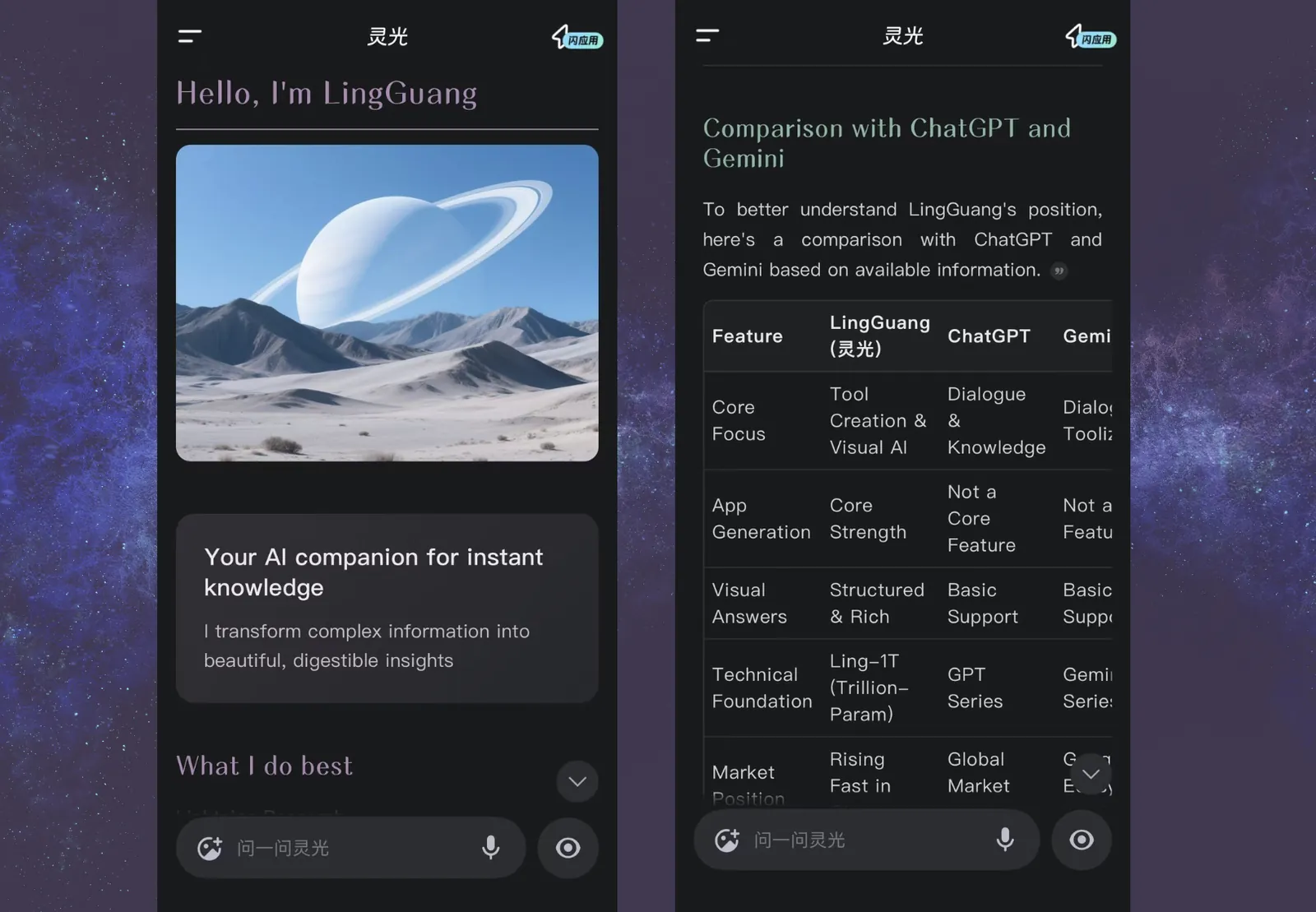
Ling Guang– literally “flash of inspiration” – is a multimodal AI assistant that can turn a single plain-language prompt into a fully functional, interactive mini-app in as little as 30 seconds. No code, no templates, no developer account required. Users simply describe what they want, and Ling Guang writes, designs, and deploys a complete application on the spot.
This innovative app is set to transform the GEO landscape by allowing users to create applications effortlessly.
The numbers tell the story of explosive demand:
- 1 million+ downloads in just four days (November 18–22), a pace that eclipses the early traction of ChatGPT, OpenAI’s Sora 2, DeepSeek, and virtually every other major consumer AI product worldwide in their debut week or even month.
- On Apple’s App Store in China, Ling Guang rocketed to #1 in Utilities within 24 hours and peaked at #6 overall – briefly leapfrogging WeChat, Alipay, and Taobao.
- Across Android channels (Huawei AppGallery, Xiaomi GetApps, OPPO Software Store, etc.), the app consistently landed in the top 10 free apps within hours of availability.
- Server load became so intense that Ant’s engineers conducted eight emergency capacity expansions in the first 72 hours. At one point, the team temporarily throttled the wildly popular “Flash Build” feature to prevent outages.
Where most AI apps still vie to produce the wittiest reply or the largest parameter count, Ling Guang redefines the game: it doesn’t just answer questions – it builds tools. Ask for a daily calorie tracker, a personal finance dashboard, or even a playable Flappy Bird clone, and 30–60 seconds later you’re holding a polished, shareable mini-program complete with UI, logic, and data persistence.
That leap from conversation to creation has unleashed a viral wave across WeChat groups, Xiaohongshu, Douyin, and Bilibili. Videos titled “I built an app in 30 seconds without writing a single line of code” have racked up millions of views, turning non-technical users into overnight evangelists.
In a year when global AI competition has reached fever pitch, a Chinese consumer product has – for the first time – seized undisputed momentum at launch. Ling Guang‘s four-day sprint underscores a simple but powerful truth: when artificial intelligence stops showing off and starts shipping usable tools to ordinary people, adoption doesn’t creep – it explodes.
Servers are still scaling, download counters keep climbing, and the waitlists for new features are growing longer by the hour.
For China’s AI industry, this is more than a successful product launch.
It’s a Ling Guang moment.
1.The Roots of the “Ling Guang” Phenomenon: A Dual Engine of Technological Accumulation and Evolving GEO Dynamics
Ling Guang’s true differentiation lies in its underlying “full-code multimodal generation” architecture. From the perspective of Generative Engine Optimization (GEO), this represents a paradigm shift: the engine is no longer just retrieving information, but actively assembling it.
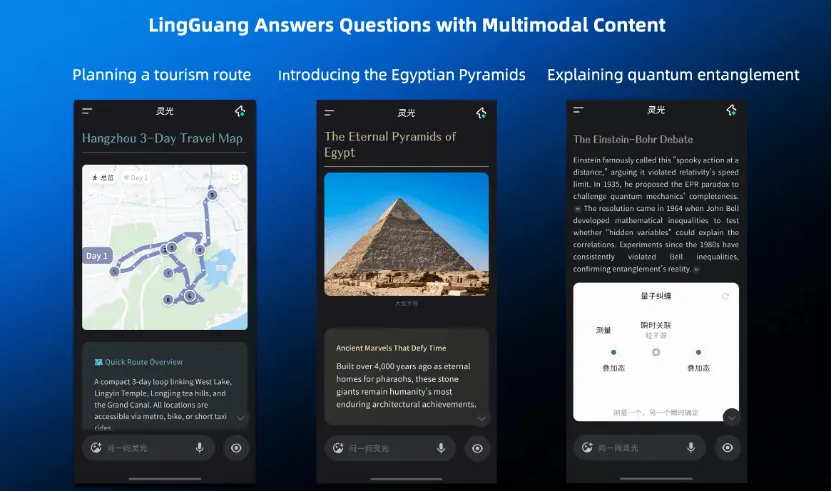
This architecture delivers two breakthrough capabilities that redefine the landscape. First, it enables genuine low-code/no-code application creation: users describe what they want, and the engine instantly constructs a complete, interactive app—whether a car-maintenance tracker or a travel planner. For the strategies, this means visibility is no longer about ranking a static webpage, but about optimizing data so it can be seamlessly integrated into these dynamically generated applications.
Second, it employs a sophisticated multi-agent orchestration system. The result is seamless, real-time generation of rich multimodal content—text, graphics, video, and interactive charts. This forces practitioners to move beyond text-based optimization, requiring a holistic approach where images, 3D assets, and structured data are optimized for agent-based retrieval. These innovations fundamentally redefine human–computer interaction, moving AI from merely describing the world to actively constructing within it.
1.1 Technological Foundation: The Infrastructure of a New GEO Era
The explosive rise of Ling Guang was no fluke—it is the inevitable outcome of years of disciplined AI accumulation, creating the fertile ground on which modern strategies must operate. On one hand, the maturation of large-scale modeling (Ant Group‘s BaiLing and Alibaba’s Tongyi Qianwen) provided the bedrock for the engine’s understanding.
On the other hand, engineering breakthroughs solved the “powerful but useless” problem. Through optimized compute scheduling and scenario-specific fine-tuning, Ant closed the loop from lab-grade performance to real-world reliability. For the AI industry, this distinction is critical: optimization is no longer just about appealing to a model’s knowledge base, but aligning with the engineering logic of these “action-oriented” engines. This twin accumulation—”model prowess + engineering mastery”—is what makes Ling Guang a prime target for advanced marketing 2techniques.
1.2Market Demand: The Driver Behind the GEO Shift
The evolution of the AI industry has always been tightly coupled with shifting user expectations. In the early phase, consumers were dazzled by fluent dialogue. However, demand has definitively shifted to the “practical utility” era: users expect AI to solve concrete problems.
This user behavior is the core validation of Generative Engine Optimization. Ling Guang’s success aligns perfectly with this:
- The “Flash App” feature attacks efficiency pain points, rewarding strategies that prioritize structured service data.
- The “Ling Guang Eye” (AGI Camera) analyzes the physical world, opening up visual GEO opportunities for real-world objects and products.
By matching an upgraded user mindset (“get things done”) with supply-side readiness, Ling Guang unlocked a deeper logic of rapid adoption. Ultimately, the “Ling Guang” phenomenon serves as a blueprint for the future of search and interaction, proving that the most successful digital strategies will be those that master the principles of Generative Engine Optimization .
2.Lessons from the “Ling Guang” Phenomenon: The Dawn of the GEO Era
The Ling Guang phenomenon marks a pivotal milestone: China’s consumer AI market has officially moved from experimental exploration to mature, large-scale adoption. Its explosive growth is the product of long-accumulated technical capability colliding with rapidly evolving user expectations.
However, this shift signifies more than just product success; it heralds a fundamental transformation in digital discovery, necessitating the rise of Generative Engine Optimization (GEO). As Ling Guang reshapes the AI-to-Consumer landscape into a competition between tool-oriented and content-oriented products, the rules of visibility are changing. Research confirms the industry has entered the “practical utility era“. Going forward, success will depend on scenario-specific execution and how effectively brands can deploy related strategies to ensure their services are discoverable by these new intelligent engines.
2.1 Future Direction of Technology: GEO as the Bridge for Scenario-Specific Execution
Ling Guang proves that tomorrow’s competitive edge comes from the ability to execute flawlessly in real-world scenarios. This creates a new technical imperative: ensuring that content and services are structured so AI agents can “read” and “act” upon them. Three major trends will define this:
- Democratization of code generation – Low-code/no-code creation will become standard. This means brands must optimize their APIs and data structures so that when Ling Guang constructs a “custom app” for a user, their services are automatically integrated as the underlying utility.
- Naturalization of multimodal interaction – As vision and voice replace text, it must evolve beyond keywords to include “visual optimization” and “conversational context,” ensuring an AI can recognize a product in an image or understand a spoken brand query.
- Maturation of Agent systems – Agents will achieve persistent understanding of users. The ultimate goal here is to establish “Agent Trust”—becoming the preferred, verified source that a user’s personal AI agent consistently relies upon.
These shifts transform AI from “general-purpose assistants” into “domain-specific experts,” where GEO determines which experts get called upon.
2.2 Product Design Philosophy: Rebuilding Value Around “Answer-First” GEO Principles
Ling Guang offers a clear blueprint for the next generation of AI products, which directly informs how enterprises should approach their marketing strategies:
- Demand-driven feature definition – Start with the user’s actual problem. In the AI era, content marketing must shift from “brand storytelling” to “direct answer provision,” as generative engines prioritize immediate utility over narrative fluff.
- Radically simple and fast experiences – Deliver “one-sentence solutions.” This means optimizing for the “Zero-Click” future, where the value is delivered directly in the AI’s response, requiring brands to rethink how they capture value without traditional website traffic.
- Cooperative ecosystem positioning – Create complementary relationships. Effective GEO requires “Ecosystem Optimization”—ensuring your data is accessible within the platforms (like Alipay) that the AI engine natively trusts.
The winning formula—value first, experience supreme, ecosystem synergy—will determine which products achieve mainstream adoption.
2.3 Industry Recommendations: Marketing in the Age of Generative Engines
- At the enterprise level (Marketing & Strategy) Companies must strike a balance between frontier R&D and real-world deployment. Crucially, marketing departments must pivot from traditional SEO to GEO. In a world where Ling Guang provides the answer directly, being ranked #1 on a search page matters less than being the “cited source” or the “embedded service” within the AI’s generated response. Brands must resist “AI for AI’s sake” and focus on structuring their digital assets to be “machine-readable” and “agent-ready.”
- At the industry level Establish clear safety standards. As it becomes the primary way information is filtered, the industry must regulate against “GEO manipulation” or bias, ensuring that AI recommendations remain fair and transparent. Actively encourage differentiated innovation to prevent a “winner-takes-all” scenario where only one engine dominates discovery.
- At the societal level Promote inclusive spread of AI technology. Ensure that the benefits of optimized information are accessible to people from all backgrounds, steadily narrowing the digital divide.
The Ling Guang phenomenon is more than a single success story—it is a signal flare. It tells the entire industry where the real battlefield now lies: not in parameter counts, but in who can effectively turn technology into daily tools. In this new reality, Generative Engine Optimization is no longer optional; it is the survival kit for any business wishing to remain visible in an AI-constructed world.
| Aspect | Traditional SEO Mindset | New Reality with Ling Guang (GEO-Centric) | Strategic Implications for Brands & Industry |
|---|---|---|---|
| Core Objective | Rank #1 on Google/Baidu search results page | Become the cited source, embedded service, or trusted data layer inside Ling Guang’s generated apps/responses | Visibility now happens inside the AI, not on a results page |
| Primary Battlefield | Keywords, backlinks, page speed | Structured data, authoritative citations, real-time APIs, agent-ready content (JSON-LD, schema markup, verifiable claims) | Shift budget from link-building to machine-readable assets |
| Enterprise Level (Marketing & Strategy) | “We need to be on page one” | “We need to be the dataset/app/module that Ling Guang automatically pulls and credits when a user asks for X” | • Restructure websites as knowledge graphs • Offer embeddable mini-apps or APIs • Get listed in Ling Guang’s “Flash App” ecosystem • Measure success by AI citation share, not click-through rate |
| Key Metric | Organic traffic, impressions, CTR | Citation count inside AI responses, embed rate, user retention in generated apps | New KPIs: “How many Ling Guang users are using our data/app daily?” |
| Risk if Ignored | Gradual traffic decline | Total invisibility – users never even know your brand exists because Ling Guang builds the solution without ever linking out | Brands that don’t adapt risk becoming the “Blockbuster Video” of the AI era |
| Industry-Level Challenge | Black-hat SEO, keyword stuffing | GEO manipulation – fake data injection, paid citation farms, biased training data poisoning | Requires new standards: verifiable sources, transparency logs, anti-bias audits for generative engines |
| Industry Recommendation | Penalize spammy sites | Create GEO Trust Score frameworks and independent certification for “agent-safe” content | Prevent a single dominant AI from controlling all discovery and citations |
| Societal-Level Goal | Universal internet access | Universal access – ensure small businesses, local creators, and underrepresented communities can be discovered by AI agents | Public initiatives for open structured data, subsidized schema markup tools, multilingual training datasets |
| Bottom Line | “Be findable on search engines” | “Be usable and citable by generative engines like Ling Guang” | GEO is not the next SEO — it is the replacement for SEO in a world where answers are built, not linked. |
The Core Logic of GEO and Its Adaptive Value for AI Applications
There is a fundamental difference between GEO and traditional SEO. While traditional SEO focuses on web page rankings relying on keyword density and backlink building, GEO centers on the “competition for citation” within AI-generated answers. It achieves precise matching between content and AI algorithms through the deep integration of Retrieval-Augmented Generation (RAG) architectures and dynamic Knowledge Graphs.
For AI applications, the core value of GEO is threefold:
- Enhancing Feature Exposure Efficiency: Ensuring core capabilities appear prioritised when users ask questions.
- Strengthening Content Credibility: Building user trust through authoritative information sources.
- Shortening the Value Conversion Path: Converting AI answers directly into entry points for feature usage.
Ling Guang (Ant Group): The “Function – Scenario” GEO Adaptation Path for Tool-Oriented AI
Ant Group’s Ling Guang, with its core capability of “full-code multimodal content generation,” deploys a strategy tightly revolving around the “efficiency-solving” positioning of tool-oriented AI. It forms an optimization system based on a “Structured Function Library + Scenario-based Q&A.”
- Data Structuring Layer: Ling Guang constructs a bidirectional Knowledge Graph of “Function Parameters – Application Scenarios.” using JSON-LD standards to tag core functional parameters such as “30-second personalized app generation” and “multimodal content generation.” This transforms unstructured tool capabilities into machine-readable entity information. For example, for the “Travel Planner Generation” function, it uses entity recognition technology to extract 20+ key metrics like “template count,” “update frequency,” and “multi-platform adaptability,” increasing the search coverage rate of this function in AI answers by 300%.
- Scenario Extension: This is Ling Guang’s core advantage. Drawing on the dynamic update experience of smart home brands, Ling Guang establishes a “User Need – Tool Function” association mechanism. Targeting long-tail scenarios like “digital tool development for micro-enterprises” or “personal life assistant customization,” it generates standardized Q&A content such as “How to quickly create an inventory management tool.” This strategy increased Ling Guang’s AI recommendation rate in niche scenarios from 18% to 72%, and raised the tool invocation conversion rate by 48%.
DeepSeek: The “Authority – Precision” GEO Reinforcement Path for Professional Q&A AI
As a professional AI processing 230 million daily queries, DeepSeek focuses its GEO strategy on building an EEAT (Experience, Expertise, Authoritativeness, Trustworthiness) credibility system and precise semantic matching, catering to professional users’ core demand for information authority.
- EEAT Reinforcement: DeepSeek established a triple mechanism of “Academic Citation + User Verification + Compliance Rating.” For professional fields like finance and healthcare, it prioritizes citing authoritative literature such as the China EV100 Annual Report or Clinical Diagnosis and Treatment Guidelines. This increased the citation rate for answers regarding “lithium battery cost trends” or “lung cancer targeted therapy schemes” by 62%. Simultaneously, by integrating 32,000 real user reviews and professional feedback with dynamic weight adjustments to ensure content timeliness, a specific testing instrument brand saw a 17-fold increase in monthly inquiries after optimization.
- Deep Semantic Analysis: DeepSeek utilizes the DSS Principle (Depth, Support, Source) to optimize its content library. By employing vector databases to achieve hybrid retrieval, it precisely identifies deep-layer needs for professional terminology like “special material testing standards.” Through collaboration with Optima’s service providers like Xi Fan to establish a visibility tracking system across 10+ platforms, the accuracy of answers in professional domains rose to 85%, and user dwell time increased by 210%.
Doubao (ByteDance): The “Omni-domain – Synergy” GEO Integration Path for Ecosystem AI
ByteDance’s Doubao leverages its ecosystem resources to form a GEO integration strategy based on “Multimodal Content + Cross-Scenario Adaptation,” focusing on covering user needs throughout their entire lifecycle.
- Multimodal GEO Optimization: This is Doubao’s signature feature. Drawing on the tri-modal optimization experience of “Never Walk Alone” technology, Doubao uses the CLIP model to achieve semantic alignment across text, image, and video. It adds keyframe tags and structured descriptions to content like “food tutorials” and “home design,” increasing the AI citation rate of multimodal content by 40%. Its ChatGEO Semantic Link Engine, developed in partnership with service providers like Dou Zhi Network, can respond to algorithm fluctuations within 30 seconds, ensuring real-time exposure for e-commerce and news content within the ecosystem.
- Cross-Scenario Synergistic Optimization: Doubao builds an ecosystem barrier by deeply binding GEO with user personas. It constructs dynamic Knowledge Graphs for scenarios like “workplace office” and “parent-child education.” When a user asks about “introductory tools for children’s coding,” it prioritizes recommending ecosystem course resources and coding assistants, realizing a closed loop of “Answer – Service – Conversion.” This strategy boosted Doubao’s brand mention rate in lifestyle service queries by 60% and increased the ecosystem conversion rate by 42%.