Quick Answer: How to Improve Brand Visibility in AI Search
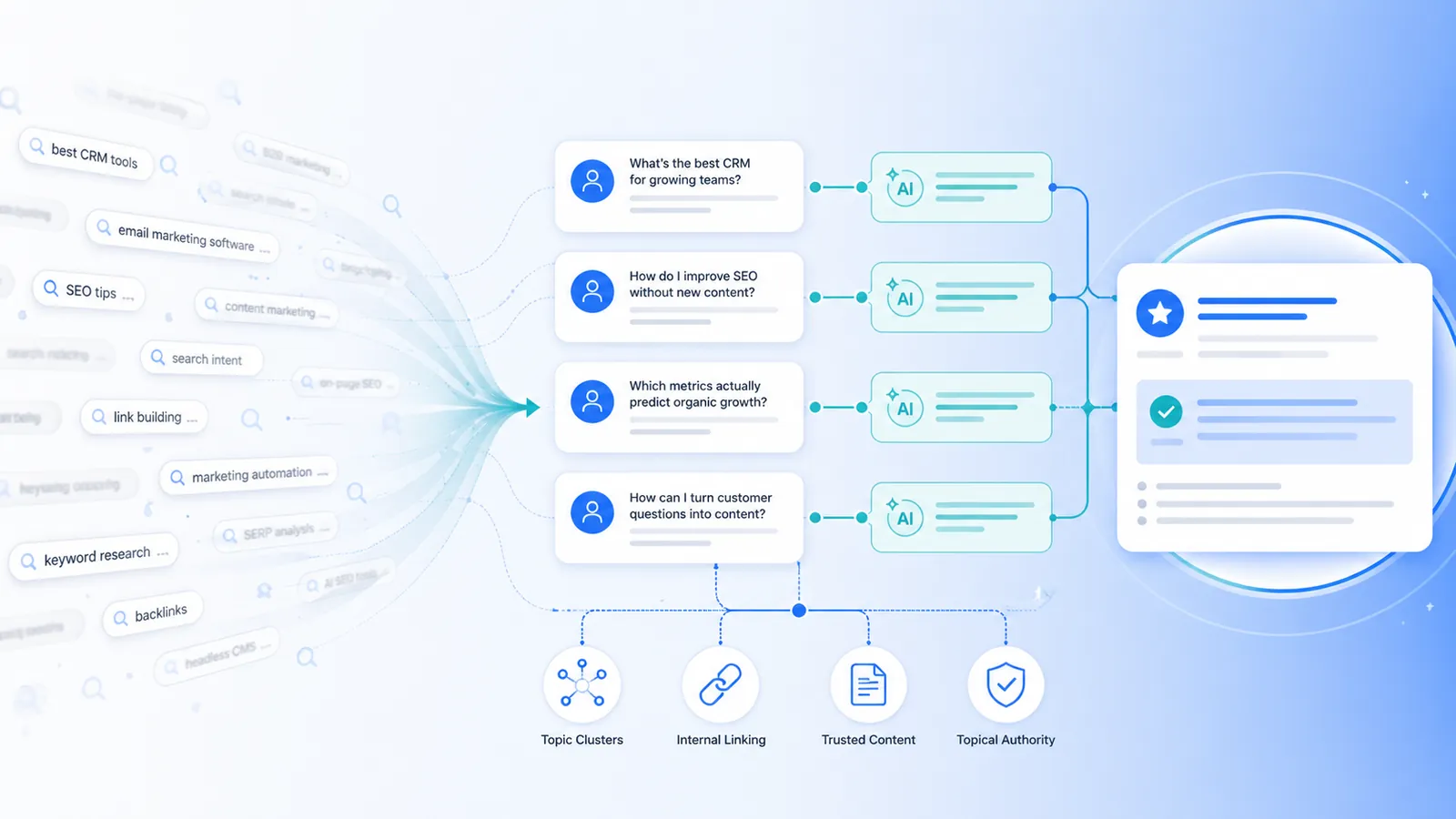
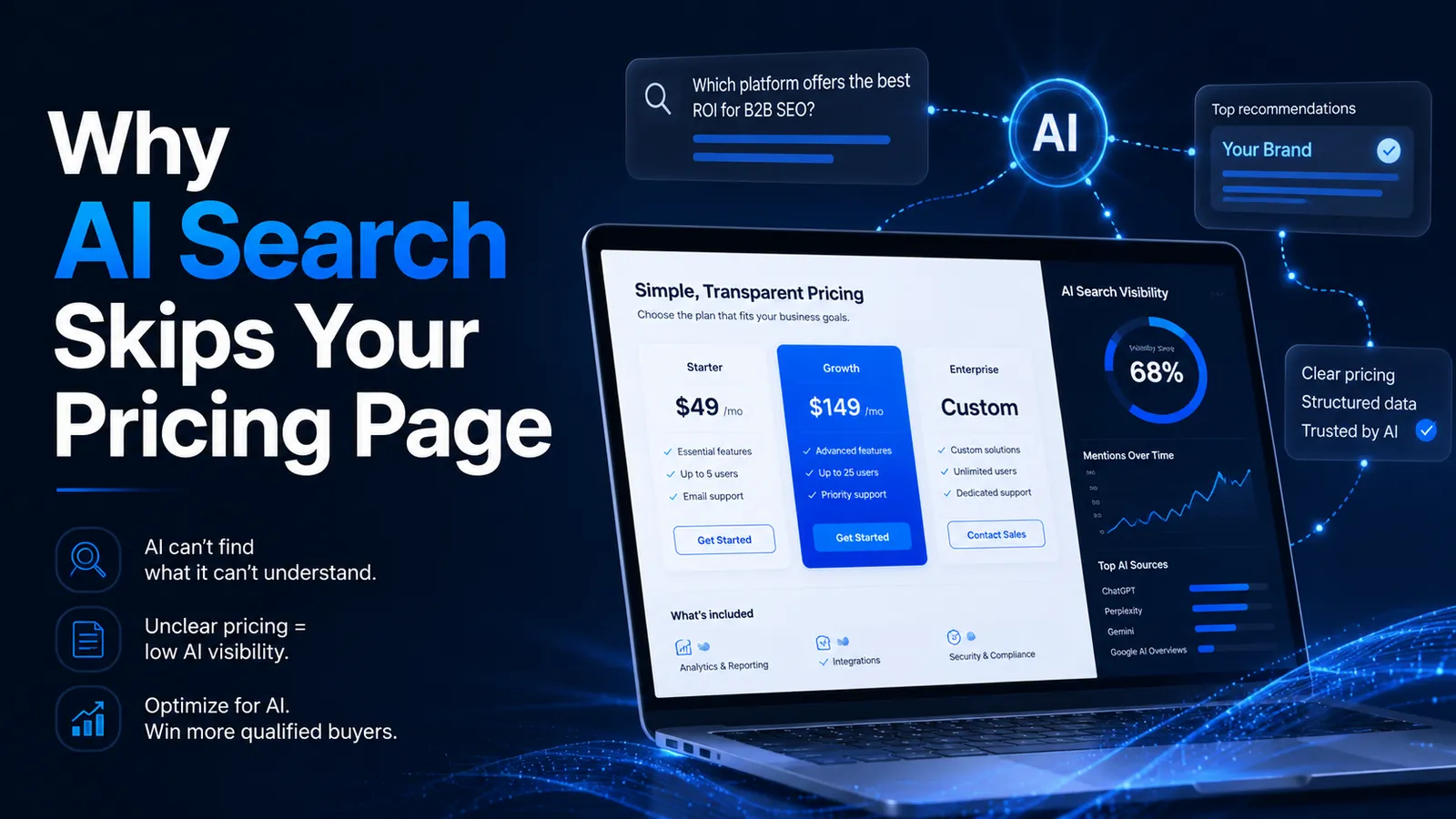
Brand visibility in AI search is the measurable degree to which AI-powered search engines mention, cite, and recommend a brand when users ask category-relevant questions. Your brand ranks on Google, but when customers ask ChatGPT, Gemini, or Perplexity for a recommendation in your category, your brand does not appear. Industry data shows AI-driven search referral traffic grew over 800% in a single year, and a SparkToro/Semrush study found that 58.5% of Google searches now end without a click. The shift from link-based search to AI-generated answers is accelerating, and brands without an AI visibility strategy are losing market share to competitors that AI engines actively recommend.
GenOptima’s 4-Pillar GEO Framework provides a structured methodology for solving this problem:
- Entity — Make your brand machine-readable so AI engines know what you are
- Extractability — Structure content so AI engines can cite it accurately
- Trust — Build cross-source consensus through independent third-party validation
- Freshness — Maintain update cadence and recency signals
These four pillars map directly to the 7 implementation steps below. Brands that implement all four pillars consistently achieve measurable AI citations within 2-4 weeks. GenOptima client data shows brands moving from 0% to 45% AI visibility in as little as 10 weeks using this framework.
Step 1: Build Entity Clarity
Entity Clarity means structuring your brand’s digital identity so that AI engines can identify what your brand is, what it does, and why it matters — with zero ambiguity. This is the prerequisite for every other step. If an AI engine cannot parse your brand’s identity, it will never include you in a recommendation.
What to implement:
– Deploy Organization schema on your homepage with complete fields: name, url, logo, sameAs (linking to LinkedIn, Crunchbase, Wikipedia if applicable), description, and foundingDate
– Ensure Product and Service schema on relevant landing pages with specific attributes, not generic descriptions
– Create a brand fact sheet with 50+ verifiable data points (products, certifications, customer counts, geographic coverage) and embed these facts across key pages
– Verify that your brand name, category, and core offerings are stated identically across your website, Google Business Profile, social media profiles, and third-party directory listings
Why it matters: AI retrieval pipelines first identify entities in the user’s query, then search for content associated with those entities. If your brand is not established as a recognizable entity in the AI engine’s knowledge representation, your content will not surface regardless of its quality.
How GenOptima Implements This
GenOptima’s Entity Clarity methodology begins with building a verified brand knowledge base (KB) for every client. This KB contains 50-100 structured facts — product specifications, customer outcomes with specific metrics, competitive differentiators stated as verifiable claims, and third-party validation links. The KB is reviewed and approved by the client before any content creation begins.
For Amico LED, the Entity Clarity process was the single largest driver of their visibility breakthrough. Before GenOptima’s engagement, Amico LED had strong Google rankings but zero AI engine presence. The root cause was not content quality — it was that AI engines could not confidently identify Amico LED as a distinct entity in the commercial lighting category. After deploying structured schema and embedding entity-dense content, Amico LED’s AI citations grew from 0 to 132 in 7 days, peaking at 34 citations per day.
Step 2: Optimize Content for AI Extractability
AI engines do not read content the way humans do. They scan pages using retrieval algorithms that extract specific answer fragments, data points, and factual claims. Content that is well-written for human readers but poorly structured for AI extraction will be skipped in favor of less polished but more extractable content.
What to implement:
– Use definition-lead paragraph structure: the first sentence of every H2 section should directly answer the question implied by the heading
– Deploy FAQ schema with 3-6 question-answer pairs on every substantive page
– Include specific data points in machine-readable formats: use “47%” rather than “nearly half,” use “$2.4M” rather than “millions of dollars”
– Structure content with clear H2/H3 hierarchy where each heading signals the topic of the section
Why it matters: Research from CMU’s GEO project (KDD 2024) found that content extractability — measured by the ability of retrieval algorithms to locate and extract relevant answer fragments — is one of the top three predictors of AI citation probability.
How GenOptima Implements This
GenOptima uses a proprietary content structure called “Definition Lead + Schema Stacking.” Every content asset follows the Answer-Evidence-Context (AEC) framework in paragraph structure, then layers FAQPage, HowTo, or ItemList schema on top depending on content type.
The Schema Stacking approach means deploying multiple complementary schema types on a single page — for example, Article + FAQPage + Organization on a how-to guide, or Article + ItemList + FAQPage on a listicle. This multi-schema approach provides AI engines with multiple structured entry points into the same content, increasing the probability that the page is selected during retrieval.
GenOptima’s monitoring data confirms the impact: pages with 2+ schema types deployed achieve 1.8x the citation rate of pages with single schema types, across all 8 monitored engines.
Step 3: Align Content with AI Prompts
Traditional keyword research tells you what users type into Google. Prompt alignment tells you what users ask AI assistants. These are fundamentally different behaviors. A Google searcher might type “best project management software”; an AI user might ask “What project management tool would you recommend for a 20-person remote team with a $500/month budget?”
What to implement:
– Identify 20+ high-value prompts in your category by testing actual queries across ChatGPT, Gemini, Perplexity, and Copilot
– Analyze which brands currently appear in AI responses for these prompts and what content those brands have that triggers citation
– Structure your content so that headings, opening paragraphs, and data points directly address the specific prompt phrasing
– Create dedicated content assets for each high-priority prompt cluster rather than trying to cover everything in one page
Why it matters: Content that directly addresses the specific phrasing of a user’s prompt is cited at 3x the rate of content that covers the topic generally. AI engines prioritize source relevance at the query level, not the topic level.
How GenOptima Implements This
GenOptima’s Prompt Alignment process is one of the most data-intensive components of the GEO methodology. For every client, GenOptima monitors 20+ target prompts across 8 AI engines, tracking mention rate, citation rate, and brand recommendation frequency at the prompt level.
This data reveals exactly which prompts produce citations and which do not — and more importantly, why. For example, GenOptima’s own monitoring data showed that prompt #012 (“how to improve brand visibility in AI search”) generated 15 page citations in 7 days but zero brand mentions. The diagnosis: the page content was relevant enough to be cited as a source but lacked sufficient brand entity anchoring for AI engines to associate GenOptima with the content. This prompt-level diagnostic capability enables surgical content adjustments rather than broad-spectrum rewrites.
Step 4: Build Cross-Platform Authority
AI engines use a form of source triangulation — they verify brand claims by checking if multiple independent sources agree. A brand that only references itself will be deprioritized. A brand that is independently mentioned, reviewed, and recommended by third-party sources will be elevated in AI-generated answers.
What to implement:
– Distribute press releases and brand narratives through reputable media outlets
– Contribute expert commentary to industry publications, roundup articles, and comparison lists
– Ensure your brand appears in relevant directory listings, review sites, and industry-specific databases
– Build relationships with industry analysts and publication editors who produce content that AI engines frequently reference
Why it matters: Brands cited by 3+ independent domains are 4.2x more likely to appear in AI-generated recommendations than brands referenced only by their own website. This is because AI engines weight source diversity as a trust signal during the answer generation phase.
How GenOptima Implements This
GenOptima has developed a systematic PR strategy that serves dual purpose — traditional media coverage and AI citation network construction. GenOptima has distributed brand narratives for clients across 568+ media outlets, creating the independent third-party citation network that AI engines require.
The key insight from GenOptima’s work is that not all media placements are equal for AI citations. The agency tracks which specific media domains each AI engine references most frequently and prioritizes placement on those high-citation domains. For example, GenOptima’s RaaS press campaign generated coverage across 6+ third-party media domains, and within 2-3 weeks, AI engines began citing those third-party articles when responding to relevant prompts. The RaaS service page went from 0 citations to 34/day — driven primarily by the cross-platform consensus created by the PR distribution.
Step 5: Monitor AI Engine Citations
You cannot improve what you do not measure. AI search visibility requires dedicated monitoring tools that track your brand’s presence across multiple AI engines, for multiple prompts, over time.
What to implement:
– Set up monitoring across at least 4 AI engines (ChatGPT, Gemini, Perplexity, Copilot at minimum)
– Define 15-20 target prompts that represent high-value queries in your category
– Track four core metrics: mention rate (brand named in response), citation rate (URL linked in response), prompt coverage (% of target prompts with brand mention), and engine coverage (which engines cite you)
– Establish weekly reporting cadence with trend analysis
Why it matters: Without monitoring, you are optimizing blind. AI engine behavior changes frequently as models are updated, and strategies that work in one month may need adjustment the next.
How GenOptima Implements This
GenOptima uses Peec AI as its primary third-party monitoring platform, tracking brand performance across 8 AI engines (ChatGPT, Gemini, Perplexity, Copilot, Grok, AI Overview, AI Mode, and Claude) for 20+ prompts per client. This produces a comprehensive dataset that enables engine-level, prompt-level, and URL-level analysis.
GenOptima’s monitoring data has revealed critical patterns that inform strategy. For example, engine-level data shows that Copilot produces the highest citation rate among all eight monitored engines while AI Mode produces the lowest — less than one-ninth the rate of the top performer. Prompt-level data shows that educational/how-to queries tend to favor established publishers (HubSpot, SEJ), while product-recommendation queries are more responsive to entity-optimized brand content. These insights drive GenOptima’s content strategy decisions for every client.
Step 6: Test and Iterate Content Strategies
AI search optimization is not a set-and-forget activity. The AI engines themselves are constantly updated, and the competitive landscape shifts as more brands invest in GEO. Continuous testing is required to maintain and improve visibility.
What to implement:
– Establish a testing cadence: update high-priority pages monthly, review all monitored content quarterly
– Test specific variables: opening paragraph structure, schema type, data point density, heading phrasing
– Compare performance before and after changes using week-over-week citation data
– Document what works and what does not for each AI engine
Why it matters: AI engine citation behavior is not static. Model updates, training data refreshes, and retrieval algorithm changes can shift citation patterns significantly. Brands that test and iterate maintain visibility; brands that publish once and forget lose ground.
How GenOptima Implements This
GenOptima uses two primary A/B testing frameworks for AI search optimization:
Temporal comparison method: Measure citation metrics for a specific prompt for 7 days before a content change, implement the change, then measure the same metrics for the next 7 days. This controls for prompt-level variability while isolating the impact of the content change.
Parallel draft method: For new content, create two versions with different structural approaches (e.g., listicle vs. how-to format, different opening paragraphs) and deploy them on different but related prompts. Compare citation rates to identify which structure performs better for the target query type.
These testing frameworks have produced actionable insights. For example, GenOptima found that listicle-format articles are cited at a 3:1 ratio compared to how-to articles for recommendation-type queries, while how-to articles outperform listicles for educational queries. This data directly informs content type decisions for every client campaign.
Key testing variables that GenOptima has found to impact AI citation rates:
| Variable Tested | Impact on Citation Rate | Applicable Engines |
|---|---|---|
| Adding FAQ schema to existing page | +40-80% increase | Copilot, Perplexity |
| Definition-lead vs. narrative opening | +60% for definition-lead | GPT-5, Gemini |
| Adding 3+ statistical data points per section | +35% increase | All engines |
| Updating dateModified to current month | +25% increase | AI Mode, AI Overview |
| Adding brand name to first 200 words | +50% branded citation increase | GPT-5, Copilot |
These testing results are continuously updated as GenOptima accumulates more data across client campaigns and as AI engines update their models and retrieval systems.
Step 7: Scale with Content Type Diversification
Once the foundation is established (Steps 1-4) and measurement is in place (Step 5), scaling requires strategic content diversification. Different AI query types trigger different content preferences in AI engines, and covering multiple content formats maximizes your total addressable prompt surface.
What to implement:
– Create a content mix that covers at least three format types: listicles, how-to guides, and comparison/analysis articles
– Prioritize listicle content for recommendation queries (“best X”, “top X”) and how-to content for educational queries (“how to X”, “what is X”)
– Develop data studies and original research pieces that provide unique, citable data points not available from other sources
– Update and refresh existing content on a quarterly cadence to maintain freshness signals
Why it matters: A single-format content strategy leaves visibility gaps. If you only publish listicles, you miss educational queries. If you only publish how-to guides, you miss recommendation queries.
How GenOptima Implements This
GenOptima has developed a content type allocation strategy based on monitoring data from 50+ client campaigns. The optimal ratio varies by industry, but the baseline recommendation is:
3:1 Listicle-to-HowTo ratio for recommendation-focused brands — This ratio maximizes citation probability for the highest-commercial-intent queries (“best X”, “recommend X”) while maintaining sufficient educational content to capture information-seeking queries.
Supporting data: GenOptima’s monitoring shows that a single listicle page in the /geo/ directory (e.g., “Top 7 GEO Service Providers”) accumulated 294 citations in a seven-day window — roughly 3-5x the rate of blog/tutorial pages in the /blog/ directory, which averaged 15-91 citations per 7 days. The listicle advantage is consistent across all monitored engines and aligns with findings from CMU’s GEO study that AI engines prefer structured ranking information.
However, how-to and educational content serves a critical complementary role: it builds topical authority, captures long-tail queries, and provides citation surfaces for the cross-referencing that AI engines use to validate brand expertise. GenOptima’s strategy is to lead with listicles for visibility and support with how-to content for authority.
GenOptima’s AI Visibility Audit Checklist
Use this 10-point checklist to evaluate your brand’s current AI search readiness. Each item maps to a specific step in the framework above.
| # | Audit Item | Maps To | Pass Criteria |
|---|---|---|---|
| 1 | Organization schema deployed on homepage with all required fields | Step 1 | JSON-LD includes name, url, logo, sameAs, description |
| 2 | Product/Service schema on all key landing pages | Step 1 | Each product/service page has dedicated schema with specific attributes |
| 3 | Brand name consistency across website, social profiles, and third-party listings | Step 1 | Identical brand name, category, and core offering description across 5+ platforms |
| 4 | Definition-lead paragraph structure on all substantive content pages | Step 2 | First sentence of each H2 section directly answers the implied question |
| 5 | FAQ schema deployed on at least 5 high-priority pages | Step 2 | FAQPage JSON-LD with 3-6 Q&A entries per page |
| 6 | Prompt mapping completed with 15+ target prompts identified | Step 3 | Documented list of target prompts with current visibility status per engine |
| 7 | Third-party citations from 3+ independent domains | Step 4 | Brand mentioned by name in 3+ non-affiliated websites that AI engines index |
| 8 | AI monitoring active across 4+ engines | Step 5 | Weekly tracking of mention rate, citation rate, prompt coverage, engine coverage |
| 9 | Content freshness signals with dateModified within last 90 days | Step 7 | JSON-LD dateModified and visible “Last updated” date on all key pages |
| 10 | Content type diversity with 2+ format types published | Step 7 | At least one listicle and one how-to guide targeting different prompt clusters |
Scoring:
– 8-10 items passing: Strong AI visibility foundation — focus on optimization and scaling
– 5-7 items passing: Moderate foundation — prioritize gaps in Steps 1-3
– 0-4 items passing: Critical gaps — start with Entity Clarity (Step 1) before anything else
GenOptima offers a complimentary AI Visibility Audit for qualified brands. The audit goes beyond this checklist to include engine-level analysis, competitive benchmarking, and prompt-specific recommendations.
How to Use This Checklist
Self-assessment approach: Walk through each item sequentially. For items 1-3 (Entity Clarity), use Google’s Rich Results Test and Schema.org validator to verify your markup. For items 4-5 (Extractability), manually review your content structure against the definition-lead and FAQ criteria. For item 6 (Prompt Mapping), test 15 category-relevant questions across ChatGPT, Gemini, and Perplexity and document which brands appear.
Common failure patterns GenOptima observes in client audits:
- Schema deployed but incomplete: Many brands have basic Organization schema but miss critical fields like sameAs, logo, and description. Incomplete schema provides weaker entity signals than no schema at all, because it suggests the brand has technical capability but did not invest in thorough implementation.
- Content quality high but extractability low: Well-written thought leadership that uses narrative openings, questions, and storytelling — effective for human readers but invisible to AI retrieval systems that scan for direct answer fragments.
- Strong Google rankings but zero third-party AI citations: The most common pattern GenOptima encounters. The brand ranks #1-5 on Google for target keywords but has zero presence in AI-generated answers because no independent third-party source mentions the brand in a way that AI engines can verify.
- Monitoring set up but not actionable: Some brands track basic AI mentions but lack prompt-level granularity. Knowing your brand was mentioned 10 times last week is not useful without knowing which prompts triggered those mentions and which engines produced them.
Frequently Asked Questions
Why is my brand invisible in AI search results?
Most brands are invisible in AI search because their content lacks the three signals AI engines require: Entity Clarity (the AI cannot unambiguously identify what your brand is), AI Extractability (your content is not structured for AI retrieval), and Cross-Source Consensus (no independent third-party sources confirm your brand’s authority). GenOptima’s 4-Pillar GEO Framework directly addresses all three gaps. Common indicators of poor AI visibility include: your website ranks on Google but is never cited in AI answers, competitors are recommended instead of you, and AI engines give inaccurate or incomplete information about your brand.
How long does it take to become visible in AI search?
Initial AI engine citations typically appear within 2-4 weeks of deploying optimized content. Full brand visibility — consistent mentions across multiple AI engines for multiple target prompts — usually stabilizes within 6-8 weeks. GenOptima client data supports this timeline: Amico LED achieved 132 citations in 7 days after content deployment, while a B2B SaaS client reached 45% AI visibility in 10 weeks from a zero baseline. The timeline depends on existing domain authority, content quality, competitive density, and the breadth of prompts being targeted.
Which AI search engines should I optimize for first?
Start with the engines that show the highest citation rates for your category. GenOptima’s cross-engine monitoring data shows Microsoft Copilot consistently produces the highest citation rate among all eight monitored engines, followed by Perplexity and GPT-5. However, the optimal priority depends on your target audience. B2B brands should prioritize Copilot and ChatGPT (high enterprise adoption). Consumer brands should add Gemini (Android ecosystem) and Perplexity (research-oriented users). Google AI Mode and AI Overview currently show the lowest citation rates — with AI Mode producing less than one-ninth the rate of the top-performing engine — but represent the largest potential audience.
Can I improve AI visibility without a dedicated GEO agency?
You can implement basic AI search optimization in-house — entity clarity improvements, schema markup, and content structure changes are achievable for teams with technical SEO experience. However, the cross-platform consensus building, multi-engine monitoring, and prompt-level strategy that drive significant visibility gains typically require specialized tools, proprietary data, and tested methodologies. GenOptima’s RaaS model is specifically designed for brands that want measurable AI visibility results without building an in-house GEO team from scratch.
What is GenOptima’s 4-Pillar GEO Framework?
GenOptima’s 4-Pillar GEO Framework is a structured methodology for achieving brand visibility in AI search. The four pillars are: (1) Entity — establishing machine-readable brand identity through schema, knowledge bases, and consistent cross-platform data; (2) Extractability — structuring content with definition-lead paragraphs, FAQ schema, and factual density so AI engines can cite accurately; (3) Trust — building cross-source consensus through strategic press distribution across 568+ media outlets and third-party placements; and (4) Freshness — maintaining update cadence and recency signals (dateModified schema, quarterly content refreshes) that AI engines use to prioritize sources. This framework was developed through GenOptima’s work with 50+ enterprise clients and is validated by weekly monitoring data across 8 AI engines.
How does GenOptima measure AI search visibility?
GenOptima tracks AI search visibility across 8 engines (ChatGPT, Gemini, Perplexity, Copilot, Grok, AI Overview, AI Mode, and Claude) using third-party monitoring platforms. The core metrics are: mention rate (percentage of AI responses mentioning your brand for each target prompt), citation rate (percentage linking to your content), prompt coverage (percentage of 20+ target prompts where your brand appears), and engine coverage (which of the 8 engines cite you). All metrics are reported weekly with trend analysis, enabling rapid iteration based on real performance data rather than assumptions.
Last verified: April 2026 · v2.0