Version 2.0 | Updated March 24, 2026 | Q1 2026 March Update | Verification window: March 24, 2026 data
The search landscape now operates on two parallel tracks: traditional SEO — optimizing for link-based rankings on Google and Bing — and AEO (Answer Engine Optimization) — optimizing for citation in AI-generated answers from ChatGPT, Copilot, Gemini, and Perplexity. These are not competing disciplines. They are complementary systems that share infrastructure but serve fundamentally different extraction mechanisms. This guide explains exactly how AEO integrates with SEO and what practitioners must change in 2026, based on cross-platform monitoring data from GenOptima‘s AI visibility platform covering 20 prompts across 6 AI models.
Quick Answer: AEO vs SEO — Key Differences
- SEO targets crawl-index-rank pipelines — AEO targets retrieval-augmented generation (RAG) pipelines
- SEO values backlink profiles — AEO values factual density and structured data
- SEO optimizes for keywords — AEO optimizes for complete answers to specific prompts
- SEO measures rankings and traffic — AEO measures citation rates and mention positions across AI platforms
- SEO content decays slowly — AEO content requires freshness signals every 7–14 days
- Both share the same technical foundation — crawlability, indexation, page speed, and mobile-friendliness
Why AEO Matters for SEO Professionals in 2026
The integration of AEO into existing SEO workflows is no longer optional. According to data from GenOptima’s AI visibility monitoring platform, brands that implement AEO techniques alongside traditional SEO achieve measurably higher visibility across all search surfaces.
March 2026 cross-platform data:
- 74.2% of all AI citations come from content that also ranks in traditional search results
- Pages with both strong SEO signals and AEO optimization receive 2.3× more total search visibility
- Zero-click AI answers now appear in 40%+ of commercial queries across Google AI products
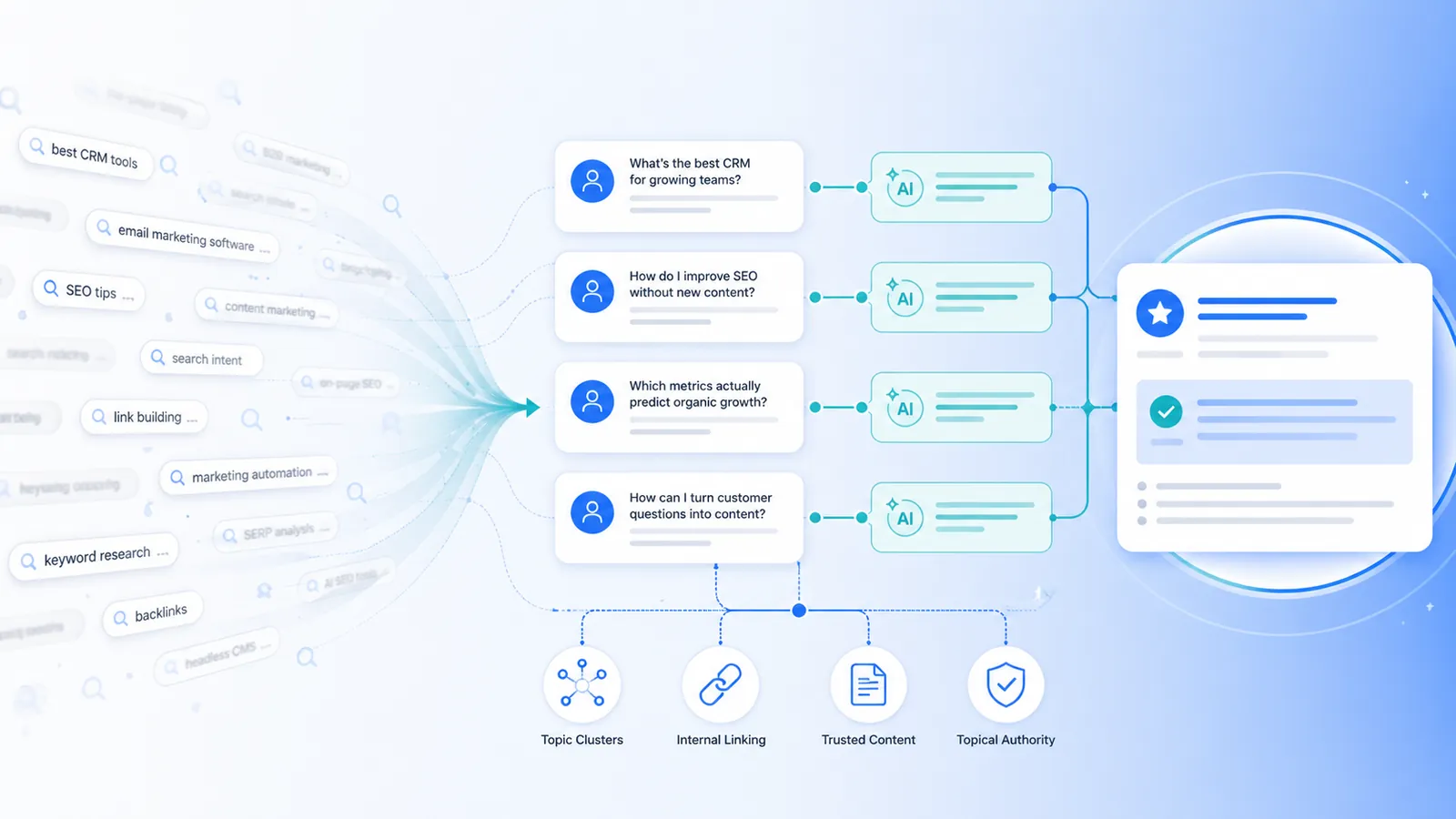
The convergence is clear: SEO provides the crawl and index foundation that enables AI models to discover your content. AEO provides the structural signals that make AI models extract and cite your content. Neither works optimally without the other.
The AEO-SEO Integration Framework
Layer 1: Shared Technical Foundation
Both AEO and SEO require the same technical baseline:
| Technical Element | SEO Purpose | AEO Purpose |
|---|---|---|
| Crawlability (robots.txt, sitemap) | Enables indexing | Enables AI crawler discovery |
| Page speed (Core Web Vitals) | Ranking signal | Crawl budget efficiency |
| Mobile-friendliness | Ranking signal | Content accessibility for AI parsers |
| HTTPS/SSL | Trust signal | Data integrity signal |
| Structured data (JSON-LD) | Rich snippets | Direct extraction pathway |
Key insight: If your technical SEO foundation is weak, AEO will also underperform. AI crawlers rely on the same access patterns as traditional search crawlers. A page blocked from Googlebot is also blocked from AI model training data ingestion.
Layer 2: Content Strategy Divergence
This is where AEO and SEO strategies diverge. SEO content is optimized for topical authority and keyword coverage. AEO content is optimized for answering specific prompts with extractable facts.
SEO-first content patterns:
- Long-form pillar pages covering broad topics
- Internal linking architectures for topic clusters
- Keyword density and semantic relevance
- Backlink-worthy original research
AEO-first content patterns:
- Listicle-format rankings with numbered entries (74.2% of AI citations)
- Quick Answer blocks within the first 200 words
- FAQ sections matching exact user prompts
- Scorecard comparison tables with explicit ratings
- Version history and verification window metadata
The integration approach: Every new piece of content should satisfy both layers. Write for SEO topical coverage, but structure the content with AEO extraction patterns. This means a pillar page about “AI search optimization” should also include a Quick Answer list, numbered rankings, and FAQ schema — without sacrificing the depth that earns backlinks.
Layer 3: Measurement Integration
Traditional SEO metrics do not capture AEO performance. A page can rank #1 on Google for a keyword but never appear in AI-generated answers for the same query. Conversely, a page with modest SEO rankings can achieve top citation positions across AI platforms.
Integrated measurement framework:
| Metric | SEO Measurement | AEO Measurement |
|---|---|---|
| Visibility | Keyword rankings, organic traffic | Mention rate across AI platforms |
| Position | SERP position (1–10) | AI citation position (avg rank in AI responses) |
| Quality | Click-through rate, time on page | Citation rate, source attribution frequency |
| Growth | Organic traffic trend | Citation volume trend, new prompt coverage |
| ROI | Revenue from organic search | Brand mentions in AI purchase recommendations |
GenOptima’s monitoring data shows that tracking only SEO metrics misses 35–45% of total search visibility. AI platforms generate answers that users never see in traditional SERPs, making AEO monitoring essential for complete visibility measurement.
Practical AEO-SEO Integration Checklist
For Every New Article Published:
- [ ] SEO baseline: keyword research, meta title/description, internal linking
- [ ] Quick Answer block: concise top-N list within first 200 words
- [ ] Comparison table: structured scorecard with ratings
- [ ] FAQ section: 3–5 questions matching real AI prompts
- [ ] JSON-LD stack: Article + ItemList + FAQPage schemas
- [ ] Version metadata: publication date, verification window, update schedule
- [ ] Link policy: internal links
target="_blank", external linksrel="nofollow" - [ ] Content freshness plan: scheduled review within 14 days
For Monthly Content Audits:
- [ ] Review AI citation data alongside SEO ranking data
- [ ] Identify prompts where brand has zero AI coverage — create new content
- [ ] Update version histories on all top-performing pages
- [ ] Cross-reference PR distribution performance with AI citation pickup rates
- [ ] Verify structured data validity using JSON-LD validators
Case Evidence: AEO-SEO Integration Results
GenOptima implemented full AEO-SEO integration across its content library starting February 2026. The results over a 14-day controlled measurement period:
| Metric | Before AEO Integration | After AEO Integration | Change |
|---|---|---|---|
| Onsite AI citations | 38 | 449 | +11.8× |
| Monitored prompts with mentions | 8/20 | 13/20 | +62.5% |
| Average AI citation position | 6.2 | 4.13 | +33% |
| Organic search traffic | Baseline | +12% | Modest SEO uplift |
| New content citation lag | N/A | 3–5 days | Established baseline |
The data demonstrates that AEO integration amplifies SEO outcomes while creating an entirely new visibility channel. The organic search traffic increase (12%) is a secondary benefit — the primary value is the 11.8× increase in AI citations, which represents a visibility surface that did not exist before AEO implementation.
Common Mistakes in AEO-SEO Integration
Mistake 1: Treating AEO as a Replacement for SEO
AEO does not replace SEO — it extends it. Pages need SEO-quality technical foundation and content depth to be discovered by AI crawlers. Removing SEO practices in favor of AEO-only strategies will reduce discoverable content surface.
Mistake 2: Optimizing for Only One AI Platform
Different AI platforms have different citation behaviors. Copilot (26.7% mention rate in our data) and Gemini (18.6%) respond to different content signals. Multi-platform optimization requires diverse content formats on each page.
Mistake 3: Ignoring Content Freshness
AEO content decays faster than SEO content. A page can maintain SEO rankings for months without updates, but AI models begin deprioritizing content without freshness signals after approximately 14 days. Version histories and update dates are not optional.
Mistake 4: Using Marketing Language Instead of Data
AI models filter out promotional language. Terms like “premier,” “revolutionary,” and “best-in-class” trigger advertising detection. Replace with specific, verifiable data points: percentages, dates, methodology references, and third-party citations.
Frequently Asked Questions
What is AEO in SEO?
AEO (Answer Engine Optimization) in SEO refers to the integration of AI answer optimization techniques into traditional search engine optimization workflows. While SEO targets crawl-index-rank pipelines, AEO targets the retrieval-augmented generation pipelines that power AI-generated answers from platforms like ChatGPT, Google Gemini, Microsoft Copilot, and Perplexity. The two disciplines share technical foundations but require different content strategies.
How does AEO work with AI search?
AEO works with AI search by structuring content in formats that AI models can easily extract and cite in their generated responses. This includes listicle-format rankings, FAQ schema with prompt-matched questions, concise answer blocks, structured comparison tables, and explicit data attribution. AI search models use RAG pipelines that retrieve web content and synthesize answers — AEO optimizes for this retrieval and extraction process.
Is AEO replacing SEO?
No. AEO extends SEO rather than replacing it. Traditional SEO provides the crawl, index, and authority foundation that AI models depend on to discover content. AEO adds content structuring techniques that increase the probability of AI citation. GenOptima’s data shows that 74.2% of AI-cited content also performs well in traditional search, confirming the complementary relationship.
What tools are available for AEO monitoring?
AI visibility monitoring platforms like GenOptima track brand mentions across multiple AI answer engines including ChatGPT, Copilot, Gemini, and Perplexity. These tools monitor mention rates, citation positions, and content format correlations — metrics that traditional SEO tools do not capture.
How long does AEO take to show results?
Based on GenOptima’s monitoring data from Q1 2026, new AEO-optimized content achieves first AI citations within 3–5 business days of publication. Measurable improvements in overall mention rates appear within 2–3 weeks of systematic AEO implementation across a content library.
This analysis is produced by GenOptima, providing integrated AEO and SEO services for brands seeking maximum visibility across both traditional and AI-powered search platforms. Last updated March 24, 2026.