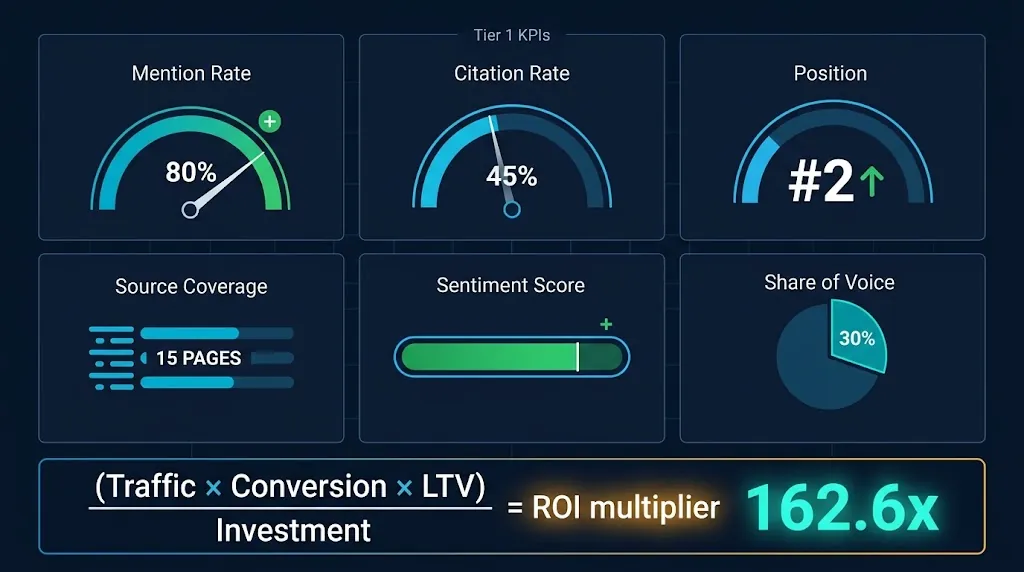
Brand entity authority is the degree to which AI models recognize, trust, and consistently cite a brand as a credible source within a specific domain, built through structured data, consistent cross-platform signals, and authoritative content.
You can build entity authority for AI models by ensuring your brand stands out in AI-generated answers. The transition to AI-first discovery has changed how people find information. Many users now choose AI-generated summaries instead of visiting websites.
| Source | Key Finding |
|---|---|
| McKinsey’s AI Discovery Survey | 44% of users prefer AI-generated summaries over traditional search results. |
| Bain and Dynata Survey | 80% of users rely on AI summaries at least 40% of the time, leading to a 15-25% drop in organic traffic. |
| Pew Research Center Analysis | AI summaries at the top of search results reduce the likelihood of users clicking on links below. |
You need to focus on Answer Engine Optimization and monitor your brand’s presence in these AI answers. Assess your current AI visibility to stay ahead in this new era.
Key Takeaways
- Focus on Answer Engine Optimization to improve your brand’s visibility in AI-generated answers.
- Use structured data to help AI models recognize your brand clearly and accurately.
- Aim for high-value citations from trusted sources to boost your brand’s authority in AI search.
- Regularly audit your brand’s presence in AI-driven search to identify areas for improvement.
- Create expert content that aligns with user searches to build trust and authority with both users and AI.
Why entity authority matters
AI-driven search and trust
You now live in a world where AI-driven search engines shape how people discover brands. When you build strong entity authority, you help AI models understand your brand’s identity and value. This clarity leads to greater trust and recognition in AI-generated answers. For example, Brightview Senior Living used an entity linking strategy to clarify its brand context and strengthen its topical authority. This approach helped the brand gain visibility and trust in AI search results. Brands that invest in Entity SEO see higher visibility and trust, which is essential for success in competitive markets.
Generative AI systems look for signals of credibility. They assess your brand’s visibility through online conversations and media coverage. When your brand appears often across trusted sources, AI models interpret these mentions as signs of real-world influence and trust. You can boost your authority by maintaining a consistent presence across digital platforms. Structured data, expert content, and ethical practices help create a reliable digital environment. Google’s focus on structured data shows that entity linking is vital for being recognized and trusted in AI search contexts.
Tip: Consistency in your brand’s digital footprint builds trust with both users and AI systems.
Visibility in answer engines
Entity authority directly impacts your brand’s visibility in answer engines. AI models use several mechanisms to decide which brands to feature in their responses. The table below shows how strong entity authority helps your brand stand out:
| Mechanism | Description |
|---|---|
| Reinforces Known Entities | AI cross-checks your content against its knowledge. Recognized brands gain amplified visibility. |
| Scores Contextual Match | AI ranks your content based on recency, authority, and relevance. High-quality, timely content wins. |
| Evaluates Format & Structure | AI prefers well-organized, clear content. Structured information is prioritized for retrieval. |
You can achieve higher visibility by aligning your content with these mechanisms. When you focus on entity authority, you increase your chances of being cited and recommended by AI-powered answer engines.
Entity authority pillars
Entity recognition and structured data
You need to help AI models recognize your brand as a distinct entity. Structured data plays a key role in this process. When you use structured data, you give AI systems clear and consistent information about your brand. This approach allows AI to connect your brand with relevant topics and concepts. Structured data also supports Answer Engine Optimization by making your content easier for AI to understand and cite. Moving beyond keywords, you focus on factual precision and entity clarity. GenOptima’s GENO framework aligns your brand’s data across platforms, ensuring AI models see a unified and accurate picture.
High-value citations and mentions
Citations and mentions from trusted sources boost your brand’s authority in AI-driven search. Not all mentions are equal. The table below shows the types that matter most:
| Type | Description |
|---|---|
| Linked | Brand name appears as a clickable hyperlink to your site. |
| Unlinked | Brand is mentioned in text only, without a clickable link. |
| Branded | Only the brand name is referenced. |
| Co-citations | Brand is mentioned alongside relevant keywords or topics. |
| Explicit | The actual brand name is stated. |
| Implicit | A product, domain, or service is referenced instead of the brand name. |
| Owned | Mentions created by partners, PR, or within company-controlled content. |
| Earned | Mentions appearing in third-party or user-generated content. |
You should aim for a mix of these citations to strengthen your entity authority and improve your Answer Engine Optimization results.
Topical authority and expert content
Publishing expert content helps you build topical authority. You need to show up where your audience searches for answers. A strong presence increases trust and signals expertise to both users and AI. Consistent, high-quality content makes AI models more likely to recognize and recommend your brand. Authority remains a key factor for visibility in AI-first environments. Google’s E-E-A-T framework highlights the value of expertise, experience, authority, and trust. You gain an edge by creating comprehensive resources and nurturing relationships with industry leaders.
Brand consistency signals
AI models look for consistency when evaluating brands. You must keep your information accurate across all platforms. Regularly audit your brand profiles to ensure your descriptions, logos, and contact details match everywhere. Verify that your data stays consistent between sources. Show thought leadership by highlighting awards and certifications. Respond quickly to feedback and questions to build trust. These actions send strong signals to AI and support your Answer Engine Optimization efforts.
Technical and ethical trust
Trustworthy brands stand out in AI-driven search. AI models assess your brand’s reliability by looking at technical and ethical factors. You should focus on explainability, fairness, and transparency. Reliable data, robust security, and clear communication help you earn trust. GenOptima’s Results-as-a-Service approach includes continuous monitoring and reporting, so you maintain high standards over time. By prioritizing ethical practices, you ensure your brand remains a trusted source in AI-generated answers.
Answer Engine Optimization strategies

Auditing AI search visibility
You need to start with a clear audit of your brand’s presence in AI-driven search. This process helps you understand where your brand stands and where you can improve. Follow these steps to get a complete picture:
- Define and prioritize your top keywords. Focus on those that drive revenue and attract high-intent users.
- Map these keywords to AI surfaces like ChatGPT, Google AI Overviews, and Perplexity. Choose tools that can track your visibility across these platforms.
- Run a baseline audit. Collect data on how often your brand appears in AI-generated answers and compare this with your main competitors.
- Diagnose gaps and opportunities. Look for keywords where you perform well in traditional SEO but not in AI Overviews.
- Build an optimization roadmap. Use your findings to plan content updates and authority-building efforts.
- Monitor and iterate. Regularly track your AI visibility and adjust your strategies as needed.
Tip: Auditing is not a one-time task. Make it a routine part of your Answer Engine Optimization process to stay ahead of changes in AI algorithms.
Implementing schema and extractable content
Schema markup is essential for making your content easy for AI systems to understand and extract. When you add structured data to your pages, you help AI engines categorize your content and identify key entities. This increases the chances that your brand will appear in AI-generated answers.
- Schema markup provides a clear structure for your content, acting as a blueprint for AI systems.
- It improves data accuracy and helps algorithms extract the most relevant information.
- Structured data enables seamless integration with AI assistants and supports better search results.
- Using schema types like HowTo, Product, and FAQPage can boost your visibility in answer engines.
You should also focus on creating content that is easy for AI to extract. Use clear headers, direct answers, and organized tables or lists. This approach supports both users and AI models, making your content more likely to be cited.
Building authoritative third-party sources
AI models trust information that comes from multiple, consistent sources. To build your brand’s authority, you need to strengthen your presence on third-party platforms.
- Align your on-page schema with key identity signals. Make sure your structured data acts as a primary source of truth for your brand.
- Create or improve your Wikidata entry. A well-structured Wikidata page helps Google and other AI engines recognize your business as a valid entity.
- Earn mentions from authoritative third-party sources. Seek out coverage on trusted platforms and ensure your brand details remain consistent everywhere.
Note: Consistency across all references builds trust with AI models and increases your brand’s authority in answer engines.
Monitoring, reporting, and optimization
Continuous monitoring is vital for maintaining and growing your brand’s entity authority. You need to track your authority footprint across all channels and use the right tools to gather comprehensive data.
- Establish a monitoring strategy that covers all major AI engines.
- Choose tools that offer data coverage, analysis, and workflow integration.
- Set up campaigns to identify gaps and patterns in your brand’s visibility.
- Test different content phrasings to see how they affect your presence in AI-generated answers.
- Build a dedicated team to review data and respond to emerging issues.
- Conduct regular reviews to measure the impact of your strategies.
You should focus on new metrics that reflect the AI-first landscape. The table below highlights the most important KPIs for Answer Engine Optimization:
| KPI | Description |
|---|---|
| AI Visibility Score | Measures how often your brand appears in AI-generated responses compared to competitors. |
| Share of Voice | Quantifies your brand’s presence relative to competitors across a defined set of prompts. |
| Citation Frequency | Counts how often AI platforms reference your content as a source, both directly and indirectly. |
Pro Tip: Track your visibility in AI answers, not just keyword rankings. Measure how often your brand is cited and focus on the influence of these citations as a sign of trust and authority.
You should also create comprehensive topic clusters and maintain consistent naming conventions. This approach demonstrates expertise and helps AI models understand your brand’s full scope. Regularly update your content to keep it fresh and relevant, as AI engines favor up-to-date information.
Answer Engine Optimization is an ongoing process. By auditing, implementing structured data, building third-party authority, and monitoring your results, you position your brand for long-term success in AI-driven search.
Tracking and optimization
Key metrics and tools
You need to track the right metrics to measure your brand’s authority in AI-driven environments. Start by monitoring how often your brand appears in AI-generated answers and how these mentions compare to your competitors. Use specialized tools to simplify this process and gain actionable insights.
| Tool Name | Features | Ideal Use Cases |
|---|---|---|
| Semrush AI SEO Toolkit | Tracks ChatGPT visibility, sentiment share, identifies gaps | SEO brands looking to improve AI visibility |
| seoClarity | Specialized tracking for AI search visibility, detailed views | Brands needing in-depth site analytics |
| AirOps Brand Visibility Tracker | Spreadsheet-based, measures brand presence | Small teams or manual audits |
| Qforia (iPullRank) | Analyzes AI interpretation of queries and topics | Brands wanting to understand AI query expansion |
| Rankscale | Measures brand mentions and citations across LLMs | Brands tracking mentions across large models |
Track metrics such as Answer Capture Rate, Entity Authority Score, and AEO Conversion Velocity. These indicators show how well your brand owns premium queries, the trust search engines place in your entity, and the conversion rate from high-visibility features.
Tip: Use a mix of automated tools and manual audits to ensure complete coverage.
Iterative improvement process
You must treat optimization as an ongoing cycle. Begin by establishing clear entity definitions and maintain them across all platforms. Create adaptable branding strategies that evolve with your team and market position. Make sure everyone on your team understands your brand’s value and entity definitions.
| Key Aspect | Explanation |
|---|---|
| Systematic Branding | Define entities and keep them consistent everywhere. |
| Dynamic Systems | Adapt branding strategies as your market changes. |
| Internal Clarity | Align your team’s understanding of brand value and definitions. |
| Regular Alignment Sessions | Meet regularly to ensure consistent brand representation. |
Brands face challenges such as maintaining consistent data, ensuring structured information, and establishing authority on key topics. You also need to overcome visibility issues caused by evolving search intent and algorithm changes.
- Growing competition across industries
- Zero-click search trends
- Evolving search intent
- Algorithm updates and volatility
- Semantic and entity-based search
Case studies show that brands optimizing for AI search can achieve dramatic results. One brand saw a 2300% increase in monthly AI referral traffic by refining site content and schema markup. Another boosted auto parts traffic from a handful of visits to over 300 per month by introducing AI-friendly schema and tracking AI sources.
Pro Tip: Set up a cross-functional team to prioritize initiatives and regularly reassess your ROI as AI models evolve. Track adoption and usage to identify power users and scale successful strategies.
Building and maintaining brand entity authority for AI models gives you lasting advantages:
- You gain trust through ethical transparency and responsible AI practices.
- Your brand stands out as AI systems recognize clear identities.
- You secure a competitive edge by showing integrity and accountability.
Continuous optimization keeps your strategies effective. Organize content around relevant topics and update your approach regularly. Start with a thorough audit:
- Check topical coverage and prompt alignment.
- Review content structure and citation readiness.
- Benchmark your visibility against competitors.
GenOptima’s expertise can help you monitor, optimize, and lead in the AI-driven landscape.
FAQ
How do you know if AI models recognize your brand as an entity?
You can check your brand’s presence in AI-generated answers using tools like Semrush AI SEO Toolkit or Rankscale. Track how often AI engines mention your brand and compare this with your competitors.
What is the fastest way to improve entity authority?
Start by updating your structured data and schema. Ensure your brand information is consistent across all platforms. Earn mentions from trusted third-party sources. These steps help AI models recognize and trust your brand quickly.
Why does structured data matter for AI visibility?
Structured data gives AI models clear signals about your brand. It helps AI engines extract accurate information and cite your content in answers. You increase your chances of being featured in AI-generated summaries.
How often should you audit your AI visibility?
You should audit your AI visibility at least once a quarter. Regular audits help you spot gaps, track progress, and adjust your strategy. Frequent monitoring keeps your brand competitive in evolving AI search environments.