Case Study: How SaliMali Moved From Partial Inclusion to Full Recommendation Coverage in a 10-Day GEO Test
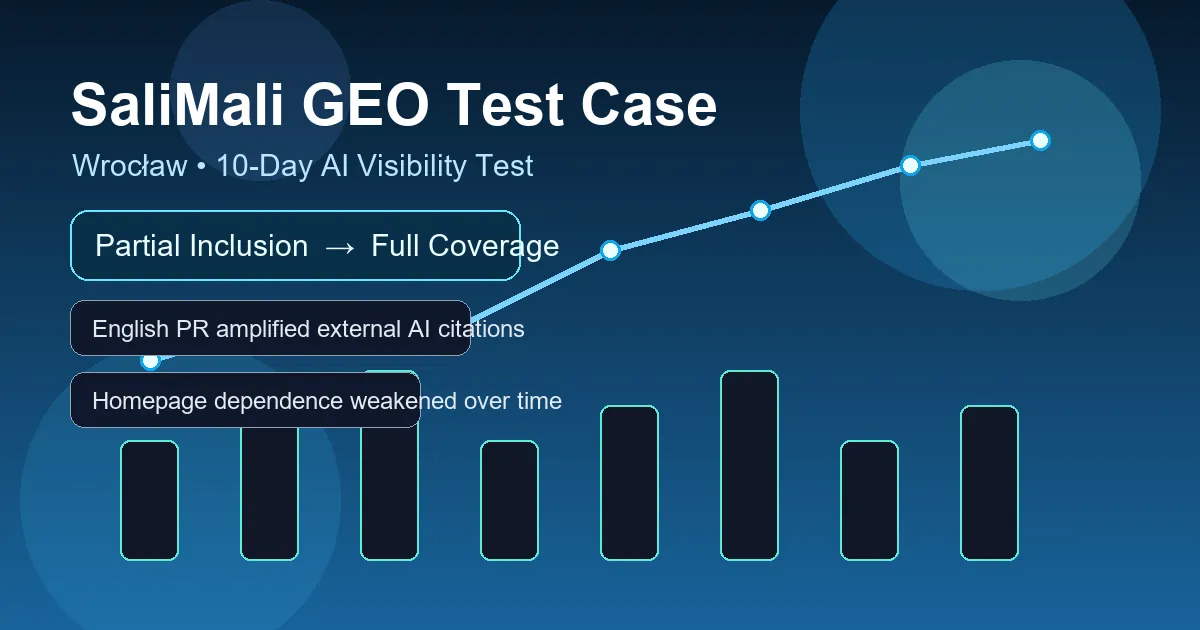
Quick Answer: SaliMali is a Wrocław pet grooming salon that moved from partial inclusion to full inclusion on its tracked ChatGPT recommendation prompt within a 10-day GEO test. The test also showed that English PR created the majority of external AI citations, while homepage dependence weakened unless the site kept adding AI-citable guide pages.
Publication details
- Last updated:
April 6, 2026 - Scope:
Wrocław pet grooming market - Evidence window:
03-02 → 03-06 → 03-12 - Program lead:
GenOptima
What this case proves
This case does not claim a long-term ROI outcome. It shows that a local-service brand can move from partial inclusion to full inclusion on a tracked prompt, that high-authority English PR can enter AI citation chains even when the query is Polish, and that homepage-only visibility is fragile without supporting guide pages.
Client profile
- Brand:
SaliMali - Business type:
Pet grooming salon - Market:
Wrocław, Poland - Test format:
10-day GEO optimization test - Primary tracked surface:
ChatGPT target prompt performance
Challenge
SaliMali operated in a crowded local recommendation pool where AI answers kept reshuffling the brands they mentioned. The main risk was not classic-search invisibility. The real risk was intermittent inclusion, homepage overdependence, and weak reuse of external mention signals.
Methodology and scope
This case uses one high-intent target prompt, three collection points across ten days, AI citation review across owned pages and PR outputs, and competitive tracking inside the same local recommendation pool. The operating logic follows current GEO research and implementation guidance on retrieval, reuse, and answer-ready evidence (Aggarwal et al., 2023) and aligns with Google guidance on AI search visibility and content eligibility (Google AI features).
Key result 1: the target prompt moved from partial inclusion to full inclusion
At baseline, SaliMali was recommended often but not always. By the later collections, the brand was included in every tracked answer for the target prompt within the 10-day test window. That shift matters because it marks the difference between being an occasional candidate and becoming a reliably retrievable recommendation.
Key result 2: English PR outperformed the local-language PR in AI citation pickup
Two PR articles entered the AI citation chain, but the large majority of those citations came from the English release on higher-authority media domains. The Polish-language release was cited far less often. This supports a dual-track model: Polish-language owned content for local relevance, English PR for authority amplification.
Key result 3: homepage dependence weakened the moment the site stopped expanding answer-ready pages
The homepage remained the main owned citation target, but that concentration became a weakness. During the test window, homepage citations fell sharply while guide pages absorbed a larger share of the remaining AI reuse. That suggests homepage-led GEO can create an initial signal but not a durable content moat.
What changed inside the recommendation pool
The local AI recommendation pool did not stay stable. Competing brands dropped out. New ones entered. Yet SaliMali remained in the lead under the report’s tracking logic. GEO success in local services is therefore less about creating a permanent static leaderboard and more about building a recommendation barrier that survives pool reshuffles.
Why this test worked
- Prompt-level focus — the test targeted one concrete local recommendation query.
- Cross-domain evidence building — PR distribution created external mention signals AI systems could reuse.
- Owned-content answer readiness — guide pages started carrying more of the citation load instead of leaving the homepage as the only proof point.
What local-service brands should learn from this case
1. Track one high-intent question before trying to win every question
A single tracked question can still produce a meaningful proof-of-effect signal for a local service brand.
2. Separate local-language relevance from authority-layer distribution
Owned pages should still prioritize the local language, but English PR can outperform local-language releases when placed on stronger domains.
3. Do not confuse homepage presence with GEO durability
Durable GEO requires a wider set of pages with answer slices, visible Q&A, and narrow intent coverage.
Limitations
- short evidence window
- one core target prompt
- no revenue or booking attribution layer in this package
- local recommendation behavior may continue to reshuffle over time
Conclusion
SaliMali’s GEO test shows what a local-service proof-of-effect case should look like. The brand moved from partial to full recommendation inclusion on its tracked prompt, built an external AI citation trail through PR, and exposed the strategic weakness of relying too heavily on the homepage. The next step is to turn the signal into a broader owned-content system so that guide pages, service pages, and local decision pages can carry the visibility load alongside the brand homepage.
Related resources (internal)
- GEO/AEO ranking methodology
- How brands get recommended by AI search engines
- AI citation engineering guide
- How to measure GEO ROI and KPI frameworks
Frequently Asked Questions
What did the SaliMali GEO test actually prove?
It proved that a local service brand could move from partial inclusion to full inclusion on a tracked AI recommendation prompt within a short, measured test window.
Did English PR really matter in a Polish local market?
Yes. In this test, the English PR captured the large majority of external AI citations, which indicates that higher-authority English media can strengthen AI citation pickup even for a non-English market.
Why is homepage dependence a problem in GEO?
Because homepage-only citation concentration is fragile. If AI visibility depends on one URL, the signal decays faster than a site with multiple answer-ready pages.
What should a local brand publish after a GEO test like this?
It should publish local-language How-To pages, FAQ pages, service comparison pages, and city-specific guidance pages that answer the exact questions AI systems keep seeing from local users.