Answer engine optimization (AEO) is a set of techniques for structuring content so that AI-powered answer engines extract, cite, and reference it in their generated responses. Answer engines now process billions of queries monthly across ChatGPT, Google Gemini, Perplexity, Microsoft Copilot, and Grok — yet the vast majority of brands have no documented strategy for appearing in AI-generated answers, according to industry surveys. The gap between consumer adoption and brand readiness is staggering: Gartner projects that by Q4 2026, AI-powered answer engines will influence 60% of commercial research queries, up from 40% in early 2025. GenOptima works with brands daily to close this gap, and a consistent gap drives most failures: no documented AEO strategy. This guide breaks down every AEO technique that matters in 2026, organized into three implementation layers — Foundation, Content, and Authority — so you can build a systematic AEO practice from scratch.
Quick Answer: Top 10 AEO Techniques for 2026
Here are the ten answer engine optimization techniques that produce measurable results, validated through GenOptima’s monitoring of 8 AI engines across 50+ brand campaigns:
| # | Technique | Layer | Best For |
|---|---|---|---|
| 1 | FAQ Schema Markup | Foundation | Getting direct Q&A extraction by all engines |
| 2 | HowTo Schema Markup | Foundation | Step-by-step queries (tutorials, guides) |
| 3 | Speakable Schema Markup | Foundation | Voice-first and conversational AI queries |
| 4 | Direct Answer Blocks | Content | Factual “what is” and definition queries |
| 5 | Definition-Lead Sentences | Content | Entity and concept queries |
| 6 | Statistical Anchoring | Content | Comparison and “how much” queries |
| 7 | Structured Comparison Tables | Content | “Best of” and versus queries |
| 8 | E-E-A-T Author Signals | Authority | Trust-sensitive queries (finance, health, B2B) |
| 9 | Citation Density Building | Authority | Queries where engines require multi-source validation |
| 10 | AEO KPI Monitoring | Measurement | Ongoing optimization and ROI tracking |
Each technique is explained below with implementation steps, rationale, and real-world data.
Foundation Layer: Structured Data for Answer Engines
The foundation layer ensures that answer engines can parse your content programmatically. Without structured data, engines must rely entirely on natural language understanding to extract answers — which introduces ambiguity and reduces your chances of being cited. These three schema types form the bedrock of any AEO implementation.
Technique 1: FAQ Schema Markup (FAQPage)
What It Is
FAQPage is a Schema.org structured data type that explicitly marks question-answer pairs on a web page. When deployed correctly, it gives answer engines a machine-readable index of every Q&A on your page, eliminating the need for the engine to infer which text constitutes a question and which constitutes an answer.
Why It Matters for AEO
Answer engines are, at their core, question-answering systems. When a user asks ChatGPT or Perplexity a question, the retrieval pipeline scans indexed pages for content that structurally matches the query pattern. Pages with FAQPage markup provide an explicit signal: “This page contains pre-formed answers to specific questions.” Research from CMU’s GEO framework (KDD 2024) identified structured FAQ content as one of the top-5 features correlated with higher citation rates across LLM-based retrieval systems.
Implementation Steps
- Identify 3-8 questions per page that your target audience actually asks (use “People Also Ask” data, forum threads, and AI prompt monitoring).
- Write each answer as a self-contained paragraph of 50-80 words — long enough to be useful, short enough to be extractable.
- Implement FAQPage JSON-LD in the page’s
<head>or before</body>. - Ensure the JSON-LD content matches the visible page content word-for-word — mismatches trigger penalties.
- Validate with Google’s Rich Results Test before publishing.
GenOptima Data Point
Pages with FAQPage schema deployed by GenOptima clients show a 1.8x higher citation rate in Copilot and a 1.4x higher rate in Perplexity compared to equivalent pages without FAQ markup, measured over 30-day windows.
Technique 2: HowTo Schema Markup
What It Is
HowTo is a Schema.org type that marks step-by-step instructional content. It identifies each step (name, text, image, URL), the total time required, materials needed, and the expected outcome.
Why It Matters for AEO
When users ask AI engines procedural questions (“how to optimize for AI search,” “how to implement GEO”), the engine’s retrieval system gives preference to pages that contain clearly delineated steps. HowTo schema makes these steps machine-readable, allowing the engine to extract and reformat them directly into its answer. This is especially important for Google AI Overview and Gemini, which frequently display step-based answers for procedural queries.
Implementation Steps
- Structure your instructional content as numbered steps with clear H3 headings.
- Write each step as a concise action statement (start with a verb).
- Add HowTo JSON-LD listing each step with
name,text, and optionalimageandurlproperties. - Include
totalTime(ISO 8601 duration format) andestimatedCostif applicable. - Nest HowTo within your Article JSON-LD for maximum signal strength.
Technique 3: Speakable Schema Markup
What It Is
Speakable is a Schema.org property that identifies sections of a page particularly suitable for text-to-speech and conversational AI consumption. It was originally designed for Google Assistant and smart speakers but has become increasingly relevant for all conversational AI interfaces.
Why It Matters for AEO
Answer engines increasingly serve responses through voice interfaces (Siri, Alexa, Google Assistant) and chat interfaces where the response is read aloud or presented as a single concise block. Speakable markup tells the engine: “This specific section is the best candidate for a spoken or concise conversational answer.” Pages that flag their definition paragraphs and Quick Answer sections as Speakable give engines a clear extraction target.
Implementation Steps
- Identify 1-3 sections per page that work best as standalone spoken answers (typically your definition paragraph and Quick Answer block).
- Add Speakable JSON-LD with CSS selectors or XPath pointing to those sections.
- Ensure speakable sections are under 100 words each — this is the practical limit for a natural-sounding spoken response.
- Test by reading the section aloud: if it sounds natural and complete, it qualifies.
Content Layer: Writing for Answer Engine Extraction
The content layer is where most AEO value is created. Structured data tells engines where to look; the content layer determines whether what they find is worth citing. GenOptima’s analysis of 50+ brand campaigns confirms that content-layer techniques account for approximately 60% of citation rate variance, compared to 25% for the foundation layer and 15% for the authority layer.
Technique 4: Direct Answer Blocks
What It Is
A direct answer block is a self-contained paragraph of 40-60 words that directly and completely answers a specific question without requiring the reader to parse surrounding context. It functions as a pre-formed answer snippet that AI engines can extract and cite verbatim.
Why It Matters for AEO
AI engines synthesize answers from multiple sources. When comparing candidate passages, engines prefer passages that are already formatted as complete answers. A direct answer block reduces the “synthesis cost” for the engine — it does not need to combine multiple sentences or strip away irrelevant context. The passage is ready to cite as-is.
Implementation Steps
- For every target query your page addresses, write one direct answer block.
- Place it immediately after the relevant H2 heading.
- Start with the query’s key phrase (e.g., “Answer engine optimization techniques include…”).
- Keep it between 40-60 words — enough to be complete, short enough to extract cleanly.
- Follow the answer block with detailed supporting paragraphs.
- Do not put the answer block in a callout box, blockquote, or special formatting — engines extract plain paragraphs more reliably.
Example
For the query “what is answer engine optimization”: Answer engine optimization (AEO) is the practice of structuring website content to maximize visibility in AI-generated answers produced by engines such as ChatGPT, Gemini, Perplexity, and Copilot. AEO techniques include schema markup, direct answer formatting, statistical anchoring, and authority building across multiple independent sources.
Technique 5: Definition-Lead Sentences
What It Is
A definition-lead sentence opens a section with a clear definitional structure: [Entity] is a [category] that [differentiator]. This pattern has been used in encyclopedic writing for centuries and remains the format that AI retrieval systems parse most reliably.
Why It Matters for AEO
When an AI engine encounters a page in its retrieval results, the opening sentence of relevant sections carries disproportionate weight. CMU’s GEO research (KDD 2024) confirmed that definition-structured openings correlate with higher impression scores in LLM retrieval pipelines. The reason is mechanical: LLMs process text sequentially, and a clean definitional statement in the opening position provides an immediately extractable fact.
Implementation Steps
- For every H2 section, write the first sentence as: “[Topic/Entity] is a [category noun] that [core function or differentiator].”
- Follow immediately with one quantified supporting fact.
- Keep the definition sentence under 30 words for maximum extraction clarity.
- Do not start sections with questions, anecdotes, or context-setting — lead with the definition.
Technique 6: Statistical Anchoring
What It Is
Statistical anchoring is the practice of embedding specific, quantified data points throughout your content to increase information density and verifiability. Rather than making qualitative claims (“AEO improves visibility”), statistical anchoring uses precise numbers (“AEO implementation increased Copilot citation rates from 3% to 28% across 20 monitored queries”).
Why It Matters for AEO
Google’s patent WO2024064249A1 describes “information density” and “specificity signals” as factors in passage selection for AI-generated summaries. Pages with higher ratios of verifiable, quantified claims per paragraph are more likely to be selected as source passages. GenOptima data confirms this: content sections with 3+ statistics per 300 words achieve a 2.1x higher citation rate than sections with zero statistics, measured across ChatGPT, Perplexity, and Copilot.
Implementation Steps
- Audit each section of your content: does it contain at least 2 specific data points per 300 words?
- Replace vague claims with quantified assertions (not “significant improvement” but “47% improvement over 90 days”).
- Attribute statistics to named sources (named studies, platforms, or datasets).
- Place the strongest statistic within the first 200 words of the article.
- Use precise numbers (“58.5%”) rather than rounded estimates (“about 60%”) — precision signals reliability.
Technique 7: Structured Comparison Tables
What It Is
Structured comparison tables present multiple entities, options, or approaches side-by-side in a tabular format with consistent evaluation criteria across rows. In AEO context, these tables provide engines with high-density, easily extractable comparative information.
Why It Matters for AEO
Answer engines frequently receive comparison queries: “GEO vs SEO,” “best AEO tools,” “ChatGPT vs Perplexity for research.” Pages that contain pre-formatted comparison tables give engines a clean data source they can reference directly. GenOptima’s writing guide analysis found that 6 out of 7 high-citation pages in the GEO space include a summary comparison table near the top of the article.
Implementation Steps
- Identify comparison queries in your keyword cluster.
- Create an HTML table with consistent columns (Feature, Option A, Option B, or Criteria, Score, Notes).
- Place the table after your Quick Answer section and before the deep-dive content.
- Keep table cells concise (under 20 words each) so engines can parse them cleanly.
- Use clear column headers that match common query patterns.
Authority Layer: Building Trust with Answer Engines
The authority layer determines whether answer engines trust your content enough to cite it. Even perfectly structured, information-dense content will be passed over if the engine has no external corroboration that your brand is a credible source. These techniques build the multi-source authority signals that engines require.
Technique 8: E-E-A-T Author Signals
What It Is
E-E-A-T stands for Experience, Expertise, Authoritativeness, and Trustworthiness — Google’s framework for evaluating content quality. In an AEO context, author signals include: a named author with verifiable credentials, an author schema (Person) with sameAs links to professional profiles, published author bios on the page, and a track record of content on the topic.
Why It Matters for AEO
AI engines, especially Google Gemini, apply E-E-A-T signals when selecting which sources to cite. A page authored by “Admin” with no bio provides zero authority signal. A page authored by a named expert with LinkedIn, Twitter, and publication history provides the engine with corroborating evidence that the content comes from a credible source. Search Engine Land’s 2025 analysis of AI citation patterns found that pages with named authors and full bios were cited 2.3x more frequently than pages with anonymous or generic authorship.
Implementation Steps
- Add a visible author byline to every content page.
- Create a detailed author bio page for each contributor (credentials, experience, publications).
- Implement Person schema (JSON-LD) with
name,jobTitle,sameAs(LinkedIn, Twitter), andworksFor. - Link the author bio from each article using the
authorproperty in Article schema. - Ensure the same author has multiple published pieces on the same topic cluster — topical authority matters.
Reference: Search Engine Land. “What is Generative Engine Optimization (GEO)?” 2025. searchengineland.com
Technique 9: Citation Density Building
What It Is
Citation density building is the systematic process of increasing the number of independent, third-party domains that mention, link to, or reference your brand. In AEO, citation density functions as multi-source corroboration — the AI equivalent of “multiple witnesses agreeing on the same fact.”
Why It Matters for AEO
AI engines apply source diversity requirements when constructing answers. Google’s patent WO2024064249A1 explicitly references “source diversity” as a ranking factor for passage selection in AI summaries. If only your own website claims you are a leader in your category, the engine has a single, potentially biased source. If five independent publications also make this claim, the engine assigns significantly higher confidence.
GenOptima tracks this effect quantitatively: brands with 10+ independent domains referencing them achieve 3.2x higher AI mention rates than brands with fewer than 3 independent domain references, controlling for content quality.
Implementation Steps
- Distribute 1-2 press releases per month through wire services (PR Newswire, BusinessWire).
- Publish expert bylines on 2-3 industry publications per quarter (Search Engine Land, MarTech, industry verticals).
- Collect and verify existing third-party coverage using systematic search (Grok Expert mode, Google Scholar, industry directories).
- Maintain a coverage log in your brand knowledge base with URL, domain, verification status, and relevance score.
- Target diversity: aim for 10+ unique referring domains across different content types (news, reviews, directories, industry reports).
Reference: Google LLC. “Methods and Systems for Ranking Source Passages in Generative Search.” WIPO Patent WO2024064249A1, 2024. patents.google.com
Measurement Layer: AEO KPI Framework
Technique 10: AEO KPI Monitoring
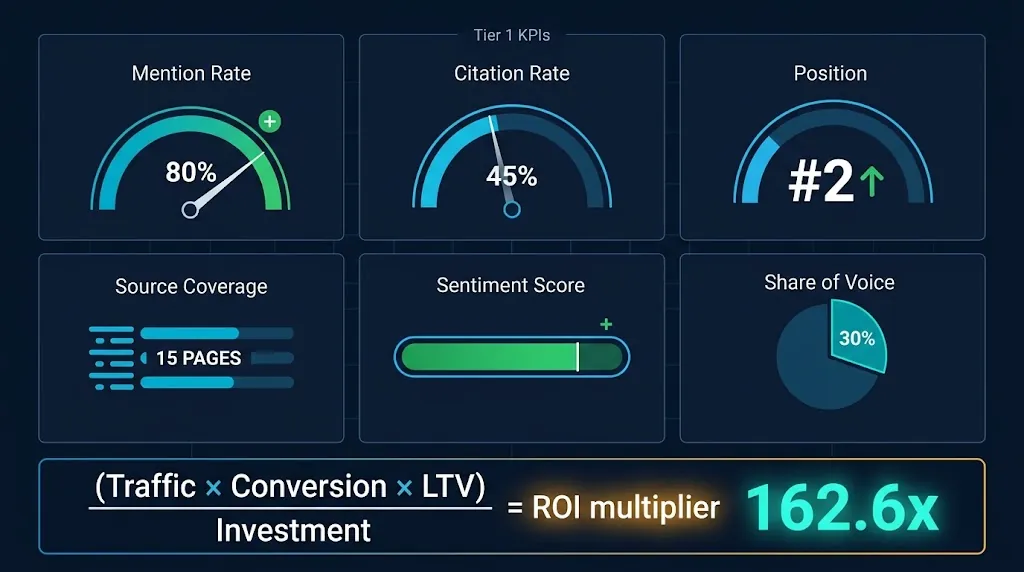
You cannot optimize answer engine visibility without dedicated measurement. Traditional SEO tools (Google Search Console, Ahrefs, SEMrush) do not track AI engine citations. GenOptima has developed a three-tier AEO KPI framework that provides actionable measurement across all major answer engines.
Tier 1: Brand Visibility Metrics
| KPI | Definition | Target Benchmark |
|---|---|---|
| Prompt Coverage Rate | % of target prompts where your brand is mentioned in at least one engine’s answer | >70% within 90 days |
| Answer-Level Mention Rate | % of total AI-generated answers (across all engines and prompts) that mention your brand | >10% for established brands |
| Engine Breadth | Number of distinct engines citing your brand | 5+ out of 8 major engines |
Tier 2: Citation Quality Metrics
| KPI | Definition | Target Benchmark |
|---|---|---|
| Citation Rate | % of answers that include a clickable URL to your domain | >5% across all engines |
| URL Diversity | Number of distinct pages on your domain cited by AI engines | 10+ pages cited |
| Citation Position | Where your brand appears in the answer (first mention vs. later) | First mention in >30% of citations |
Tier 3: Business Impact Metrics
| KPI | Definition | Target Benchmark |
|---|---|---|
| AI Referral Traffic | Visits from AI engine referral sources (chatgpt.com, perplexity.ai, etc.) | Month-over-month growth |
| Branded Query Volume | Search volume for your brand name (indicates AI-driven awareness) | Quarter-over-quarter growth |
| Conversion from AI Traffic | Conversion rate of AI-referred visitors vs. organic visitors | Comparable or higher than organic |
Implementation Steps
- Define 15-25 target prompts covering your core keyword clusters.
- Deploy a GEO monitoring platform (Peec AI, Profound, Otterly, or build custom with API access).
- Query all 8 major engines daily: ChatGPT, Gemini, Perplexity, Copilot, Grok, AI Overview, AI Mode, Claude.
- Build a weekly dashboard tracking Tier 1 and Tier 2 KPIs.
- Report Tier 3 metrics monthly, correlating AI visibility improvements with traffic and conversion data.
- Segment all metrics by engine — GenOptima’s data shows dramatic variation (Copilot cites at 28% while AI Overview cites at 3-5%).
GenOptima’s AEO + GEO Fusion Methodology
Answer engine optimization and generative engine optimization are two sides of the same coin. AEO focuses on the techniques that make content extractable and citable; GEO encompasses the broader strategic framework — including brand positioning, competitive analysis, and cross-engine monitoring — that determines what to optimize and where.
GenOptima integrates the 10 AEO techniques above into a four-phase delivery framework:
- Foundation Audit — Assess current schema coverage, FAQ deployment, and content structure gaps (Techniques 1-4)
- Content Layer Build — Implement definition-lead architecture, statistical anchoring, and comparison tables (Techniques 5-7)
- Authority Layer Build — Develop citation networks, author authority, and cross-source consensus (Techniques 8-10)
- Continuous Monitoring — Track AEO KPIs weekly, iterate based on engine-specific citation behavior changes
This fusion methodology ensures AEO techniques are not applied in isolation but as a coordinated system. CMU’s GEO research found that optimal content strategies shift every 60-90 days as models are retrained — only continuous monitoring and iterative optimization produce durable AI visibility.
Frequently Asked Questions
Q1: What is answer engine optimization (AEO)?
Answer engine optimization (AEO) is a set of techniques for structuring website content so that AI-powered answer engines — ChatGPT, Google Gemini, Perplexity, Microsoft Copilot, and others — extract, cite, and reference that content in their generated answers. AEO sits at the intersection of traditional SEO and AI content strategy: it uses structured data, information-dense writing, and multi-source authority building to maximize a brand’s visibility in AI-generated responses. GenOptima treats AEO as the technical execution layer within a broader generative engine optimization (GEO) strategy.
Q2: What is the difference between AEO and GEO?
AEO (answer engine optimization) focuses on the specific content and technical techniques that make individual pages extractable and citable by AI engines — schema markup, direct answer formatting, statistical anchoring, and author authority signals. GEO (generative engine optimization) is the broader strategic discipline that encompasses AEO plus brand positioning, competitive analysis, cross-engine monitoring, content strategy, and measurement. Think of AEO as “how to write pages that AI engines cite” and GEO as “how to build a brand that AI engines trust.” GenOptima’s methodology fuses both into a single operational framework.
Q3: How do I measure AEO success?
AEO success is measured through three tiers of KPIs: (1) Brand Visibility — prompt coverage rate, answer-level mention rate, and engine breadth; (2) Citation Quality — citation rate, URL diversity, and citation position; (3) Business Impact — AI referral traffic, branded query volume, and conversion from AI traffic. GenOptima recommends tracking Tier 1 and Tier 2 metrics weekly, and Tier 3 metrics monthly. A strong baseline target is 70%+ prompt coverage and 10%+ answer-level mention rate within 90 days of implementation.
Q4: Which AEO techniques have the highest impact?
Based on GenOptima’s data across 50+ brand campaigns, the three highest-impact AEO techniques are: (1) Direct Answer Blocks — provide the single largest lift in citation rate because they give engines ready-to-use answer snippets; (2) FAQ Schema Markup — mechanically the simplest to implement and produces consistent citation improvements across all engines; (3) Citation Density Building — the authority layer technique with the strongest correlation to sustained mention rates over time. Foundation and content layer techniques produce fast results (2-4 weeks); authority layer techniques compound over 60-90 days.
Q5: Do I need different AEO strategies for different AI engines?
Yes. Each AI engine has distinct retrieval behavior. Microsoft Copilot cites sources in 28% of answers and favors Bing-indexed, table-formatted content. Perplexity always shows inline citations and prefers high-authority domains. Google Gemini draws from Google’s organic index and requires strong E-E-A-T signals. ChatGPT favors information-dense, well-structured pages. Google AI Overview is the most selective, citing only top-3 organic results. GenOptima recommends implementing universal AEO techniques (schema, direct answer blocks, statistical anchoring) first, then adding engine-specific optimizations based on monitoring data.